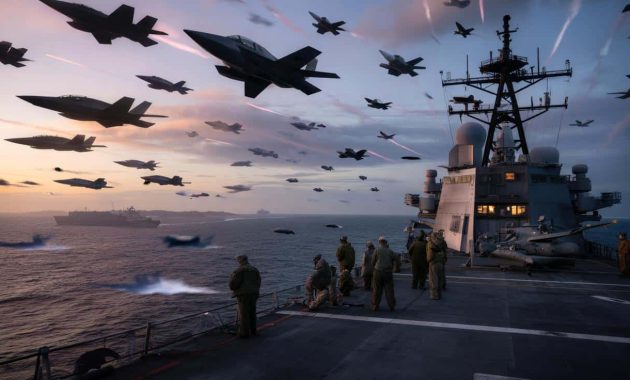
The sky over the Western Pacific looks deceptively calm from the deck of a U.S. destroyer. A flat blue dome, a few contrails at high altitude, the steady buzz of helicopter blades. Yet somewhere beyond the line of sight, hundreds of radar-dark shapes are quietly rewriting the balance of power. Chinese stealth jets, invisible on most screens and flying in tight, networked packs, are starting to feel less like prototypes and more like a weather system rolling in.
Pilots talk in low voices. Planners stare at screens filled with red icons.
For the first time in decades, some in the U.S. military whisper the unthinkable: maybe the United States no longer owns the sky.
The day the Pacific stopped feeling like “American airspace”
For a long time, U.S. pilots flying out of Guam or Japan had a simple mental map: this was their playground. American jets, American tankers, American AWACS, stretching a security umbrella over allies and shipping lanes. Chinese fighters were distant, fewer, less advanced. That story is fading fast.
What’s emerging instead is a picture of crowded skies where Chinese stealth squadrons patrol closer, stay longer, and appear in places U.S. planners didn’t expect. The sense of automatic air superiority, baked into Washington’s thinking since the Cold War, is quietly slipping away.
One recent Pacific exercise, described off the record by a U.S. officer, captured this shift. In the scenario, Chinese J-20 stealth fighters and new J-35 carrier-capable jets were modeled in large numbers, supported by drones and ground-based missiles. Within simulated minutes, “red” forces had flooded the airspace around Taiwan and the First Island Chain with wave after wave of low-observable aircraft.
The U.S. side still won some air battles, but not like before. They ran out of missiles first. Key tankers and surveillance planes were “shot down” early. When analysts replayed the drills, one pattern stood out: China didn’t need to win every dogfight. It just needed *enough* stealth jets to swamp the region and exhaust U.S. defenses.
This isn’t only about one shiny aircraft model. It’s about volume, timing, and geography. China is now fielding hundreds of modern fighters, with the J-20 steadily moving from boutique asset to frontline workhorse. New stealth types like the J-35 are entering production aimed at carriers and forward bases.
Add long-range missiles, AI-assisted targeting, and a dense web of radars stretching from the mainland to artificial islands, and the math starts to hurt the U.S. China is turning the Pacific airspace into a layered trap, where American jets have to push deeper, stay exposed longer, and rely on support aircraft that may not be survivable anymore. That’s how air superiority erodes: not with one dramatic loss, but as the odds quietly tilt against you every single sortie.
How China is flooding the sky – and why the U.S. is struggling to keep up
Chinese planners have taken a very blunt approach: build a lot, field fast, accept some imperfections, fix them later. The J-20’s early versions weren’t perfect. Engines were a problem, software still evolving, stealth shaping not always F-35-level. Yet the aircraft kept rolling off the production lines, squadron by squadron.
➡️ Psychologists reveal why emotional sensitivity is linked to deep cognitive processing
➡️ Iron Water Tank Scaling Up Fast? The Simple Trick That Stops Marks And Breakdowns
➡️ If your dog follows you everywhere, here’s what it means
Beijing is betting that quantity, upgraded over time, beats a smaller number of exquisite jets that arrive late and cost a fortune. From an industrial perspective, China is acting like a country preparing not just for deterrence, but for a contest that could last months, not days.
On the U.S. side, the contrast is almost painful. Pilots fly some of the most capable aircraft on the planet, from the F-22 to the F-35, yet they’re flying fewer of them, older, and under relentless maintenance pressure. The F-22 line closed years ago. F-35s are arriving, but not nearly in the kind of numbers that could casually absorb losses in a high-intensity Pacific war.
The “support cast” is even more vulnerable. Slow, lumbering tankers. Big radar planes that light up the sky. Vital, but obvious targets for swarms of long-range Chinese missiles guided by stealth jets working as forward scouts. One U.S. analyst summed up the nightmare scenario: lose the tankers and AWACS early, and your elite fighters turn into stranded sprinters, fast but out of breath with nowhere to land.
The logic behind China’s strategy is brutally simple. Control the bases. Control the tankers. Control the sky. Long-range DF-21 and DF-26 missiles threaten U.S. runways and hangars from Guam to Japan. At the same time, stealth jets and drones push the defensive line farther away from the Chinese coast, forcing U.S. aircraft to operate from greater distances and burn fuel just to get in the fight.
Let’s be honest: nobody really builds a thousand-missile arsenal and hundreds of stealth jets just for air shows. The underlying message to Washington and its allies is clear – any attempt to intervene over Taiwan, the South China Sea, or the East China Sea will face a dense, lethal, and resilient air defense ecosystem. You might win some engagements, but you won’t dominate the way you used to. And that, strategically, is a win for Beijing.
What the U.S. can still do when air superiority is no longer guaranteed
For U.S. planners, the new game is no longer “own the sky from day one.” It’s closer to “bend, disperse, and punch from unexpected angles.” That means scattering aircraft across lots of smaller airfields, some barely more than strips carved from jungle or island roads, so no single missile barrage can knock out an entire wing. It means fueling and arming jets quickly, sometimes from rough ramps, sometimes with improvised teams.
This is the logic behind concepts like Agile Combat Employment in the Pacific. Less glamorous than a new stealth fighter, but potentially just as decisive. If your aircraft and crews are always on the move, always shifting, always popping up where Chinese planners didn’t expect them, the dense net over the Pacific starts to fray.
There’s also a cultural adjustment underway, and it’s a tricky one. For generations, U.S. aircrews trained with the quiet confidence of being the undisputed “top dog”. That mindset breaks down when you know the other side might have more jets, closer to the fight, with enough stealth and long-range missiles to score painful early hits. Nobody likes to admit that, especially in a community as proud as fighter aviation.
We’ve all been there, that moment when you realize the game you’ve been playing for years just got harder, and the old tricks aren’t enough. The emotional temptation is either denial or fatalism – pretending nothing has changed, or whispering that everything is lost. Neither helps a pilot, a planner, or a policymaker.
Inside the Pentagon and allied headquarters, a quieter, more sober tone is taking hold. Not despair – adaptation. One U.S. strategist put it starkly in a closed-door briefing, later echoed publicly by several think tanks:
“Air superiority is no longer a birthright. It’s a day-to-day contest, and some days, in some places, we might not win.”
To navigate that reality, three lines of thinking keep coming back:
- Redefine victory – Shift from total dominance to “good enough control” in key time windows and locations.
- Spread the burden – Rely more on allied jets, missiles, and bases in Japan, Australia, and beyond.
- Invest in attrition – Drones, decoys, cheaper systems that can be lost without breaking the war plan.
*The plain truth is that air wars of the future will be fought as much by software lines and fuel hoses as by ace pilots in sleek cockpits.*
A sky crowded with questions
Walk along the shoreline in the Philippines, Taiwan, or Okinawa, and the debate over air superiority suddenly stops feeling abstract. Fishing boats share the horizon with warships. Commercial jets trace routes that could someday be cut or contested. Somewhere above, out of sight, sensors are already watching, cataloging, simulating.
The United States losing its effortless grip on the Pacific sky doesn’t automatically mean defeat. It does mean a far more dangerous, compressed, and anxiety-heavy world for those living under those flight paths, and for the pilots asked to fly into that contested maze of radars and missiles.
China’s surge of stealth jets – the hundreds of J-20s and their successors, the upcoming carrier-based fleets, the drone escorts and swarm concepts – is rewriting risk calculations from Washington to Canberra. The next crisis might not start with a single dramatic shot, but with a quiet realization in some command bunker that the air plan no longer “guarantees” anything.
For readers scrolling this on a phone somewhere far from the Pacific, this can feel remote, like someone else’s storm. Yet the trade routes, chip factories, and data cables that cross this region shape your prices, your job, your screen. The sky over the Pacific is not just about jets and flags. It’s a pressure barometer for a global order that’s creaking, but not yet broken.
How long that balance holds – and how wisely both sides treat this new, crowded sky – is still an open question.
| Key point | Detail | Value for the reader |
|---|---|---|
| China’s stealth jet surge | Hundreds of J-20s and new J-35s entering service, backed by long-range missiles and dense sensors | Helps you understand why U.S. air dominance in the Pacific is no longer a given |
| U.S. vulnerability | Limited numbers of top-tier fighters, exposed tankers and AWACS, aging infrastructure across the Pacific | Clarifies how a technologically advanced force can still be strategically overstretched |
| Shifting strategies | Dispersed basing, allied cooperation, drones, and “good enough” air control instead of total superiority | Offers a realistic picture of what future conflicts and deterrence in the region may look like |
FAQ:
- Is the U.S. really losing air superiority to China?The U.S. still fields extremely advanced jets and pilots, but in the Western Pacific the balance is shifting. China now has enough stealth fighters, missiles, and nearby bases to challenge U.S. dominance in ways that were unthinkable 15–20 years ago.
- How many stealth jets does China have?Estimates vary, but open-source analysts believe China already operates several hundred J-20s, with production accelerating, plus growing numbers of newer designs like the J-35 aimed at carrier operations.
- Can U.S. F-22 and F-35 fighters beat Chinese J-20s?In one-on-one terms, U.S. jets are extremely capable and may still hold an edge. The real issue is numbers, geography, and support assets – China can field more aircraft closer to home, supported by powerful missile and radar networks.
- Does this mean China would win a war over Taiwan?Not automatically. War outcomes depend on politics, alliances, logistics, and many unknowns. What’s changing is the level of risk and uncertainty: a U.S. intervention would now face serious air and missile threats from day one.
- Why should ordinary people care about Pacific airpower?Because what happens in that airspace shapes global trade, technology supply chains, and overall stability. A miscalculation between two nuclear-armed powers in those crowded skies could ripple into economies and daily life far beyond the region.