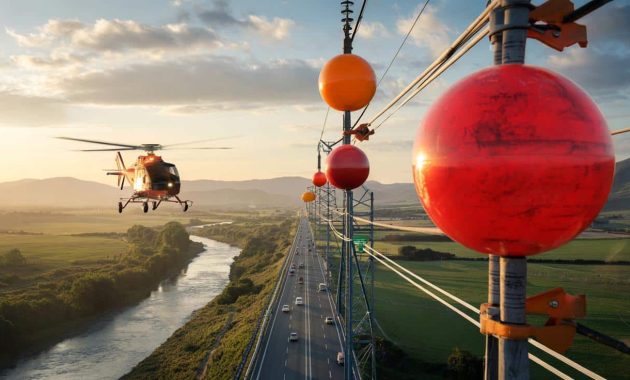
You’re driving along a country road, late afternoon, sun dropping low. The landscape is quiet, almost flat, and then you see them: a row of giant red balls hanging on a high-voltage power line, like some oversized, forgotten Christmas garland in the sky.
You’ve seen them before from the highway or from a train window, without really asking why they’re there. They’re just part of the scenery, like road signs or field fences.
Yet those bright spheres are doing a job that has very little to do with decoration, and a lot to do with danger, speed, and human error.
They’re a warning, but not the one most people think.
What those mysterious red balls are really doing up there
From the ground, those red balls look a bit absurd. Out of scale. Out of place. Suspended over rivers, highways, valleys, sometimes right above farmland where tractors crawl beneath them.
If they were just about electricity, they’d probably be smaller, greyer, more discreet. Instead they shout their color into the sky. *They’re not talking to you walking on the sidewalk – they’re talking to pilots.*
Those balls, technically called aerial marker balls or visibility marker spheres, exist so that aircraft don’t slam into power lines they can’t see in time.
Picture a helicopter pilot on a rescue mission, flying low in bad weather, visibility shrinking by the minute. Or a crop-dusting plane skimming over fields at dawn, hugging the ground to spread product evenly. High-voltage lines can be almost invisible from the cockpit, especially against clouds, water, or dense forest.
That’s where the red balls change the game. They turn a thin, grey, almost transparent cable into a bright visual obstacle. A line becomes a dotted, colored path. A pilot’s brain doesn’t have to guess anymore: there’s something here, do not cross.
Every year, collisions between aircraft and power lines still happen. Statistics are cold, but for pilots, those balls can literally mean getting home that night.
➡️ “I feel tense when there’s nothing to worry about”: what psychology says about this reaction
➡️ $9 billion, 730 missiles: the US–Saudi arms deal sparking fresh controversy
➡️ Why this divisive glass in bathroom hack is turning neighbors against each other
➡️ Why cleaning the same way every week can slowly make things worse
➡️ The overlooked cause of tension in the neck and upper back
➡️ Why some rooms never stay clean no matter what you do
➡️ Legendary rock band calls it quits after 50 years the hit everyone knows was never really that good
The idea is simple: eyes spot color and shape faster than a thin metal wire. On high-risk sections of line – near airports, over rivers used by low-flying aircraft, in mountainous zones, over roads – grid operators hang these markers at regular intervals.
They’re not random. Spacing, size, even color are regulated or recommended. Often you’ll see red, but also white or orange, to stand out whatever the background. The goal is contrast.
From the ground, we mostly read those balls as a curiosity. From the sky, they’re a loud, unambiguous visual shout: **“Obstacle ahead, change course now.”**
How those red balls work – and why you shouldn’t mess with them
Let’s zoom in on one of those spheres. Up close, it’s not a simple plastic balloon. It’s a heavy, rigid shell, usually made of high-strength plastic or fiberglass, clamped directly onto the cable.
Technicians install them using specialized equipment, often from helicopters or with line-walking methods that would give most of us vertigo. They have to position each ball at a precise spot on the conductor, tighten it just enough so it holds for years, and do it all while dancing above thousands of volts.
Each ball has a specific diameter, often around 60 to 90 cm, so it’s visible from far away and at high speed.
We’ve all been there, that moment when curiosity kicks in and someone jokes, “Imagine shooting one of those with a slingshot.” On social media, you’ll even see fake videos claiming they explode dramatically or are filled with gas.
Reality is far less cinematic and much more serious. Those balls are part of a safety device for aviation and energy infrastructure. Damaging them can degrade visibility for pilots, and tampering with high-voltage lines is not just illegal, it’s life-threatening.
Electric companies regularly find bullet holes, pellet marks, or vandalized markers. Behind each “prank” there’s a risk you don’t see from the ground: a pilot flying too low, a line not spotted in time, a crash that will never trend on your feed.
Engineers and regulators design these markers with one obsession: reliability. They must resist UV radiation, wind, rain, snow, and temperature swings for years. They’re tested in labs, modeled in simulations, and inspected in the field.
There’s also a human factor: pilots are trained to look for them, to expect them in certain areas, to integrate them into their mental map of dangerous zones. When markers are missing or damaged, that expectation breaks.
Let’s be honest: nobody really checks every single ball every single day. That’s why the base design has to be robust, forgiving, and as bulletproof as possible, literally and figuratively. **A simple red sphere becomes a chain in a long, invisible safety system.**
Colors, codes, and the quiet choreography between sky and ground
If you look closely next time, you might notice the balls aren’t always the same color or pattern. Sometimes they’re all red. Sometimes they alternate red, white, orange. That’s not random decoration, that’s coding.
Colors are chosen to contrast with the background: red against greenery, white against dark hills, orange against grey skies. In some places, the sequence of colors even helps pilots estimate distance or better outline a crossing section.
Think of it like a visual highlighter pen on a thin, invisible line in the sky.
Around airports, you’ll often see long series of markers indicating power lines, communication lines, or cableways that cut across approach or departure paths. Pilots know these zones by heart. The red balls are an extra layer of redundancy when weather, fatigue, or distraction creep in.
In mountainous regions, helicopters used for construction, rescue, or tourism operate close to the terrain. Valley crossings with power lines are particularly risky. A single misjudged turn, a small gust of wind, and suddenly that “tiny” cable isn’t so tiny anymore.
By amplifying the presence of the line, the markers create a visual fence in the air. Not pretty, maybe, but clearly readable.
All of this raises an almost tender detail: those ugly, practical spheres are actually a kind of pact between two worlds. The world on the ground that needs electricity, and the world in the air that needs space to move freely and safely.
Grid operators talk to pilots through these silent shapes. There’s no radio message, no blinking screen, just a piece of color suspended in the wind.
As one safety engineer told me during an inspection along a river crossing:
“Every time I sign off on a line with new marker balls, I think: someone I’ll never meet may owe me their life one day, and they’ll never even know my name.”
- **Red balls = aerial marker spheres** used to warn pilots about hard-to-see power lines.
- They’re placed in strategic, high-risk areas like rivers, highways, and airport zones.
- They’re built to survive years of weather, wind, and sometimes vandalism.
- Damaging them isn’t just a bad joke, it can increase the risk of aircraft collisions.
- From the cockpit, they turn an almost invisible wire into a clear, colored obstacle.
Next time you spot them, you might see a different story
Next time you’re on the road or looking out from a train window, try this small exercise: follow the power lines with your eyes, and watch where the red balls appear and where they disappear. You’ll suddenly see the landscape differently.
A valley crossing stops being just “a nice view” and becomes a risky air corridor. A calm river turns into a potential low-flying route for helicopters. That straight line over the highway takes on weight: a place where two networks intersect, the electric and the aerial.
Those balls are like punctuation marks in the fabric of our territory. They mark the spots where human systems overlap, where we had to stop and say, “OK, here, we need to be extra clear.”
They’re a reminder that modern life is made of layers we rarely think about. The grid you plug your phone into. The sky where planes carve invisible paths. The regulations and quiet rituals of people whose job is to anticipate the worst, so it never makes the news.
You don’t have to become an electricity nerd or an aviation expert. Just noticing them is already a way to read the world a bit more deeply.
And maybe, as you catch sight of those bright spheres against a blue or cloudy sky, you’ll feel a small flicker of respect for the anonymous choreography that keeps planes flying, lights on, and risks just far enough away.
Behind every red ball there’s a calculation, a map, a worker who once clipped it on with cold hands and a clear head.
They don’t look like much. But up there, between metal and wind, they’re holding a fragile line between routine flight and disaster.
| Key point | Detail | Value for the reader |
|---|---|---|
| Role of red balls | Aerial marker spheres that highlight hard-to-see power lines for pilots | Transforms a daily curiosity into a clear safety function |
| Where they’re installed | High-risk zones: rivers, highways, airports, valleys, low-flying routes | Helps you “read” the landscape and spot hidden risk areas |
| Why they matter | Prevent aircraft–power line collisions and protect energy infrastructure | Connects a simple visual object to real-world lives and reliability |
FAQ:
- Are the red balls on power lines full of gas or liquid?
No. They’re usually hollow, rigid spheres made of plastic or fiberglass, clamped around the cable. They don’t contain gas or liquid and are not designed to explode or burst.- Why are some balls red and others white or orange?
Colors are chosen for visibility against the background. Red, white, and orange are common so that at least one color stands out against trees, sky, clouds, or water.- Do the red balls reduce the electricity or change how the line works?
No. They don’t affect the electrical function of the line. Their role is visual, not electrical, as long as they’re correctly installed and balanced.- Why don’t all power lines have red balls?
They’re only installed in places where aircraft are likely to fly low, or where regulations require extra visibility. Many lines in open, low-risk areas don’t need them.- Is it dangerous to touch or shoot at those red balls?
Yes, both practically and legally. They’re attached to high-voltage lines, so approaching them is extremely dangerous. Damaging them can also increase the risk of aircraft accidents and is treated as vandalism of critical infrastructure.