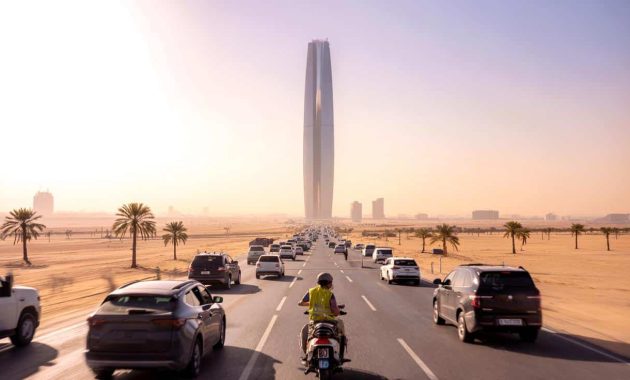
Just before sunset in the Gulf, the sky turns a kind of dusty pink that Instagram can’t quite capture. Traffic is frozen on an eight-lane road, air conditioners humming like a giant hive, while a huge digital billboard glows above the cars. On it, a gleaming 3D render: a one‑kilometre skyscraper rising from a beige void, wrapped in glass, promising “the future of human living”. Down below, a motorbike delivery driver wipes sweat from his forehead, stuck between SUVs, waiting for the light to change. No one looks up at the billboard.
A 1km tower has never felt further away from the reality on the ground.
A monument to height, not to wisdom
You can almost hear the boardroom conversation that births a 1km desert tower. PowerPoint slides. Drone footage of dunes. A consultant explaining “iconic landmarks” and “global positioning”. Someone says, “Let’s break the record.” Heads nod. Nobody asks who will walk there at noon in August, or who will clean those windows in a sandstorm.
This is how fantasy architecture slips into the real world: a beautiful render, far from anyone’s daily life, but close to someone’s ego.
Look at Jeddah Tower in Saudi Arabia, the much‑publicized project aiming to surpass the Burj Khalifa and brush the one‑kilometre mark. Construction started, stalled, restarted. Workers came, cranes rose, then everything paused in the desert wind. Money, politics, logistics, climate: all caught up with the dream of height.
The tallest building in the world was already just a plane ride away in Dubai. Yet the race went on, as if human progress could be measured with a tape measure pointed at the sky.
There’s a strange logic at work. For some leaders, a giant tower is a shortcut to a story: “We are modern. We are advanced. We have arrived.” It compresses the messy complexity of development into one sharp vertical line.
Real progress is slower, humbler, spread horizontally: reliable buses, cooler streets, clean water, decent housing. None of that fits in a single photo. A 1km tower does. So the budget, the brains, the attention climb upward, while the ground level stays stubbornly ordinary.
What we could build instead of chasing the sky
Urban planners who actually walk their cities talk a different language. They speak of shade first. Wind corridors. Public transit that doesn’t fry people at the bus stop. When you listen to them, the idea of pouring billions into a needle of glass in a scorching desert starts to feel like a joke with a very high price tag.
A simple gesture, like planting dense rows of trees along a street, can drop perceived temperature by several degrees. No glossy render. Just more people outside, talking, living.
➡️ A polar vortex disruption is approaching, and its scale is almost unheard of for the month of March
➡️ Michael Schumacher, the new separation
➡️ I don’t boil potatoes in water anymore, ive switched to this aromatic broth
➡️ Rosemary and rock salt in a jar : what it’s for, the benefits and why so many homes swear by it
➡️ Bird lovers use this cheap March treat to keep feeders busy and attract birds every morning
➡️ A study suggests cats can develop a dementia-like illness similar to Alzheimer’s
➡️ The one thing to ask your broadband provider to get a discount
The contrast is sharp if you spend a day in an old Middle Eastern medina, then drive to a futuristic desert “vision city”. In the medina, narrow alleyways twist between thick-walled houses. Shade is everywhere. You smell bread, spices, engine oil. Kids run, old men sit on plastic chairs, women lean from balconies. The architecture grew from climate and necessity, not from a PR deck.
Then you arrive at the mega-project. Vast highways, huge setbacks, mirrored facades. Try walking 500 meters outside at midday and your body gives you the answer faster than any academic report.
This is not nostalgia for the past; it’s basic physics and common sense. Hot air rises, glass traps heat, large paved surfaces bake and re‑radiate. A 1km glass tower in a desert is a machine for fighting nature, all day, every day, at colossal energy cost.
A city that respects its setting does the opposite. It uses height sparsely, folds in courtyards, overhangs, colonnades. It spreads social life at ground level instead of locking it behind access cards on the 92nd floor. Let’s be honest: nobody really feels “part of the city” from a private sky lobby with a members‑only bar.
How to read these mega‑projects with clearer eyes
There’s a simple personal habit that changes how you see announcements like “world’s tallest tower”. Next time you watch one of those glossy videos, hit pause and ask three questions: Who benefits daily from this? What problem does it actually solve? What will it be like here on a weekday afternoon, in 15 years, at street level?
If your imagined answer is “tourists taking selfies from a viewing deck” and “luxury apartments for people who live mostly elsewhere”, that’s a red flag.
Many of us secretly feel impressed by mega‑projects, then vaguely guilty about that reaction. We grew up equating progress with big, shiny things. If you feel that tug, you’re not alone. The renderings are designed to short‑circuit critical thinking and light up desire: height, glass, lights at night.
There’s no shame in that first “wow”. The question is what comes after it. Do we stay in the fantasy, or do we zoom in: workers’ housing, water use, energy load, community access? Emotional maturity in the 21st century partly means being able to love cities and still say: *this is beautiful, and also, this makes no sense*.
“Skyscrapers are not inherently bad,” an environmental architect in Dubai told me. “**Building the wrong skyscraper in the wrong place, for the wrong reasons, is what turns them into monuments to waste.**”
- Ask about shade: Are there trees, arcades, or canopies around the project, or just empty plazas baking in the sun?
- Follow the energy: How will it be cooled, powered, maintained in 30–50 years?
- Look for life at eye level: Shops, benches, sidewalks, or just entrances for cars and service trucks?
- Check who it serves: Social housing nearby, or only penthouses and corporate offices?
- Listen to locals: Are residents excited, skeptical, or mostly excluded from the conversation?
A farewell letter to common sense, or a chance to rewrite it
A 1km tower in the desert is not just an engineering stunt. It’s a story a society tells about what matters. At the moment, that story sounds a lot like: “We’d rather impress strangers on the internet than quietly improve the lives of the people who already live here.” It’s a strange kind of farewell letter to common sense, written in steel and glass.
Yet stories can change. Cities rediscover older wisdom all the time: compact blocks, mixed neighborhoods, shade, public transit, modest height where climate demands it.
We’ve all been there, that moment when you stand in front of some flashy new thing and feel the emptiness behind the shine. That instinct is worth listening to. It’s the same instinct that says a cool, tree‑lined street at 35°C is more “futuristic” than a shimmering tower no one can walk to.
If enough people start asking boring, grounded questions about water, shade, access, and cost, prestige projects will have to evolve. The next big thing doesn’t have to scrape the sky. It could simply touch the ground better.
| Key point | Detail | Value for the reader |
|---|---|---|
| Desert towers ignore climate | Glass, height, and vast paved areas amplify heat and energy use | Helps you judge whether a “futuristic” project actually fits its environment |
| Real progress happens at street level | Shade, transit, services, and mixed neighborhoods improve daily life | Gives you a new lens to evaluate what kind of development your city truly needs |
| Critical questions shift the debate | Asking who benefits, who pays, and how it works in 20 years exposes vanity projects | Empowers you to be a sharper citizen, voter, or investor when mega‑projects are announced |
FAQ:
- Question 1Are all tall towers in hot countries a bad idea?
Not automatically. Compact tall buildings in dense, transit‑rich cities can reduce sprawl. The problem is when extreme height ignores climate, relies on heavy cooling, and serves only a tiny elite.- Question 2Isn’t building higher more efficient than spreading a city outward?
Up to a certain point, yes. Moderate height can support transit and walkability. A 1km tower is far beyond that sweet spot and brings structural, safety, and energy challenges that often outweigh the benefits.- Question 3Don’t these towers create jobs and attract tourists?
They do, but so do hospitals, universities, transit lines, and shaded public spaces. The question is whether the same money could create more durable, widely shared benefits elsewhere.- Question 4Can mega‑projects like this ever be sustainable?
They can reduce some impacts with efficient systems and renewable energy, yet the embodied carbon and ongoing cooling loads of extreme-height towers in deserts remain enormous compared to lower‑tech, climate‑sensitive design.- Question 5What should I look for when my city announces a “world‑class” project?
Look at who it serves, how it fits the climate, what happens at street level, and how it connects to everyday needs like housing, mobility, and public space. If those answers are vague, the project might be chasing headlines, not genuine progress.