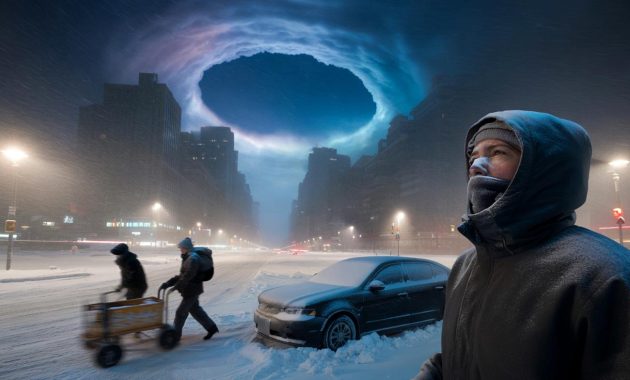
The first thing you notice is the silence. The kind that falls over a city when the air hurts to breathe and every sound gets swallowed by snow and concrete. Streetlights glow in a frozen haze, your eyelashes start to crust over, and your phone cheerfully informs you it “cannot operate in these temperatures.”
Meteorologists have a word for the monster crouching above us in the upper atmosphere: the polar vortex. Most winters, it minds its business, spinning calmly over the Arctic like a cold halo. This year, though, that halo is wobbling and threatening to crack.
Somewhere above your head, 30 kilometers up, a chain reaction has already started.
What drops out of that broken ring of cold could rewrite the meaning of “extreme.”
A polar vortex that won’t behave like the others
On weather maps right now, high above the headlines about rain and weekend forecasts, something subtle is shifting. Temperatures in the stratosphere are spiking, flipping the script on what usually keeps the polar vortex tight and contained over the Arctic.
Down here on the ground, that sounds abstract. Up there, it’s like slamming on the brakes of a spinning top. The vortex slows, tilts, stretches. Sometimes it splits into two ragged whirlpools of cold air. When that happens, those whirlpools don’t stay politely over the pole. They slide south. Right into where people live, commute, work, and try to stroll their dogs without freezing their breath.
We’ve seen hints of this movie before. In early 2019, a major polar vortex disruption helped unleash a brutal cold wave over the U.S. Midwest, with Chicago colder than parts of Antarctica. Pipes burst in apartment hallways, the rail network froze, and emergency rooms filled with frostbite cases from people who thought ten minutes outside would be fine.
That event helped popularize the term “polar vortex” in everyday speech. But what’s brewing now, according to several climate and weather models, could be deeper and more prolonged. Some simulations suggest stratospheric temperatures will spike by 40–50°C at about 30 km altitude, a classic sign of a “sudden stratospheric warming” that shatters the vortex’s stability. On the ground, those numbers flip upside down into bitter negatives.
To understand the magnitude, you have to picture the polar vortex not as a single storm, but as the entire pattern of freezing air caged above the pole. The stronger and rounder it is, the more that cold stays locked up north. When waves in the atmosphere punch into it — from mountain ranges, ocean temperature patterns, or even long-term climate shifts — the vortex can wobble off-center.
That wobble is what opens the gates. Cold, dense Arctic air spills south while warmer air rushes north, contaminating the pole. This clash doesn’t create the cold out of nowhere; it redistributes it, violently. That’s why meteorologists are starting to ask if the thresholds they use to define “extreme cold” even fit a world where those gates are swinging wider and more often.
How to live through air that feels aggressively cold
When temperatures plunge below what forecasts used to flag as “record-breaking,” survival becomes less about comfort and more about timing. The first method seasoned cold-climate locals rely on is layering with intent. Not just “wear more clothes,” but three specific layers: a moisture-wicking base, an insulating middle, and a wind-stopping shell.
➡️ The real difference between brown and white eggs, finally explained by science
➡️ Are microwave ovens dangerous for your health?
➡️ Bridging Education And Employment In The Tech Sector
➡️ Farewell to happiness : the age when it fades, according to science
Every exposed centimeter of skin becomes a decision. Gloves over thin liner gloves, a buff that can slide over your nose, socks that trap air instead of just feeling thick. Carrying a spare pair of dry socks in your bag suddenly feels like advanced strategy, not overkill. Little rituals — warming your car gently, keeping a thermos in your backpack, taping over boot holes — stop feeling quirky and start feeling like a plan.
The big mistake most people make the first day a brutal cold wave hits is underestimating just how fast things deteriorate. You step outside “just to grab something from the car” in sneakers and a light jacket. A quick dash across the street turns into a stalled engine, a dead phone, and a body losing heat faster than your problem-solving kicks in.
We’ve all been there, that moment when confidence quietly flips into panic.
There’s shame, too — as if needing to duck into a store just to thaw your fingers means you didn’t “handle winter right.” Cold snaps that push into new, historic ranges don’t care about pride. They punish thin gloves, cotton hoodies, and the myth that you can run your way warm in minus-30 wind chills.
“During extreme cold, we stop talking about ‘feels like’ temperatures and start talking about survival times,” says a Canadian emergency physician used to Arctic blasts. “At certain wind chills, exposed skin can freeze in under 10 minutes. That’s not a scare line. That’s physiology.”
- Dress in intentional layers: base, insulation, shell — not just “a big coat.”
- Cover extremities first: fingers, toes, ears, nose, and cheeks are the frontline.
- Think in time limits outdoors, not distances. How long will you be exposed if something goes wrong?
- Prepare a micro–“cold kit” at home and in your bag: extra gloves, dry socks, chemical warmers, a backup battery.
- Watch out for the people who don’t get to opt out: delivery workers, people living outside, elderly neighbors.
A new definition of “too cold” is quietly arriving
Meteorologists don’t throw around words like “extreme” lightly. They calibrate them with data, frequency, return periods. A cold wave that once stood out as a one-in-50-year event now seems to reappear every decade or less in some regions. The language lags behind the lived reality.
That’s why this incoming polar vortex disruption feels like more than a forecast curiosity. It’s a stress test for grids, homes, and bodies that were built for a different baseline. A power plant fails in one corner of a frozen state, and suddenly hundreds of thousands of people are practicing “indoor camping” beside a gas stove, if they’re fortunate enough to have one. Others simply huddle beneath every blanket they own, watching the indoor thermostat drop like a countdown.
Climate scientists are still arguing, passionately, about how a warming planet interacts with polar vortex behavior. Some studies suggest that losing sea ice and heating the Arctic might be destabilizing the vortex more often, leading to louder winter swings — record warmth here, record cold there. Other research urges caution, saying the link is not settled science.
What’s not in dispute is the human angle: a world used to certain seasonal patterns is getting whiplash. One winter you worry about mud and rain in January, the next about schools closing for a week because buses can’t safely run in the deep freeze. *The emotional weather of that kind of volatility is just as real as the meteorological kind.* People start asking whether their homes, their clothing, their routines belong to the wrong climate.
Let’s be honest: nobody really updates their winter playbook every single year. We drag habits along behind us — the same jacket, the same sleepy reaction to a cold warning push alert. That worked when “cold” behaved within familiar limits. When -10°C was a story to tell at work, not the warm-up act to something harsher.
As this polar vortex disruption unfolds in the real atmosphere, not just in model runs, there’s an odd kind of collective watching. People refreshing satellite loops, parents rethinking school drop-offs, city planners quietly gaming out frozen-pipe scenarios at 2 a.m. The thresholds we used to rely on — what counts as safe, normal, survivable — are shifting by degrees you can actually feel on your face. And once your breath crystallizes mid-sentence on a “new normal” winter morning, that’s hard to unlearn.
| Key point | Detail | Value for the reader |
|---|---|---|
| What a polar vortex disruption is | Breakdown or displacement of the normally stable Arctic cold pool in the stratosphere | Helps you understand why forecasts mention the vortex and what it means for your region |
| Why upcoming cold may be unprecedented | Models show strong sudden stratospheric warming capable of sending intense Arctic air far south | Signals when to take cold alerts seriously, beyond “typical winter weather” |
| How to respond in daily life | Layering strategy, exposure time awareness, and simple preparation habits | Reduces health risks and stress when temperatures plummet fast |
FAQ:
- Question 1What exactly is the polar vortex everyone talks about?
- Question 2Does a disrupted polar vortex mean every place will get colder than usual?
- Question 3How long can a polar-vortex-driven cold wave last at ground level?
- Question 4Is climate change making these extreme cold outbreaks more common?
- Question 5What’s the one practical thing I should do before this cold arrives?