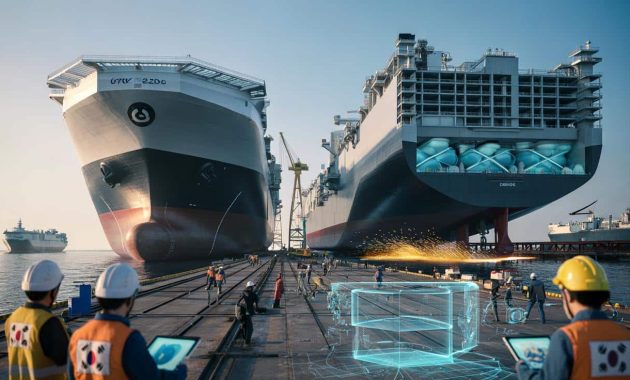
While oil majors grab the headlines, a specialist in cryogenic ship technology has become one of the biggest winners from the global rush for liquefied natural gas, and 2026 is already shaping up as another defining year.
A French industrial champion you rarely see
Most travellers will never spot its logo, yet Gaztransport et Technigaz, better known as GTT, sits behind a large share of the world’s LNG fleet. The group designs the ultra-cold containment systems that line the belly of giant LNG tankers, keeping natural gas liquefied at around –163°C as they cross the oceans.
The company does not build ships. Instead, it licenses a highly technical “membrane” architecture and supports shipyards as they integrate it into the hull. These metallic membranes and insulation layers prevent leaks and limit deformation when the ship rolls, flexes and slams into heavy seas.
GTT turns steel hulls into floating thermos flasks, making long-distance LNG trade physically and economically possible.
That expertise has positioned the French group at the centre of a reconfigured gas market. LNG has become a bridge fuel for countries seeking to reduce dependence on coal and pipeline gas, especially since Russia’s invasion of Ukraine. Every new long-term gas deal signed between producers and buyers tends to trigger a wave of tanker orders. GTT benefits from almost all of them.
A blistering start to 2026 with nine new LNG carriers
The opening days of 2026 sent a sharp message to investors: demand for LNG tonnage remains strong. Within less than a week, two major South Korean shipbuilders booked nine new LNG carriers, all of them contracted with GTT’s latest membrane technology.
The Samsung Heavy Industries order
On 8 January 2026, Samsung Heavy Industries confirmed a contract for two next-generation LNG carriers. Delivery is scheduled between the third quarter of 2028 and the first quarter of 2029, reflecting the crowded slots at top-tier yards.
These vessels will use GTT’s Mark III Flex system, a modern variant of its long-established Mark series. The design targets very large capacity ships and responds to tougher environmental rules that push shipowners to reduce fuel use and greenhouse gas emissions.
Seven more ships at Hanwha Ocean
A few days earlier, Hanwha Ocean (formerly DSME) announced a larger batch: seven LNG carriers ordered by a European shipowner, again fitted with the Mark III Flex system. Deliveries will run from late 2027 through the end of 2029.
➡️ People who feel uncomfortable relying on others often learned early self-sufficiency
➡️ Europe backtracks on electric cars: “People are not ready for only battery vehicles in 2035”
➡️ People who follow this evening habit wake up feeling more rested
➡️ Why chefs always add a pinch of sugar to their tomato sauces
That timing shows how shipowners are betting far ahead on LNG trade patterns for the 2030s. The ships ordered now are likely to serve new export terminals coming online in Qatar, the US Gulf Coast and possibly Africa.
Nine ships, two Korean yards, one French technology: these early-2026 deals alone could represent about €90 million in revenue for GTT.
Analysts estimate around €10 million per vessel for GTT’s licence and related engineering work, although the company does not publicly confirm per-ship figures. Beyond those headline numbers, each contract opens several years of design, project management and on-site technical assistance.
Why South Korean shipyards dominate LNG carriers
The concentration of these orders in South Korea is no coincidence. The country’s big three – Samsung Heavy Industries, Hanwha Ocean and HD Hyundai Heavy Industries – have steadily carved out a near-monopoly on large LNG carrier construction.
They combine high-tech engineering, large dry docks and experience managing complex supply chains, from cryogenic steel to advanced propulsion systems. Their orderbooks now stretch years ahead, often with dozens of LNG vessels under construction at any one time.
For GTT, these long-term relationships are crucial. Having its technology specified as standard at leading yards means the French group is almost automatically present whenever global energy giants place LNG carrier orders.
- Shipowners gain proven technology accepted by charterers and financiers.
- Yards benefit from standardised designs and familiar installation procedures.
- GTT secures recurring, high-margin business with strong visibility.
Inside the Mark III Flex system
The Mark III Flex system is more than just a storage tank. It is a complete architecture integrated into the hull structure of the ship. The core element is a thin corrugated metal membrane, supported by a complex stack of insulating materials.
This insulation limits heat ingress, which in turn reduces “boil-off” – the natural evaporation of LNG as it slowly warms. If too much gas boils off, it must be burned or reliquefied, both of which cost money and add emissions.
Cutting boil-off by even a fraction of a percent can tilt the economics of a 266,000-cubic-metre giant LNG carrier over a 25-year lifetime.
The “Flex” in Mark III Flex signals enhanced thermal performance and increased adaptability compared with earlier Mark designs. It allows shipowners to fine-tune the trade-off between initial construction cost and long-term operating savings. For many, rising fuel prices and tightening emissions rules are pushing them towards higher-spec insulation.
Revenue growth that tracks the LNG boom
GTT’s financial trajectory has mirrored the acceleration of LNG trade. Between 2021 and 2025, the company’s revenue grew by roughly 167%, an average annual increase close to 28%.
| Year | Revenue (approx.) | Annual growth (approx.) |
| 2021 | €290m | — |
| 2022 | €320m | +10% |
| 2023 | €420m | +31% |
| 2024 | €625m | +49% |
| 2025 | €775m (est.) | +24% |
After a spectacular 2024, the pace cooled slightly in 2025, but activity remained high thanks to a swollen orderbook for large-capacity LNG carriers. The ramp-up of exports from the US and Qatar continues to support this pipeline of work.
Beyond LNG tanks: digital services and new fuels
GTT’s future no longer rests solely on LNG tanks. The company has been pushing hard into software, data and alternative fuels, aiming to stay relevant as shipping decarbonises.
Digital monitoring and operational optimisation
Modern LNG carriers are packed with sensors. GTT provides digital tools that collect and analyse data from cargo containment systems, hull performance and fuel consumption. These platforms help shipowners adjust speed, routing and loading patterns to cut costs and emissions.
Crucially, digital services bring recurring revenue: annual licences, maintenance contracts and remote diagnostics. That smooths out the cyclical nature of shipbuilding, which tends to swing with energy markets and interest rates.
Cryogenic engineering for future fuels
The same know-how used to keep LNG ultra-cold can be adapted to other cryogenic or near-cryogenic fuels. GTT is already working on concepts for:
- Liquid hydrogen – far colder than LNG and more technically demanding.
- Ammonia – does not need such low temperatures but raises toxicity and corrosion challenges.
- Carbon dioxide – for potential transport of captured CO₂ in liquid form.
These markets are still small and somewhat experimental, but regulators and shipowners see them as candidates for deep decarbonisation after 2030. By positioning early, GTT hopes to carry its current dominance into the next fuel era.
How LNG carriers actually make money
For readers not steeped in shipping economics, LNG carriers earn cash mainly through long-term charter contracts. An energy major, a trader or a utility rents the ship, often for 10 to 20 years, and pays a daily rate that can range from tens of thousands to over €150,000 depending on market tension.
Key factors that influence profitability include:
- Boil-off rate and fuel consumption.
- Reliability and maintenance costs.
- Flexibility to serve both long-haul and shorter regional routes.
- Compliance with emissions rules set by the IMO and the EU.
GTT’s technologies impact several of those levers at once. That explains why shipowners and charterers often insist on specific containment systems when they negotiate financing and contracts.
Risks and scenarios for the next decade
The rosy numbers do not mean zero risk. A sharp policy shift against fossil fuels, a prolonged recession or a faster-than-expected rollout of renewable energy could dent LNG demand. If fewer export terminals get built, the need for new carriers will slow.
There is also technological risk. Competitors are trying to offer alternative containment concepts and digital platforms. A serious failure on a high-profile ship, even if rare, could damage confidence and trigger regulatory pressure.
On the other hand, a tighter climate regime could actually push more buyers from coal to gas in the interim, especially in Asia. In that scenario, LNG trade might stay robust well into the 2040s while low-carbon fuels scale up. GTT would then have a long transition runway to shift from LNG to hydrogen, ammonia or CO₂ transport solutions.
Key terms worth unpacking
Two expressions often appear in discussions about LNG carriers and GTT’s technology:
What “boil-off gas” really means
Boil-off gas is the portion of LNG that evaporates during storage and transport. On a voyage of several weeks, even a tiny percentage of daily boil-off can add up to thousands of cubic metres of gas.
Ship operators sometimes use this gas as fuel. That reduces the need for separate bunker fuel, but if the gas must be burned in a flare or reliquefied, it becomes a cost and an environmental burden. Lowering boil-off is therefore a direct financial and climate gain.
Why a “membrane tank” differs from a classic tank
Instead of hanging a big independent cylinder inside the hull, a membrane tank turns the hull itself into the structural support for the liquid. The thin metal membrane simply contains the LNG, while the surrounding hull and insulation take the mechanical loads.
This yields better use of space, lighter structures and large uninterrupted volumes – all valuable when each extra cubic metre of LNG carried can improve a ship’s long-term return on investment.