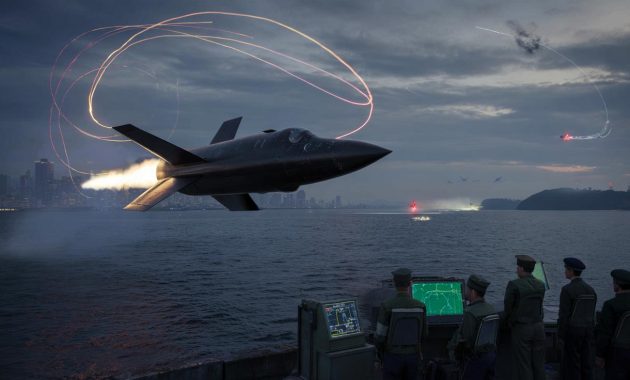
Tokyo Bay at night feels deceptively calm. The water is flat, the city lights pulse softly in the distance, and somewhere over that black horizon, a new kind of missile is being tested in secret. Not the old, straight-line kind our brains are used to from Cold War movies. This one twists, shimmies, does mid-air corkscrews like a fighter pilot in a panic — except it isn’t panicking at all.
A few officers on a windswept pier watch the radar screens glow, their eyes flicking up to a starless patch of sky. What they’re seeing isn’t just a weapon; it’s a crossing of a line Japan has tiptoed along for decades.
On the monitors, the track looks like a drunk bee. On the map, it reaches beyond 1,000 kilometers.
Some red lines don’t shout when they’re crossed — they whisper.
Japan’s stealth corkscrew missile: the night the rules quietly changed
The first thing that hits you is the movement. Engineers who’ve watched classified footage describe a slender, dark shape racing low over the sea, then suddenly veering into a tight rolling corkscrew that would tear a human pilot apart. The missile wobbles on purpose, like a boxer slipping punches. Each twist is calculated to confuse radars and throw off interceptor missiles keyed to predict a straight or gently curving path.
To the human eye, it would look almost wrong — like a physics glitch. To a modern air-defense system already juggling drones, jets and decoys, it’s a nightmare given wings.
Inside a wind tunnel facility outside Nagoya, a young Japanese engineer reportedly watched the scale model complete its first stable spiral run and just said one word: “Yabai.” Dangerous. The test logs, according to a defense source, showed the missile maintaining control through aggressive rolling maneuvers at transonic speed, its radar signature smeared and unpredictable.
On paper, this new stealth cruise missile can hit targets beyond 1,000 kilometers. That means from northern Japan, you’re suddenly in quiet reach of airfields, ships and command posts deep inside an adversary’s envelope. The corkscrew flight isn’t a stunt. It’s the difference between being tracked and fading into noise.
What makes this feel like a red line is not just the range or the acrobatics. It’s Japan’s story. Since World War II, the country has lived under a pacifist constitution, insisting its forces are “self-defense” only. Long-range strike weapons were treated as taboo, something for other nations. Now Tokyo is funding missiles that can slip past layered defenses and hit faraway targets before anyone can scramble.
The official language still talks about deterrence, about protecting islands and sea lanes. Yet a missile that can curve, hide and punch past 1,000 kilometers quietly shifts Japan from shield to something closer to spear.
➡️ France Races To Britain’s Rescue To Help Design New Mine-Hunting AI
➡️ I tried this slow-cooked recipe and loved how rich it turned out
➡️ 10 hobbies to adopt that help prevent loneliness in old age, according to psychology
➡️ This small hidden button will make your life easier
➡️ K-beauty cushion foundation: flawless coverage in one tap
➡️ China Unearths 2,200-Year-Old Imperial Road That Challenges Our Modern Highways
➡️ 4 phrases to end a conversation intelligently
➡️ How bananas can stay fresh and yellow for up to two weeks when stored with one simple household item
How do you build a missile that dances in mid-air?
Designing a missile that corkscrews on command starts with one deceptively simple idea: don’t fly like a textbook. Traditional cruise missiles follow semi-predictable paths — low, fast, but smooth. Japanese engineers working with advanced guidance software are teaching this new weapon to fly like it’s improvising, while remaining fully under control.
Hidden in its nose are sensors constantly reading the environment. The guidance computer feeds that into algorithms that tweak fins and thrust in micro-bursts, generating those spiral moves that shred tracking predictions and decoy older guidance systems into aiming at where it “should” be.
We’ve all been there, that moment when your GPS recalculates after you miss a turn. Air-defense radars do something similar: they guess where a missile will be in a few seconds, then fire interceptors along that path. This system is built to punish that habit. When the Japanese missile suddenly rolls and corkscrews, the prediction models collapse. Interceptors waste precious milliseconds re-aiming, and in missile combat, milliseconds are survival.
Some of the inspiration, insiders say, comes from studying how human pilots in dogfights used extreme barrel rolls to break lock-on. The difference is, this thing doesn’t black out, doesn’t get tired, doesn’t lose focus.
The logic behind the range — beyond 1,000 kilometers — is brutally simple. If Japan wants to stop incoming attacks, striking only at the last moment over its own cities is a losing game. So planners are shifting toward what they call “counter-strike capability”: hitting launch sites, ships and key hubs before they fire. A missile that can be launched from Japanese territory, weave through contested airspace and still hit a precise point deep beyond the horizon fits perfectly into that doctrine.
Let’s be honest: nobody really reads dense defense white papers every single day. But this is where those dry words turn into something concrete — a weapon that can reach almost as far as Tokyo to Shanghai, or Okinawa to the Taiwan Strait, without ever leaving Japanese soil or waters.
A quiet arms race, step-by-step — and the risks nobody likes to say out loud
If you strip away the acronyms, Japan’s method is almost domestic in its rhythm: small steps, pilot projects, then a jolting leap. The stealth corkscrew missile is part of a broader program to extend the range of existing missiles like the Type 12 and to field entirely new designs that can be fired from trucks, ships and aircraft. The basic tip from defense planners is simple: diversify where you launch from, and no enemy can easily wipe your capabilities off the map in a single strike.
So Japan is spreading these future launchers across island chains, highway networks and naval decks, creating a moving puzzle any attacker would have to solve in real time.
There’s a human side to this that rarely fits in neat strategy slides. Local mayors in remote prefectures are being briefed about new missile units arriving near fishing villages and tourist spots. Residents worry out loud about becoming “targets on a map”, even as they understand the arguments about protecting sea lanes and deterring aggression. The emotional mistake many commentators make is to treat this as a video game — red and blue arrows sweeping across screens.
In reality, each new launcher means soldiers’ families relocating, new drills echoing through quiet valleys, an invisible layer of risk that settles over daily life like a fine dust no one asked for.
Japan’s former defense ministers have started to speak more bluntly: “If we remain only a shield, we invite the spear,” one said at a closed-door event in Tokyo. The message is simple, and a little chilling — deterrence through the ability to hit back hard, fast and unpredictably.
- Range beyond 1,000 kmPushes Japan squarely into long-range strike territory, blurring the old self-defense-only red lines.
- Stealth and corkscrew flightMakes interception dramatically harder, potentially outpacing current regional air-defense systems.
- Layered launch platformsFrom ground, sea and air, giving Japan a flexible, mobile strike web that’s tough to neutralize.
What this missile really changes in Asia’s fragile balance
Seen from space, the Pacific looks vast and empty. From ground level in East Asia, it’s starting to feel crowded with invisible tripwires. Japan’s corkscrewing stealth missile doesn’t exist in a vacuum; it’s emerging in a region where China is pumping out hypersonic weapons, North Korea is firing off test salvos like clockwork, and the United States is quietly re-positioning assets across Guam, the Philippines and Australia.
A single new system can act like a psychological accelerant. Neighbors will ask: if Japan can do this, what will it do next? And what do we need to buy to stay ahead?
For everyday people in Tokyo, Seoul, Taipei or Shanghai, the change is mostly invisible. Life goes on: crowded trains, school runs, late-night convenience stores glowing on street corners. Yet over all of that hangs a new question mark. A missile that can twist through the sky, shrug off tracking and hit beyond 1,000 kilometers doesn’t just defend territory. It creates options for pre-emptive or retaliatory strikes that used to be politically unthinkable in Japan.
*Once a country crosses the psychological barrier of owning such tools, stepping back becomes much harder than inching forward.*
So where does this leave the rest of us, scrolling headlines on our phones, half a world away? On one level, it’s another piece in a big, scary puzzle we don’t control. On another, it’s a stark reminder that red lines in security policy are less like brick walls and more like foggy fields—easy to wander across, hard to retrace.
The Japanese missile that dances in the sky is really a mirror pointed at a region on edge. It asks bluntly: are we building stability through fear of each other’s weapons, or are we rehearsing a disaster none of us truly believes will happen — until the night a corkscrew track on a radar screen stops being just a test?
| Key point | Detail | Value for the reader |
|---|---|---|
| Japan’s new red line | Stealth cruise missile with corkscrew maneuvers and >1,000 km range | Helps you grasp how Japan is shifting from pure shield to potential spear |
| Corkscrew as strategy | Unpredictable spirals confuse radar and interceptor prediction models | Makes sense of why this specific flight pattern terrifies air-defense planners |
| Regional ripple effect | Feeds into an already tense arms buildup across East Asia and the Pacific | Offers context for future headlines about China, North Korea and US deployments |
FAQ:
- Question 1Is this missile officially confirmed by Japan?
- Question 2How does a corkscrew flight path help evade defenses in practice?
- Question 3Does a range beyond 1,000 km violate Japan’s constitution?
- Question 4How might China and North Korea react to this new capability?
- Question 5Should people in the region feel more or less safe because of this missile?