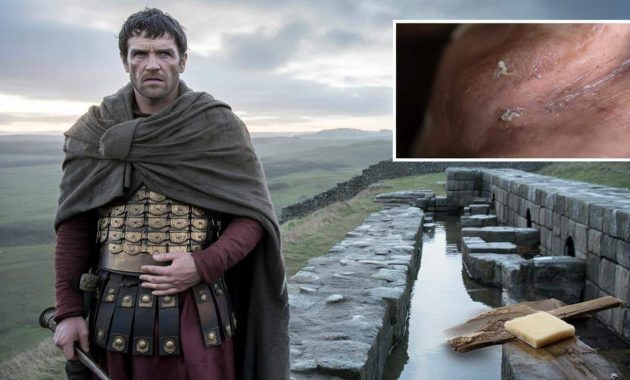
The wind hits first. Up on Hadrian’s Wall, the kind that slices through three layers of modern waterproofs once sliced through wool tunics and bronze helmets. Tourists pose for photos, stamping their feet on the old stone, imagining heroic legionaries staring north into the barbarian mist. Nobody talks about what was happening a few meters behind those soldiers – inside the dark, reeking pits where their waste collected, and where something else lived on for decades.
In those latrines, under our boots and Instagram shots, scientists are now finding tiny eggs of worms that spent years inside Roman guts. Silent passengers. Constant, gnawing reminders that empire doesn’t smell like marble and glory.
The new analysis is forcing historians into uncomfortable territory.
Because once you look into the toilets, the romance starts to crack.
When Rome’s “best and bravest” were quietly scratching
Stand in the remains of the communal latrine at Housesteads fort and it’s easy to picture the scene. Stone benches, cold even in summer. A channel of running water in front, for washing the sponge sticks the soldiers used in place of toilet paper. Boots clacking, low voices, maybe a joke traded in bad Latin.
Now add another layer: men shifting their weight more than they should. Bellies cramping again. Skin crawling with an itch they can’t quite reach. The everyday misery that never makes it into museum gift shops.
Archaeologists have been quietly scraping the bottom of those latrines, taking soil samples that most visitors walk past without a second glance. Under the microscope, those samples tell a blunt, unflattering truth.
Eggs of whipworm. Roundworm. Possibly tapeworm. Parasites that only get there one way: through the human gut and right back out again. Some Hadrian’s Wall sites show infection levels high enough that, in a modern clinic, a doctor would raise an eyebrow and reach for medication fast. These soldiers were living with them for years, not days.
The science is fairly simple and relentlessly unglamorous. Parasite eggs survive for centuries in damp soil, locked away from light and air by collapsed stone and compacted waste. Analysts float those eggs out of the dirt with dense liquids, then count them under a microscope. Numbers don’t lie.
What they show at Hadrian’s Wall is a cycle that never really broke. Contaminated hands touching food. Undercooked meat. Shared sponges dipped in water that wasn’t as clean as it looked. It’s a quiet blow to the polished image of Roman efficiency. The empire that laid out straight roads across Europe couldn’t break the loop of its own gut worms on the windy edge of Britain.
➡️ Get trusted advice on heat pump grants from Efficient Renewables experts this weekend
➡️ Stylists say this layered cut grows out better than most and saves money on salon visits
➡️ Simple brow lamination techniques create fuller thicker brows without salon visits
➡️ Probably F15s, F16s, F22s And F35s : Dozens Of US Jets Now Converging On The Middle East
➡️ “Why do Lidl cashiers go so fast?” There’s a very specific psychological reason, we’ll explain.
The toilet trenches that fractured a legend
The latest wave of analysis has a strangely modern feel to it. Teams move along the Wall with GPS devices and sample tubes, mapping latrines like we map coffee shops. Every few meters, another plug of earth comes up. Another microscopic census of who – and what – lived there.
The results are not just random specks under glass. They cluster around kitchens, barracks, bathhouses. Patterns appear: higher parasite loads in older forts, spikes in certain time periods, drops when garrisons were rotated. A biological fingerprint of daily life, preserved in muck.
One example keeps coming up in discussions: Vindolanda, south of the Wall but part of the same frontier world. Tablets from the site tell us about boot orders, birthday parties, and complaints about the cold. Latrine samples now add an unspoken line: these letter-writers were probably malnourished and often exhausted.
Imagine a centurion who prided himself on discipline, drilling his men in perfect formation, then spending his nights battling abdominal pain and anemia from roundworm. The “front line of civilization” starts to look much closer to a rough work camp, where survival beat comfort every time. We’ve all been there, that moment when the workplace myth doesn’t quite match the reality you can smell.
That’s where historians start to split. Some argue that the parasite data finally gives voice to the physical reality of ordinary soldiers, anchoring the story away from marble busts and imperial edicts. Others worry we’re swinging too far, reducing Roman Britain to a kind of historical misery porn.
Underneath that argument sits a simple tension: we like our past either heroic or tragic, not messy and mildly gross. Yet these worm eggs refuse to fit neat categories. They show an army that was tough and disciplined, yes, but also constantly run-down, compromised from the inside. *Empire starts to look less like a straight line of conquest and more like a long, grinding negotiation with mud, weather, and biology.*
How a sponge on a stick reshapes a whole empire
One of the most striking findings isn’t just that parasites were present, but how the system practically invited them in. Roman latrines at Hadrian’s Wall were technical achievements for their time: stone channels, flowing water, drainage out beyond the fort. On paper, that’s hygiene.
Yet the real method on the ground was messier. Soldiers sat shoulder to shoulder, sharing a handful of sponges fixed to sticks, rinsed in a common gutter. Hands went from sponge to cloak, cloak to bread, bread to mouth. The same water that swept waste away carried tiny eggs downstream, ready to be scooped up again when filling a bucket.
Modern readers love to imagine Rome as rigorously clean, all warm baths and immaculate mosaics. There’s truth in that, but it came with blind spots. The army knew how to site a latrine downwind and downhill. It didn’t fully grasp invisible threats. No germ theory. No sense that a clear stream could carry something deadly.
So the mistakes were built into the routine. Crowding in barracks, shared eating bowls, long supply lines that spoiled food. Mix that with stress, injuries, and bitter northern winters, and you get bodies that rarely had the strength to fight off much. Let’s be honest: nobody really does this every single day, that perfect routine of washing, boiling water, and cooking thoroughly, especially when you’re standing guard on a freezing wall at 3 a.m.
The new research has also pushed historians to re-read old sources with fresh eyes. Those vague references to “flux”, “weakness”, and “wasting” in ancient texts suddenly look less poetic and more clinical. One parasitologist told me, half amused and half exasperated:
“We’ve been romanticizing these men for centuries. Then you put their gut contents under a microscope and realize they were basically running a military base on half power.”
That gap between myth and microbe is where this story hits hardest. It asks us to hold two truths at once:
- Roman soldiers were highly trained, organized, and often effective.
- Roman soldiers at Hadrian’s Wall were also frequently sick, itchy, and tired from infections they barely understood.
- Our favorite empires always look cleaner when we don’t check the toilets.
- Small, unglamorous details – like worms in a latrine – can overturn big, polished narratives.
- The frontier wasn’t just a line on a map. It ran straight through the bodies of the men who guarded it.
What this does to our idea of “civilization”
Once you start seeing Hadrian’s Wall through parasite eggs, it becomes hard to unsee. The grand stone barrier separating Rome from the “barbarians” turns into a kind of shared ecosystem. Both sides of the wall dealing with cold, dirt, and the same stubborn worms. The difference wasn’t cleanliness as much as who had stone barracks and who slept in timber halls or huts.
This shift in perspective quietly asks a more unsettling question: how many of our modern fantasies rest on carefully edited bodies? We airbrush out the stomach aches, the rashes, the chronic fatigue of history, then call what’s left “civilization”. Looking into these latrines feels like switching the light on in a beautifully staged room and seeing the extension cords and dust.
For readers today, there’s something oddly grounding in that. The men we turned into statues were closer to us than we think, right down to their microbiome. They grumbled, they scratched, they spent long nights awake with pain they couldn’t name. And yet they still built walls, wrote letters, fell in love, followed orders, and sometimes deserted when it all became too much.
Sharing this kind of research can feel awkward, even a bit distasteful, yet it opens up space for more honest conversations about bodies, work, and power. If an empire could run for centuries while its front-line troops were quietly battling worms, what does that say about what we normalize today? Historians will keep arguing about the scale of the problem. The rest of us get to sit with the image: a soldier on a frozen rampart, staring into the dark, while something small and relentless curls inside his gut, unseen and unmentioned.
| Key point | Detail | Value for the reader |
|---|---|---|
| Roman soldiers on Hadrian’s Wall lived with chronic gut parasites | Latrine samples show high levels of whipworm, roundworm and other intestinal worms | Breaks the polished, heroic image and reveals the physical cost of life on the frontier |
| Infrastructure didn’t guarantee real hygiene | Communal latrines, shared sponges and limited understanding of contamination fed constant reinfection | Highlights how good systems can fail when everyday habits and blind spots collide |
| Microscopic evidence is reshaping big historical narratives | New parasite data is forcing historians to rethink health, strength and daily reality in the Roman army | Shows how small, overlooked details can change how we see power, empire and “civilization” |
FAQ:
- Question 1Were all Roman soldiers at Hadrian’s Wall infected with parasites?
- Answer 1Not every single soldier, but the density of parasite eggs in several latrines suggests infection was common and long-term in many units, especially in older, heavily used forts.
- Question 2Did the Romans know what was making them sick?
- Answer 2They noticed symptoms like diarrhea, cramps and weakness, and used herbal remedies, but they had no concept of microscopic worms or germ theory, so they never fully broke the reinfection cycle.
- Question 3Were Roman hygiene practices really that bad?
- Answer 3By ancient standards they were advanced – with latrines, baths and drainage – yet some practices, like shared sponges and crowded barracks, accidentally helped parasites spread.
- Question 4Does this change how historians view the strength of the Roman army?
- Answer 4It complicates the picture: the army was still formidable, but we now see that many soldiers likely served while undernourished, anemic and regularly ill.
- Question 5Can tourists see evidence of this at Hadrian’s Wall today?
- Answer 5You won’t see worm eggs with the naked eye, but you can visit sites like Housesteads and Vindolanda, stand by the latrine remains, and know that the real story runs far deeper than the stone.