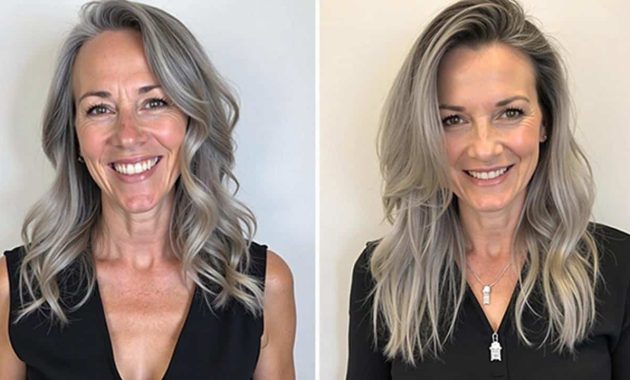
After 50, a subtle colour tweak can turn them into a real style asset.
As more women choose to let their natural grey show, colourists are quietly reinventing how we manage the awkward in‑between phase. One technique, the “salt and pepper” balayage, is emerging as a smart, low‑maintenance strategy to make maturing hair look deliberate, luminous and modern.
Why grey hair after 50 calls for a new colour strategy
The first few white strands often arrive without warning. Then, seemingly overnight, they multiply and start reshaping your entire hair colour. For many women over 50, this stage feels unsettling: hair looks neither fully coloured nor fully grey, just patchy and flat.
The classic reactions are familiar. Some people rush into full coverage dyes, locking themselves into constant root touch‑ups. Others stop colouring altogether and wait (impatiently) for the greys to “grow out”. Both options can be frustrating, costly or ageing, especially when half the head is still its natural shade.
The real challenge is not grey hair itself, but the sharp contrast between grey strands and the original colour.
Colourists now talk about “transition management” for clients over 50. Rather than masking every white hair, the goal is to blend, soften and enhance what’s already there. This is where the salt and pepper balayage comes in.
What is “salt and pepper” balayage, exactly?
The name sounds simple, but it does not refer to a one‑size‑fits‑all colour formula. Instead, it describes a personalised balayage technique that mixes lighter “salt” highlights with deeper “pepper” lowlights to balance naturally greying hair.
Traditional single‑process dye covers everything in one flat colour, which can look harsh and artificial. Balayage works differently. The colourist paints highlights and lowlights strategically, strand by strand, leaving some natural hair untouched.
Salt and pepper balayage aims to reduce the clash between grey and natural pigment, not to erase the grey altogether.
By subtly lightening some darker areas and deepening others, the colourist can:
- soften the demarcation line between grey roots and old colour
- create a more even, flattering tone across the whole head
- keep the natural sparkle of grey without the washed‑out effect
- stretch the time between salon visits
How the technique works on different types of grey
Because each head of hair greys differently, the “recipe” for salt and pepper balayage changes from person to person. A good colourist will start by assessing the percentage of grey, where it is located, and the underlying natural colour.
When you are mostly grey or white
If over half of your hair is already grey or white, the risk is that everything looks flat, especially if your skin tone is light. In that case, the colourist usually adds more “pepper” than “salt”.
That means placing deeper lowlights through the lengths and underlayers, often in cool beige, ash brown or soft charcoal tones, depending on your base. These darker strands break up the block of grey and bring back depth around the face.
On largely grey hair, well‑placed darker strands can sharpen features and give a subtle lifting effect without going fully dark again.
The result is still grey overall, but more textured and intentional, with a gentle shadow that frames the face and makes the natural silver look expensive rather than accidental.
When grey is just starting to appear
For those in their late 40s or early 50s with scattered white hairs mainly at the temples, the balance flips: more “salt”, less “pepper”. Here, the colourist usually lightens parts of the darker lengths instead of darkening the greys.
By adding soft, light highlights around the face and through the top layers, the existing white strands blend into a lighter overall palette. The greys no longer stand out as isolated streaks; they look like part of a deliberate highlight pattern.
This approach also avoids the classic helmet effect of full‑coverage dye, where roots show within weeks. The greys keep growing, but the contrast with the rest of the hair stays gentle.
What to ask your colourist for
Walking into a salon and simply saying “salt and pepper balayage” will not be enough. The technique is a direction, not a fixed formula. A clear conversation with your colourist makes all the difference.
| Your situation | What to request |
|---|---|
| Mostly grey or white hair | Ask for cool, soft lowlights to add depth and reduce a flat, overly pale look. |
| Mostly dark hair with some greys | Ask for lighter highlights to blend the greys and soften harsh regrowth. |
| Strong contrast between roots and ends | Ask the stylist to specifically blur the demarcation line rather than match your old colour exactly. |
| Sensitive scalp or damaged hair | Request a partial balayage and minimal lightener, focusing only on the top and face‑framing pieces. |
Bringing photos of hair that resembles your current colour and your goal can guide the discussion. Aim for realistic tweaks, not a complete reinvention.
Why many women over 50 prefer this approach
Salt and pepper balayage sits right between the two extremes of full coverage and going completely natural. It accepts that hair is changing, yet steers that change with subtlety.
Several benefits stand out:
- Less upkeep: roots are less obvious, so appointments can be spaced out every 8–12 weeks.
- Gentler on hair: only selected strands are coloured, limiting overall chemical exposure.
- More flattering tone: colour can be adjusted to complement skin as it evolves with age.
- Psychological ease: you are not fighting your greys, just shaping them.
For many women, this technique turns the “grey crisis” into a style decision, not a defeat.
How to maintain salt and pepper balayage at home
Once the colour is in place, simple home care helps keep it fresh. Grey hair tends to be drier and more porous, so it holds onto dullness and yellow tones more easily.
Some practical steps:
- use a hydrating shampoo and conditioner designed for coloured or grey hair
- introduce a purple or blue toning shampoo once a week to counter brassiness
- apply a nourishing mask or oil on mid‑lengths and ends to prevent frizz
- protect hair from direct sun with hats or UV sprays, as light can yellow grey
Heat styling also affects how the colour looks. Straighteners and curling irons used at very high temperatures can cause yellowing and dryness. Lower heat settings and a heat‑protective spray preserve both shine and tone.
Understanding the language of the salon
Salon jargon can be confusing, especially if you have not coloured your hair in years. A few terms are helpful when talking to a colourist about grey hair.
- Balayage: a freehand painting technique that creates soft, blended highlights with no harsh lines.
- Lowlights: darker strands added to create depth and reduce overly light or flat areas.
- Babylights: ultra‑fine highlights that mimic the natural dimension of children’s hair.
- Root shadow: a slightly deeper shade at the roots to soften the line between natural hair and highlights.
Using these terms does not mean you need to become a colour expert. They simply help describe how strong, soft or blended you want the effect to be.
Imagining different scenarios before you book
Before your appointment, it helps to picture how far you want to go. One scenario: you are 55, with about 60% grey and tired of chasing full coverage. Salt and pepper balayage could mean keeping your grey as the main shade while adding cool lowlights around the face and through the crown. You leave the salon still recognisably grey, just sharper, brighter and more polished.
Another scenario: you are 48, with grey mostly at the temples and parting. You like your natural brunette base but hate the stark white streaks. Your colourist might suggest soft caramel or cool beige highlights through the top layers. The grey strands blend with those lighter pieces, and the overall effect feels sunlit rather than streaky.
Both situations use the same principle: stop fighting the natural change and use colour strategically to make it look intentional. The result rarely resembles the uniform dye jobs of the past. Instead, hair looks three‑dimensional, modern and, crucially, low‑stress to live with after 50.