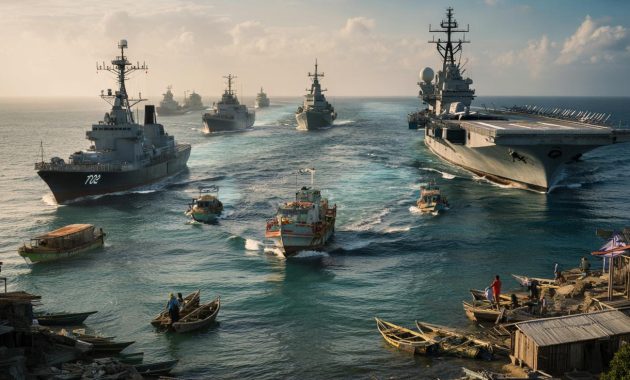
The first hint that something was off wasn’t on a radar screen. It was the way the fishermen talked. In a small harbor in the northern Philippines this week, men mending their nets kept pausing, lifting their heads toward the horizon, counting the distant silhouettes of gray hulls where there should only be tankers and cargo ships. One of them, a man in faded shorts and flip-flops, lifted a chipped mug of coffee and nodded toward the sea: “They’re closer.”
Out there, beyond the visible line, a Chinese naval flotilla was sliding into contested waters, while a US carrier strike group closed the distance from the other side of the Pacific. Two powers, two narratives, one tight stretch of sea.
The map hasn’t changed, but the mood has.
Warships where fishing boats used to be
At dawn, the South China Sea used to be a place of quiet engines and shouted jokes between fishing crews. This week, the soundtrack is different: the thrum of warship turbines, the chop of helicopter rotors, the high-pitched whine of drones circling overhead. Screens on bridges glow with colored tracks: Chinese destroyers and frigates pushing deeper into waters claimed by several countries, as the US aircraft carrier USS Ronald Reagan steams closer from the east.
On satellite images, the scene looks almost abstract. Lines of ships, precise as stitches, moving across a blue canvas. On the water, it feels like a crowd in a narrow hallway.
One Filipino coast guard officer, speaking over a crackling radio, described the moment he first saw the latest Chinese formation. Several People’s Liberation Army Navy vessels appeared on his display, accompanied by what he called “shadow ships”: large coast guard cutters and so-called maritime militia boats, trawlers that seldom seem to fish. A few hours later, tracking sites showed a familiar American outline moving closer: the flat-topped bulk of a Nimitz-class carrier, ringed by cruisers and destroyers.
In nearby coastal towns, people pass phones around, scrolling through marine traffic apps as if watching a live sports match. The numbers on the screens are cold: distances, knots, coordinates. The conversations are not. Parents talk about sons working on merchant ships. Fishermen swap rumors about new “no-go” zones. Every mile the fleets advance feels personal on shore.
What’s happening is part of a pattern years in the making. China claims almost the entire South China Sea through its “nine-dash line,” a sweeping boundary rejected by an international tribunal in 2016 but enforced at sea with metal and muscle. The US, citing freedom of navigation, responds with its own patrols and high-profile transits.
Each time a Chinese fleet pushes into contested waters and a US carrier moves nearby, both governments talk about routine operations and defensive intent. Yet the geometry of risk tightens. Warships crowd into chokepoints, aircraft fly closer, radio exchanges get sharper. *The danger isn’t a declared war; it’s a miscalculation at 30 knots and 600 miles per hour.*
How close is “too close” at sea?
Navies have a choreography, even in tense waters. Commanders talk quietly about “deconfliction,” about giving each other just enough room to maneuver without losing face. In this latest standoff, Chinese ships are reported to be operating in layered screens: outer rings of auxiliary vessels and coast guard cutters, inner circles of missile destroyers and frigates. The US carrier group, by contrast, keeps a larger protective bubble, using aircraft as a forward guard.
➡️ The winter accessory no one remembers to wash, and it’s not clothes or sheets
➡️ When an oral infection sneaks into cancer development
➡️ “I’m a freelance bookkeeper earning $5,100 per month working from home”
➡️ The French Rafale could soon be technically outclassed by a new Asian fifth-generation rival
Out on the bridges, junior officers practice the same ritual: binoculars raised, bearings called out, distances checked. One degree off course can be the difference between a tense pass and a collision.
People often imagine this as a neat chess game. It isn’t. A Chinese frigate can surge forward unexpectedly to “inspect” a foreign ship. A US destroyer can choose a straighter line through disputed waters to underline a legal point. Small coast guard boats, some less than 50 meters long, can cut in front of vessels ten times their size to “assert jurisdiction.” We’ve all been there, that moment when two cars enter the same narrow street and no one wants to be the one to back up first.
Now imagine those cars are bristling with missiles and watched live by millions on social media. That’s roughly where we are.
Analysts warn that the real trigger might not be a big carrier or a flagship destroyer, but a smaller, seemingly minor incident that spins out of control. A water cannon burst that blinds a bridge crew. A drone buzzing too close to a radar mast. A pilot misjudging distance during a “professional intercept” and clipping a wingtip. The logic of deterrence says both Beijing and Washington want to avoid open conflict.
Let’s be honest: nobody really runs daily life planning for a naval clash over a half-submerged reef. Yet the repetition of these encounters changes the baseline. What was once shocking becomes “normal.” The more normal it feels, the thinner the margin for one bad day.
What this really means for people far from the sea
Somewhere in a logistics office in Singapore, a shipping manager is already redrawing routes on a screen. When a Chinese fleet moves into contested waters and a US carrier approaches, cargo lines start calculating risk premiums. They ask simple, cold questions: How likely is a temporary exclusion zone? A sudden military exercise? A spike in insurance costs if a missile test is announced on short notice?
Their response is almost invisible to the general public: containers shifted to alternate ports, fuel reserves repositioned, delivery windows stretched. The tension at sea quietly seeps into warehouse schedules and factory inventories.
For ordinary people, the first tangible sign of these distant maneuvers is rarely a headline about destroyers. It’s a delay notice. A phone that takes longer to arrive. A car plant temporarily shut down waiting for a batch of parts stuck on a ship that detoured an extra 500 miles to stay clear of a declared exercise zone.
The emotional trap is to either shrug and say “too far away” or spiral into anxiety at every notification. Most people oscillate between the two. The trick is to stay informed without absorbing every worst-case scenario. That means checking reliable sources, not viral maps stripped of context, and remembering that behind each dramatic frame there are professionals whose main job is to avoid crossing the line.
“Escalation at sea is rarely about a single ship,” one retired Pacific Fleet officer told me by phone. “It’s about a chain of decisions, from a captain on a bridge up to leaders in capital cities, and back down through the orders they send. The danger climbs when those chains stop talking to each other, even informally.”
He then laid out, almost like a shopping list, what people should watch over the next days:
- Flight patterns – Are military aircraft flying closer, more often, or with their transponders off?
- Public language – Do official statements soften, stay flat, or shift into sharper, nationalist tones?
- Sea space closures – Are “temporary exercise zones” getting larger or drifting closer to major shipping lanes?
- Allied activity – Do regional navies start shadowing more openly or conducting joint drills nearby?
- On-the-ground disruption – Are ports reporting delays, inspections, or unexplained slowdowns?
These aren’t predictions of doom. They’re early signals in a story still being written.
A narrow sea, a crowded century
Seen from far away, the Chinese fleet’s push into contested waters and the US carrier’s approach look like just another loop in an endless news cycle. Yet each iteration leaves a trace. Coastal communities adjust their routines. Governments tweak defense plans. Shipping giants refine emergency playbooks. Over time, the region’s “normal” becomes something our grandparents would barely recognize.
The plain-truth sentence nobody likes to say out loud is that great-power competition has already moved from think-tank papers to real waves and real wakes. You can trace it in AIS ship tracks, in defense budgets, in the wary glances of fishermen who now share their grounds with gray hulls and spinning radars.
On the Chinese side, officials speak of historical rights and national rejuvenation, anchoring steel in a narrative of destiny. On the American side, admirals talk about open sea lanes and alliances, casting the carrier as a moving symbol of rules and commitments. In between sit smaller nations whose coast guards are outgunned but stubborn, whose harbors hold both fear and pride. Their decisions — to file protests, to escort, to film and publish — add small but real weights to the scales.
*What happens next will not depend on one dramatic gesture, but on a thousand quiet choices by people whose names you’ll never read.* Somewhere tonight, a watch officer will decide whether to radio back a sharp reply or a clipped, neutral acknowledgment. A pilot will decide how close to fly. A minister will decide if a phrase in a speech should be toned down, or not.
There’s room, still, for de-escalation. Western and Chinese officers who once trained together compare notes quietly over encrypted chats. Regional diplomats, weary but persistent, keep pushing for hotlines, codes of conduct, anything that might slow the speed of a mistake. Citizens scroll their feeds, share satellite images, argue about who is right, but also send money to cousins working at sea.
None of that guarantees calm. It does mean this story isn’t locked. The same waters that now host destroyers and carriers also hold fishing boats, ferries, and container ships that knit everyday life together across the region. Whether the future feels more like a shipping lane or a minefield will depend on how these days play out — and on whether the people steering the largest ships remember how small the horizon looks from shore.
| Key point | Detail | Value for the reader |
|---|---|---|
| Chinese fleet advance | Warships, coast guard, and militia vessels moving deeper into contested South China Sea zones | Helps you grasp how Beijing asserts power beyond official maps |
| US carrier approach | Carrier strike group closing in under “freedom of navigation” language | Shows how Washington signals commitment without firing a shot |
| Everyday impact | Shipping detours, supply-chain jitters, and local tensions onshore | Connects distant naval maneuvers to your own prices, deliveries, and sense of security |
FAQ:
- Is this the start of a war between China and the US?Not automatically. Both governments have strong incentives to avoid open conflict, but the risk of an accident or miscalculation rises as forces operate closer together.
- Why are these waters considered “contested”?China’s sweeping nine-dash-line claim overlaps with the exclusive economic zones of several Southeast Asian countries and clashes with international tribunal rulings.
- What is the US aircraft carrier actually doing there?The US presents these deployments as routine patrols and freedom-of-navigation operations, meant to show allies and rivals that key sea lanes stay open.
- How could this affect global trade and prices?If tensions trigger wider military drills or temporary exclusion zones, shipping routes can lengthen, insurance costs can rise, and delays can ripple into higher prices.
- What should I watch for in the coming days?Look for changes in official language, reports of near-collisions or aggressive intercepts, and any signs that regional allies are joining or avoiding the area.