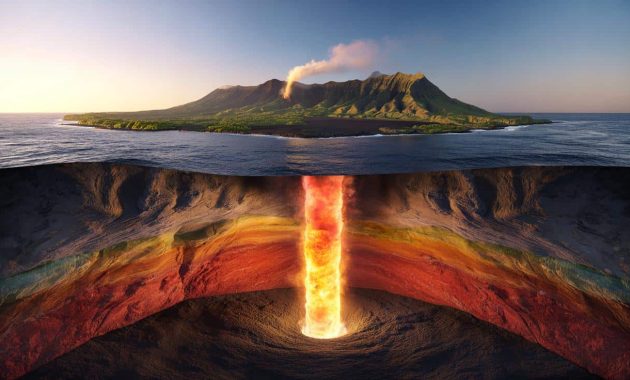
Scientists now think this hidden giant, sitting near Earth’s core, could be the missing piece that explains why the Hawaiian hot spot has stayed put for tens of millions of years while tectonic plates glide above it.
A mysterious structure at the edge of Earth’s core
For decades, seismologists have picked up odd signals from the boundary between Earth’s mantle and its liquid outer core, about 2,900 kilometres down. In certain patches, earthquake waves slow almost dramatically, hinting at unusual material. These areas are known as ULVZs, for “ultra-low velocity zones.”
One of the most striking ULVZs lies beneath Hawaii. It stretches more than 1,000 kilometres across and reaches up to 40 kilometres in thickness, making it a genuine behemoth compared with similar features elsewhere. Researchers now refer to it as a “mega-ULVZ.”
By combining data from many large earthquakes, a team from the Carnegie Institution for Science, Imperial College London and Seoul National University has produced one of the sharpest images yet of this buried block. They used different types of seismic waves – compressional P waves and shear S waves – and merged several tomography techniques to build a 3D model of the structure.
The mega-ULVZ under Hawaii appears as a broad, unusually slow and dense patch right where the mantle meets the outer core.
Its position is striking: it sits directly below the Hawaiian hot spot, the upwelling of hot rock that has fuelled eruptions across the archipelago for at least 70 million years. That alignment suggests this patch of deep rock is not just a bystander, but an active player in shaping Hawaii’s volcanism.
A solid, iron-rich “mega-blob,” not a pocket of magma
For years, many geophysicists suspected ULVZs might be partially molten regions, basically pools of very hot, squishy mantle rock. The new study pushes back firmly against that idea for the Hawaiian mega-ULVZ.
By analysing how much S waves slow compared with P waves, the researchers calculated a key ratio known as RS/P. In Hawaii’s case, that ratio ranges between 1.0 and 1.3, which fits best with a solid material enriched in iron, not a region dominated by melt.
To match the seismic data, the team proposes that the mega-ULVZ is made mostly of magnesiowüstite, a high-pressure mineral with the formula (Mg,Fe)O. This phase contains a large share of iron and can stay stable under the enormous pressures at the core–mantle boundary.
➡️ Astrology experts say this week is ideal for releasing guilt and rewriting your personal narrative
➡️ Many people don’t realise it, but cauliflower, broccoli and cabbage are varieties of the same plant
➡️ Spraying vinegar at your front door: What it does and why people swear by it
➡️ The truth remote work is great for parents and disastrous for everyone else
➡️ US Army Gets New AI-Driven Counter-Drone Tech for Border Protection
The deep structure under Hawaii is thought to be fully solid, exceptionally dense and packed with more than 20% iron oxide by volume.
That iron content is far higher than in the surrounding lower mantle. The difference suggests the mega-ULVZ has a distinct chemical identity – almost a separate “reservoir” of material that did not mix thoroughly with the rest of Earth’s interior.
This view challenges previous models in which ULVZs were seen mainly as leftovers of partial melting. Instead, the Hawaiian block looks like an ancient, chemically unusual body that has survived deep inside the planet for billions of years.
How a buried block can stabilise a hot spot
So how does a dense, solid block 2,900 kilometres down end up shaping volcanoes at the surface?
The answer lies in how heat moves through Earth’s interior. The iron-rich minerals making up the mega-ULVZ are thought to conduct heat better than the surrounding silicate rocks. That turns the block into a kind of thermal shortcut connecting the outer core and the overlying mantle.
By focusing and channelling heat from the core, the mega-ULVZ may help generate and stabilise a powerful mantle plume beneath Hawaii.
A mantle plume is a roughly column-shaped rise of hot, buoyant rock that creeps upwards from the base of the mantle. When it reaches the rigid lithosphere near the surface, it can cause intense melting and build volcanic islands. As the overlying tectonic plate moves, a chain of volcanoes forms – exactly what is seen from the Big Island of Hawaii to older, eroded seamounts trailing off into the Pacific.
The new research suggests the mega-ULVZ acts in at least two ways:
- as a thermal lens, concentrating core heat into a narrower region;
- as a dense “anchor,” slowing local mantle flow and helping the plume stay locked in place.
This could explain why the Hawaiian hot spot appears relatively fixed over tens of millions of years, while other volcanic chains may show more wobble or drift. The plume has a stable, heat-rich base fed by this deep iron block.
Ancient origins: leftovers from Earth’s early days?
Where did such an odd, iron-rich structure come from in the first place? Researchers are weighing a few main scenarios, based on mineral physics and models of how Earth cooled.
| Proposed origin | Key idea | What it would imply |
|---|---|---|
| Primordial magma ocean residue | Dense iron-rich crystals sank to the bottom when an early global magma ocean solidified. | The mega-ULVZ preserves chemical signatures from over 4 billion years ago. |
| Ancient subducted oceanic crust | Old oceanic plates sank deep into the mantle and released iron-rich components. | The block records a long history of plate tectonics and recycling. |
Both explanations share one theme: parts of the lower mantle may have stayed chemically distinct for an astonishingly long time. If that is true, the Hawaiian mega-ULVZ is not just a curiosity linked to one hot spot, but a rare survivor from Earth’s formative period.
Other ULVZs beneath Samoa and parts of the South Atlantic might be similar structures, each quietly steering mantle plumes and shaping surface volcanism above them.
What this means for our picture of Earth’s interior
The study deepens the link between what happens on the surface – lava flows, island building, volcanic hazards – and what happens far beyond any direct observation.
Hot spots like Hawaii have puzzled geologists because they do not follow plate boundaries, unlike most volcanoes around the Pacific “Ring of Fire.” If mega-ULVZs help lock mantle plumes in place, they could form the hidden infrastructure behind a whole family of intraplate volcanoes.
The stability of hot spots may be set not just by mantle flow, but by buried iron-rich blocks that act as long-term heat engines.
For planetary scientists, this has wider implications. It suggests Earth’s deep interior is not uniform but strongly layered in both composition and temperature. Those layers can influence the magnetic field, the way heat leaks out of the core and even how quickly the planet cools over geological time.
Key terms that help make sense of the deep Earth
Several technical terms underpin this story and help frame what the researchers are actually measuring:
- Seismic waves: vibrations generated by earthquakes that travel through Earth and change speed depending on the materials they cross. They are the only direct probe of the deep interior.
- Core–mantle boundary: the interface between the solid lower mantle and the liquid outer core, around 2,900 kilometres deep, where large temperature and composition contrasts occur.
- Mantle plume: a long-lived upwelling of hot mantle rock rising from near the core–mantle boundary, often linked to persistent hot spots.
- ULVZ: a region at the base of the mantle where seismic waves slow dramatically, indicating unusual properties such as high iron content, partial melt or both.
Future simulations will likely test how different shapes and compositions of ULVZs affect plume behaviour. For example, one scenario is that if the mega-ULVZ thinned or shifted over millions of years, the Hawaiian hot spot could weaken or migrate, changing the pattern of volcanism in the Pacific basin.
There are wider stakes too. If similar iron-rich blocks underlie other hot spots, they might modulate how heat escapes from the core on a global scale. That could subtly influence long-term changes in the geodynamo – the process that generates Earth’s magnetic field – and therefore feed into models of radiation shielding and habitability over deep time.