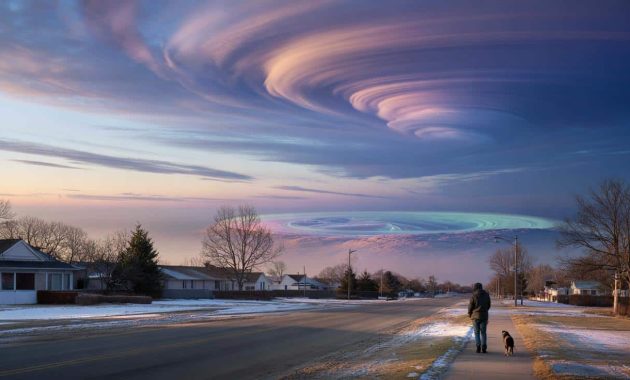
The first hint that something was off didn’t come from a satellite map. It came from a dog walk.
One of those too-bright February afternoons, the kind where the sun feels oddly high and the air can’t decide if it’s freezing or soft. Your phone buzzes in your pocket, and you glance down: “Bombshell Polar Vortex Event Incoming” screams a notification, layered over a radar image bathed in neon purple.
You stop, mitten halfway off, scrolling through a feed that shifts from scientific threads to TikToks of people taping their windows and stocking up on generators.
A rare, powerful disruption of the polar vortex is indeed building over the Arctic.
Yet the people who study it for a living are quietly repeating the same thing: this year’s event is both **exceptionally strong**… and dangerously overhyped.
What’s really happening above our heads right now
High above our heads, at about 30 kilometers up, the atmosphere is having a full-on mood swing.
Meteorologists call it a “sudden stratospheric warming” – a rapid temperature spike that can tear the usually tight polar vortex into pieces. This February, that warming is unfolding faster and more intensely than we typically see, jolting the stratosphere by tens of degrees in just a few days.
That’s why you’re seeing those swirling graphics of pinks and reds over the North Pole.
On the maps, it looks dramatic enough to feel like the plot of a disaster movie.
On the ground, the story is slower, messier, and far less certain.
Think back to February 2021 in Texas, when pipes exploded and millions plunged into darkness.
That event was linked to a disrupted polar vortex that allowed bitter Arctic air to plunge far south for days, knocking into an already fragile power system. People standing in line for water didn’t care about stratospheric temperature anomalies; they cared that their kids were sleeping in winter coats.
This year’s disruption is, by some measures, even stronger in the stratosphere. Models show the vortex stretching and contorting more dramatically than usual, like a spinning top wobbling just before it falls.
Yet that doesn’t automatically mean a repeat of 2021, or a coast-to-coast deep freeze.
The same kind of disruption in 2019 brought weeks of brutal cold for parts of the Midwest and East Coast, while other regions barely blinked.
Here’s the knot: the stratosphere isn’t the weather, it’s the steering wheel.
A powerful jolt up there can set the stage for colder outbreaks a couple of weeks later, but the exact script depends on how that disrupted energy trickles down through layers of the atmosphere. Winds can realign, high-pressure “blocks” can form, or the chaos can simply get absorbed and smoothed out before it reaches your backyard.
Scientists are tracking this event because it helps them test long-standing theories about how a warming planet might be changing these extremes.
At the same time, they’re wincing at headlines that sound like a Netflix trailer.
The truth lives in the gap between those two things.
How to read the hype without losing your mind (or your hat)
The most practical skill right now isn’t memorizing the definition of the polar vortex.
It’s learning how to read the next viral weather post like a skeptical editor. When you see “historic” and “unprecedented” next to “next week,” pause. Step one: check the time scale. Stratospheric disruptions like this often take 10 to 20 days to meaningfully affect surface weather, if they do at all.
Step two: look for geography. Are we talking about the entire Northern Hemisphere, or a specific corridor from the Plains through the Northeast?
Vague maps with dramatic colors and fuzzy borders are click magnets, not forecasts.
*If a graphic doesn’t clearly show dates and regions, treat it like background noise, not a plan of action.*
➡️ Satellites detect titanic 35?metre waves in the middle of the Pacific
➡️ The date is set: the longest solar eclipse of the century will turn day into night
➡️ The small evening habit that reduces next-day stress, according to psychologists
➡️ The simple reason some rooms echo more than others
We’ve all been there, that moment when you empty the supermarket shelf of batteries because a single tweet said “grid failure possible.”
The emotional trap with a phrase like “exceptionally strong polar vortex disruption” is that it sounds like both science and doom in the same breath. That’s where the big mistake happens: reacting to the vibe, not the details.
Let’s be honest: nobody really cross-checks every scary weather headline with a full forecast discussion every single day.
So give yourself an easier rule. If a post warns of “record cold” or “Arctic outbreak” but doesn’t name a reputable source – a national meteorological service, a known forecast center, or a named meteorologist – slide your thumb right past it.
Save the anxiety for information, not speculation.
Meteorologists watching this disruption are being unusually blunt this year.
They know it’s strong, rare, and scientifically fascinating.
They also know how fast it’s being turned into apocalypse content.
“From a stratospheric perspective, this is a major event,” one climate scientist told me. “From a day-to-day weather perspective, there’s still a wide range of outcomes, and some of them are pretty ordinary. The danger isn’t just cold – it’s people overreacting to noise and then ignoring us when real risks show up.”
- Follow a small set of trusted sources, not every viral thread.
- Look for clear timelines: “next 5–10 days” versus vague “coming weeks.”
- Distinguish between “potential pattern change” and “guaranteed deep freeze.”
- Prepare like it’s a regular late-winter cold snap, not the end of the world.
- Use hype as a nudge to check your basics: coats, car, pipes, neighbors.
When climate anxiety meets clickbait weather
There’s a strange emotional cocktail in the air this February.
Long-term climate signals say winters are warming on average, snow seasons shrinking, ice retreating. Yet here we are talking about intense cold, Arctic outbreaks, and a “shredded” polar vortex. Both can be true at the same time. A warmer background climate doesn’t erase extremes; it can actually bend them into new shapes.
What’s changing fast is not just the atmosphere, but the way we talk about it.
Every winter wobble now competes for attention alongside wildfires and heat domes.
That’s why this year’s vortex disruption feels like a test of our information reflexes as much as of our power grids.
| Key point | Detail | Value for the reader |
|---|---|---|
| Strong but uncertain | This February’s polar vortex disruption is objectively intense in the stratosphere, yet its surface impacts remain highly variable. | Helps you stay alert without assuming a guaranteed disaster. |
| Signal vs. noise | Overhyped headlines often skip timelines, regions, and probabilities, turning complex science into fear fuel. | Gives you a filter to decide which forecasts to trust and which to scroll past. |
| Practical calm | Preparing for regular late-winter hazards still covers most plausible outcomes of this event. | Reduces anxiety while keeping you realistically ready for cold snaps. |
FAQ:
- Question 1Is this polar vortex disruption really “historic”?
Some metrics in the stratosphere are near record levels, so scientists aren’t exaggerating the strength aloft. What’s overblown is the leap from “historic upstairs” to “guaranteed disaster at the surface.”- Question 2Does a disrupted polar vortex always mean extreme cold where I live?
No. It increases the odds of colder outbreaks in some mid-latitude regions, but the exact placement depends on how the jet stream rearranges over the next couple of weeks.- Question 3When will we know if this will actually hit my area hard?
Forecasters usually gain clearer confidence 5–10 days ahead of specific cold waves. That’s the window to watch local forecasts closely, not every early whisper weeks out.- Question 4Is climate change making polar vortex disruptions more common?
The research is still debated. Some studies suggest Arctic warming may destabilize the vortex more often, others find weaker or mixed signals. The science is evolving, not settled.- Question 5What’s the most sensible thing to do right now?
Treat it like a nudge to check normal winter readiness: warm clothing, home insulation basics, a simple car kit, and a plan to check on vulnerable neighbors if a real cold shot is confirmed.