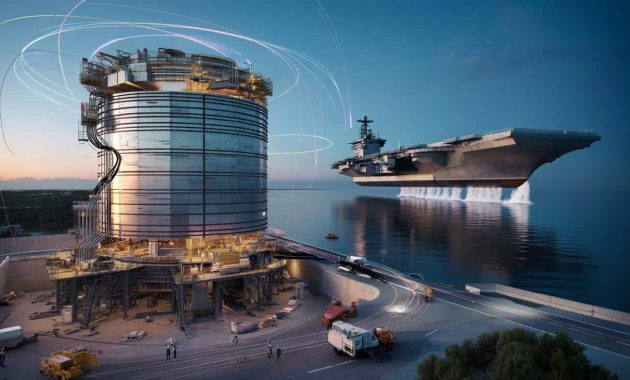
Hidden behind layers of concrete and security gates near Cadarache, this vast machine is not aimed at defence or spectacle. Its target is something far more ambitious: turning nuclear fusion – the reaction that powers the stars – into a controllable, everyday source of electricity on Earth.
A giant magnet that rewrites the limits of engineering
At the heart of the ITER site, the new central solenoid stands like a metal skyscraper laid on its side. It is 18 metres tall, weighs about 1,000 tonnes, and generates a magnetic field of 13 teslas – some 280,000 times stronger than Earth’s natural magnetic field.
This single magnet is so powerful that, on paper, its magnetic force could lift an aircraft carrier clear of the ocean.
The comparison is mostly symbolic, of course. No one plans to use the solenoid as a giant crane. What matters is its control over electrically charged particles. Inside ITER’s doughnut-shaped reactor, called a tokamak, the solenoid will drive immense electric currents through a swirling cloud of superheated gas, turning it into plasma and steering it with microscopic precision.
The scale is hard to grasp. Each of the stacked modules that form the solenoid weighs roughly as much as a passenger jet. Engineers had to align them to within a few millimetres, despite the structure’s height and mass. Any misalignment could distort the magnetic field and destabilise the plasma.
Why fusion needs such a monster magnet
Fusion is often described as the opposite of the nuclear fission used in current reactors. Instead of splitting heavy atoms like uranium, fusion joins light atoms, such as isotopes of hydrogen, to form helium and release energy.
To do that, the fuel must reach temperatures of over 100 million degrees Celsius – hotter than the core of the Sun. No solid material can contain such heat. Only magnetic fields can hold the plasma in place while keeping it away from the reactor walls.
The central solenoid is essentially the “starter motor” and stabiliser of the fusion reaction, both igniting the plasma and keeping it in check.
ITER’s design relies on a complex set of superconducting magnets working together. The solenoid induces strong currents in the plasma. Other magnets shape and compress it. If everything works, the plasma becomes dense and hot enough for atomic nuclei to fuse and release huge amounts of energy.
➡️ Light fast apple cake made with oil and yogurt for effortless desserts
➡️ Country in turmoil as government plans to tax parents for adult children still living at home
➡️ Neither shampoo nor chemicals: how rye flour can change your hair care routine forever
➡️ This is the easiest way to keep countertops clean longer
➡️ Restoring sight without major surgery : how a clear gel is reshaping damaged eyes
➡️ Goodbye fines: here are the new official speed camera tolerances drivers need to know
➡️ How bananas can stay fresh and yellow for up to two weeks when stored with one simple household item
How the central solenoid actually works
The solenoid is a superconducting magnet, meaning its coils carry electrical current with virtually no resistance when cooled to extremely low temperatures. That allows it to generate colossal magnetic fields without melting itself in the process.
To do this, ITER uses special cables made from niobium-tin, a brittle material that turns superconducting when cooled with liquid helium to around -269°C. These cables are wound into tightly packed coils, then encased in strong steel structures to withstand the intense forces they produce.
- Operating field: 13 teslas
- Length: ~18 m
- Mass: ~1,000 tonnes
- Magnetic force: equivalent to lifting an aircraft carrier (theoretical comparison)
- Temperature of coils: close to absolute zero
All this sits just a few metres away from plasma hotter than the Sun, separated by layers of cooling systems, vacuum spaces and shielding. On one side, near-absolute zero. On the other, hundreds of millions of degrees. The engineering challenge is staggering.
A global project quietly reshaping energy politics
Although the reactor is in France, ITER is not a French project in the narrow sense. Thirty-five nations, including members of the EU, the UK, the US, China, India, Japan and Russia, are partners in the scheme.
The central solenoid itself was manufactured by General Atomics in the United States. Its modules then made a slow, heavily guarded journey across the Atlantic and through French roads specially adapted for oversized convoys. Every bend and roundabout had to be measured in advance.
The magnet is a physical symbol of a rare thing in geopolitics: rival powers pooling money and expertise to tackle a shared energy problem.
The logic is straightforward. If fusion works as promised, it could weaken the grip of fossil fuels, shift the balance of power away from resource-rich states, and give countries a more predictable and independent energy base.
From experiment to energy system
ITER is not designed to feed the grid. Its task is to show that fusion can work on a large scale, producing more energy than it consumes for long periods. If it hits its targets, later reactors – sometimes called DEMO plants – would follow, built specifically to generate electricity.
Current plans suggest that these commercial-scale fusion plants might appear in the second half of this century. The timeline depends on funding, politics and how many surprises emerge once ITER starts full-power tests.
Why fusion is being sold as “the energy of the future”
Fans of fusion often make big claims, and some are grounded in physics rather than hype. Fusion fuel is based on forms of hydrogen. Deuterium can be extracted from seawater; tritium can be bred from lithium inside the reactor. Both are far more common than uranium or fossil fuels.
Fusion does create radioactive materials, but mainly in the reactor structure itself, and for a much shorter time than in fission waste. There is no chain reaction that can run away, so the risk of a meltdown-style accident is much lower. Turn off the magnets, and the plasma disperses.
If fusion becomes economically competitive, it could slash greenhouse gas emissions while providing steady, around-the-clock power without relying on sunshine or wind.
That makes it an attractive partner for renewables. A country with a mix of solar, wind, batteries and a handful of fusion plants could, in theory, keep its grid stable with minimal fossil backup.
The long list of challenges still ahead
The new magnet is a crucial milestone, but not a magic switch. ITER still faces multiple hurdles before anyone can claim victory for fusion.
| Challenge | Why it matters |
|---|---|
| Plasma stability | Instabilities can make the plasma wobble or crash, halting fusion and stressing the machine. |
| Materials resilience | Reactor walls must survive years of intense neutron bombardment without crumbling. |
| Cost and complexity | Superconducting magnets, cryogenics and vacuum systems push construction and maintenance costs up. |
| Tritium supply | Future plants must reliably breed enough tritium fuel inside their own walls. |
| Public acceptance | Any “nuclear” label brings fears and regulatory scrutiny, even with lower risks. |
Key terms readers keep hearing
What “tokamak” really means
A tokamak is a magnetic bottle shaped like a doughnut. Plasma circulates inside this ring while magnets squeeze and twist it. The term comes from a Russian acronym describing a toroidal chamber with magnetic coils.
Other fusion concepts exist – such as stellarators or laser-driven fusion – but tokamaks remain the most mature path toward large-scale power generation. ITER is currently the flagship tokamak experiment on the planet.
Superconductors, explained without the jargon
In ordinary wires, electrons bump into atoms and lose energy as heat. Superconductors avoid this. When cooled below a critical temperature, their electrical resistance collapses to almost zero. Current flows freely with minimal energy loss.
For a magnet like ITER’s central solenoid, that means it can run enormous currents continuously without melting. The trade-off is that the coils must sit in industrial freezers fed with liquid helium, one of the coldest environments engineered by humans.
What this could mean for ordinary life
Imagine a future where a handful of fusion plants quietly power a country’s industry, hospitals, trains and data centres. Petrol demand shrinks. Gas boilers for heating are replaced by electric systems. Power prices stabilise because fuel costs are tiny and predictable.
In that scenario, energy security stops being about oil tankers and gas pipelines. Instead, it hinges on high-tech supply chains for superconductors, cryogenic systems and robotics. Nations that lead on advanced manufacturing, not just raw resources, gain influence.
There are still risks. A rush to fusion could distract from faster, cheaper climate solutions such as renewables, efficiency and storage. Overpromising also undermines trust if deadlines slip, as they frequently have in fusion research.
Yet the magnet now humming away in southern France shows that at least one piece of the puzzle is real, heavy and already bolted into place. Its invisible force, powerful enough to lift a ship, is being aimed not at war, but at the physics of starlight – and, potentially, at reshaping how humanity powers almost everything it does.