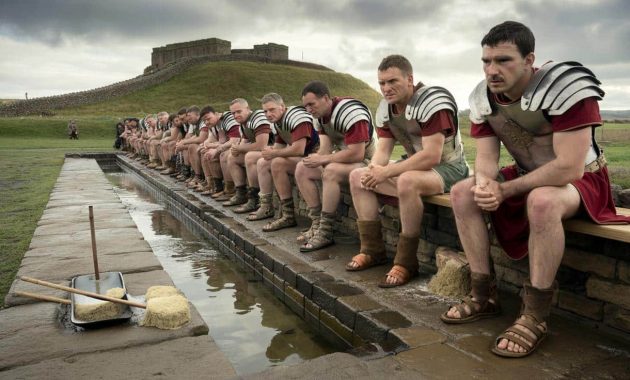
The wind at Housesteads Fort bites straight through your coat, even on a supposedly mild day. You stand where Roman soldiers once queued, shuffling and joking, above a long stone channel that used to be their communal toilet. Today it’s silent, just moss on the stones and the hiss of the grass, but the ground is still full of stories. Not glorious ones about heroes and emperors. Messy, intimate, bodily stories.
Archaeologists have been back to these latrines along Hadrian’s Wall with microscopes and sieves, re-examining soil from the drains and ditches. What they’ve found is less “invincible empire” and more “constant stomach pain”.
Because inside those ancient toilets, a very different picture of Roman military life is coming into focus.
What Roman toilets along Hadrian’s Wall are suddenly telling us
From the outside, Hadrian’s Wall still looks tough and uncompromising. A stone line across northern Britain, built to keep out enemies and project calm Roman control. Yet just a few steps away from the barrack blocks, the latrines tell another story, and it smells of discomfort. Inside the soil, preserved by cold and damp, scientists have found microscopic eggs from gut parasites that once lived inside the soldiers themselves.
Roundworm. Whipworm. Protozoa that cause violent diarrhoea. Tiny, silent proof that life at the edge of the empire meant more time clutching your stomach than Hollywood ever suggests.
One analysis focused on samples taken from the drainage systems beneath communal latrines at several forts along the Wall. Under the microscope, the pattern was startlingly clear. Parasite eggs appeared not as a rare curiosity, but as a dense, repeated carpet in layer after layer of sediment. Roundworm eggs were especially abundant, with some samples so rich that researchers described them as “heavy infestations” by ancient standards.
These weren’t isolated cases from a few unlucky soldiers. This was the microbial signature of an entire garrison living in close quarters, sharing food, water, and the same long stone benches — side by side, no partitions, no privacy, and very little chance to avoid each other’s germs.
The logic behind the findings is brutally simple. Latrines collected human waste from dozens of men every day, then flushed it along stone channels. If those men were infected, their parasites passed through them and straight into the drains, where some eggs were trapped in the sediment. Over time, those layers of sludge became a compact archaeological archive.
When modern researchers sift and stain this material, they’re not just looking at dirt. They’re reading a long, slow record of daily Roman digestion, infection, and hygiene habits. **The overwhelming presence of parasite eggs means gut problems weren’t a side issue in frontier life — they were baked into the routine of soldiering in the north.**
Why elite Roman engineering didn’t save soldiers’ stomachs
Roman forts along Hadrian’s Wall were built with classic engineering pride: aqueduct-style channels, stone-lined drains, and latrines carefully placed near water supplies. On paper, it looks like a health-conscious design. There were sponge sticks for wiping, running water to carry waste away, and strict routines about cleaning the barracks.
➡️ Do it this week: 7 aromatic plants to plant now and enjoy for years
➡️ Psychology explains that rumination increases when the brain lacks emotional closure
➡️ Goodbye to blackened grout: the quick hack, no vinegar or bleach, for a spotless tiled floor
Yet parasite eggs show that all this smart infrastructure failed at the most basic level — breaking the cycle between faeces and food. Even with flowing water and stone seats, the same invisible organisms were going in and out of the same bodies, over and over again.
Part of the problem was how people used these spaces. Communal latrines meant dozens of soldiers sharing the same benches, wiping with reusable sponges rinsed in shared water troughs. Those sponges could easily move parasite eggs from one body to the next. On top of that, sewage systems sometimes overflowed or backed up during heavy rain, contaminating nearby soil.
Imagine soldiers trudging through that mud, then returning to handle bread, stew, and shared drinking cups. Even if the water flowing under the toilets looked clear, tiny eggs could cling to hands, clothing, and wooden utensils. Let’s be honest: nobody really scrubbed their hands with soap for twenty seconds after every visit.
Food storage and cooking habits made things worse. Grain shipped from across the empire sat in damp granaries that attracted rodents and insects. Meat didn’t always cook evenly over open fires, especially when rations were stretched or the weather was brutal. That was enough for some parasites to survive and spread.
So you had a perfect loop: contaminated soil, shared washing tools, questionable cooking, and cramped sleeping quarters where sick men lay inches from healthy ones. *The Wall was strong against tribes from the north, but surprisingly weak against the life forms soldiers couldn’t see.* **This new analysis basically says: Roman discipline stopped at the latrine door.**
How scientists pulled gut parasites out of 1,800‑year‑old toilets
The method behind these discoveries is almost tender in its precision. Researchers collected tiny amounts of sediment from the old drains and latrine pits, being careful not to mix layers from different periods. Back in the lab, they soaked that ancient dirt in water and gently stirred it into suspension, then sieved it again and again to pull out particles of the right size.
What was left looked unremarkable — a thin smear on a glass slide. Under the lens, though, it transformed into a crowded landscape of oval and lemon-shaped parasite eggs, each with a distinct shell and pattern that specialists can recognise like a fingerprint.
Even with practice, the work is slow and a little hypnotic. You move the slide, field by field, counting roundworm, noting whipworm, registering the occasional protozoan cyst. It’s part detective work, part quiet conversation with people long gone. Those numbers then turn into estimates of infection rates, drawn from how many eggs appear in each gram of sediment.
We’ve all been there, that moment when a dry statistic suddenly becomes a person in your mind. A young recruit doubled over during guard duty. A veteran missing out on leave because he can’t stop running to the latrine. Behind every counted egg, a day disrupted.
The scientists who worked on the Hadrian’s Wall samples have been surprisingly candid about the emotional side of this.
“People imagine Roman soldiers as these hard, granite figures,” one researcher told me. “Under the microscope, what you see is that they were just as vulnerable as we are. They had worms. They had diarrhoea. They got weak, missed work, and probably snapped at each other when they felt lousy.”
- Techniques used – Microscopy, flotation, and careful sampling of latrine sediments.
- What was found – High levels of roundworm and whipworm eggs, plus evidence of diarrhoea-causing protozoa.
- Why it matters – It rewrites daily life on Rome’s northern frontier as a constant fight not just against enemies, but against chronic gut trouble.
What these ancient parasites say about us today
The picture that emerges from these latrines is oddly intimate. Behind the heroic inscriptions and monumental stonework, you have thousands of men living with bloating, cramps, irregular bowels, and the low, grinding fatigue that comes from long-term infection. Productivity must have dipped. Tempers probably frayed. Jokes about “Wall belly” or “fort guts” may have circulated in the barracks, half humour, half resignation.
Looking at those parasite eggs, you realise how thin the line is between past and present. We’ve upgraded our toilets, invented antibiotics, and plastered “wash your hands” signs everywhere, yet we still struggle with outbreaks tied to hygiene, water, and crowded living conditions.
| Key point | Detail | Value for the reader |
|---|---|---|
| Roman soldiers were heavily parasitised | Latrine sediments along Hadrian’s Wall are packed with roundworm and whipworm eggs | Helps you see ancient military life as fragile, embodied, and far less heroic than textbooks suggest |
| Engineering didn’t break the infection cycle | Even with stone latrines and running water, shared sponges and poor hygiene spread parasites | Offers a clear reminder that technology without habits and behaviour change rarely solves health problems |
| Modern methods expose hidden histories | Microscopic analysis of ancient toilets reveals daily suffering rarely recorded in texts | Shows how small scientific details can completely shift our understanding of the past |
FAQ:
- Question 1Were all Roman soldiers along Hadrian’s Wall infected with parasites?
- Answer 1The samples suggest very high rates of infection, but not literally everyone. The density of parasite eggs in multiple latrine sites points to widespread, routine exposure across garrisons.
- Question 2Which parasites were most common in the latrines?
- Answer 2Roundworm and whipworm dominate the findings, with some evidence of protozoa that likely caused diarrhoea. These are classic gut parasites spread via the faecal–oral route.
- Question 3Did Roman engineers try to prevent these infections?
- Answer 3They built flowing latrines and drainage systems, which was advanced for the time. Yet shared wiping sponges, limited handwashing, and occasional contamination of soil and water meant parasites still circulated easily.
- Question 4How do scientists identify parasites from 1,800‑year‑old toilets?
- Answer 4They process the sediment, concentrate the organic material, and use microscopes to spot characteristic egg shapes and shells that survive for millennia under the right conditions.
- Question 5What does this change about how we see the Roman army?
- Answer 5It softens the image of unshakeable legions. Behind the armour were bodies constantly challenged by cold, stress, bad food, and gut infections — soldiers doing their jobs while quietly feeling unwell far more often than we imagine.