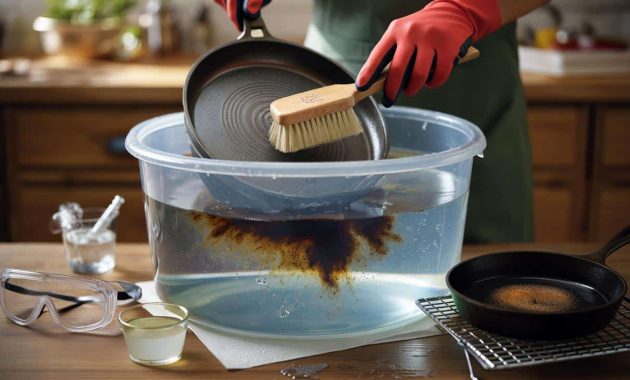
A cast-iron pan can look beyond saving: sticky rim, burnt-on varnish, stubborn gray rust like ash after a campfire. People toss them or hide them in the back of a cupboard. The fix is quieter than a wire wheel and tougher than elbow grease.
A man in a ball cap passed me a skillet that felt like a ship’s anchor, its surface lacquered in decades of cooked-on varnish. He shrugged, said it was “decor, not cookware,” and knocked five bucks off because the handle had a crust like tree bark. I dropped it into a plastic tote behind my car, poured in water, and watched the black turn to tea. The trick wasn’t fire or force.
Why a lost pan isn’t really lost
Cast iron wears its years right on the surface, which tricks the eye. That pebbly, tar-like sheen? It’s not the metal failing, it’s old oil turned to polymer and carbon, a coat that just won’t let go with soap. Underneath, the iron is nearly immortal, waiting for light and heat again. *The pan isn’t dead; it’s waiting.*
I’ve seen pans come from barn rafters, beach houses, church rummage tables. A neighbor, Lena, found a No. 8 griswold welded with crust so thick you could rake it like bark; two days later it rinsed to a satin gray, the maker’s stamp clear as a birth certificate. Another night, a friend soaked three thrift store skillets while we grilled burgers; by Sunday noon, he texted a photo that looked like a museum back room. We’ve all had that moment when a thing seems ruined and then… it isn’t.
Here’s the quiet math. Those black layers are long-chain molecules from fats that have crosslinked and charred with heat over years; water doesn’t touch them, and scrubbing just polishes the top. A strong alkaline bath snaps those chains, turns grease to soap, and floats it off like a stubborn label in warm water. **The metal doesn’t change, only the gunk loses its grip.** Then rust, if any, yields to mild acid, and you rebuild a new, thin, resilient seasoning on clean iron.
The soak that changes everything
The powerhouse method is a lye bath: sodium hydroxide dissolved in water inside a plastic tote with a lid. Add lye to water, never water to lye, and aim for a bath that’s strong but steady—think a handful of beads per gallon, roughly 3–4%. Submerge the pan on a plastic grid so it doesn’t mar the tub, wait 12 to 48 hours for light buildup, or four to seven days for a pan that looks tarred; each morning, brush the softened film with a nylon or brass brush and slip it back under. Rinse when the surface goes evenly gray.
After the lye lifts grease and polymer, a quick 1:1 water and white vinegar dip erases surface rust in minutes. It’s not a long swim, more like a rinse: five minutes, flip, five minutes more, watch for the iron to brighten, then pull it and rinse again. Dry with heat—stovetop low or in a warm oven—so no moisture hides in the pores, then wipe on the thinnest possible coat of neutral oil and bake it hard at 450°F for an hour. Let it cool and repeat twice for a humble, durable sheen that stays.
Common misses are small, human, and fixable. Folks leave a pan in straight vinegar and it pits, or they try the self-cleaning oven and the thermal shock warps what was perfect. Others skip gloves, or dunk an aluminum lid and it fizzes like a science fair volcano. Let’s be honest: nobody really does that every day. Go slow, label your tote, keep pets away, and treat lye like the tool it is—serious, predictable, not scary when respected.
“It’s not ruined. It’s just dirty chemistry,” said a restorer who has brought back more skillets than most people have cooked breakfasts.
In practice, the kit is humble and one-time: a lidded plastic tote, a bag of 100% lye (sold as drain opener), gloves that reach your forearms, and a pair of cheap goggles. **When the job’s done, neutralize a small sample of the bath with vinegar until it stops feeling slippery, then call your local waste guidance before disposal.**
➡️ This aluminum foil trick makes your radiators far more efficient in winter
➡️ Why this beard shape feels masculine without exaggeration
➡️ “I felt more secure after simplifying my financial system”
- Plastic tote with lid, big enough to submerge the pan
- 100% lye beads or flakes, measured for a 3–4% solution
- Long nitrile or neoprene gloves, plus simple goggles
- Nylon or brass brush; no aluminum in the bath
- White vinegar for a short post-lye rust dip
- Stovetop or oven heat to dry the iron fully
- Thin oil and a cloth for two to three seasoning passes
What this changes in your kitchen
There’s a quiet joy in reviving an object that outlived its first owner and might outlive you. A pan that once stuck eggs turns into your weeknight anchor for crispy potatoes and cornbread with a singing crust. The first time you wipe it clean with a dry towel and a splash of heat, you’ll feel like you got away with something.
It also shifts how you shop and cook. Thrift piles become treasure hunts instead of hazards; friends start texting photos of strange handles and sizes you’ve never seen. You stop babying cast iron and start using it every day—high heat, low heat, oven, grill, campfire—because you know the way back if life gets messy.
There’s a bigger, softer edge here too. Restoring a pan is a way of staying in the story, of choosing repair over replacement. **A soak, a rinse, some heat, and patience—that’s the whole arc.** The next time you see a skillet mottled like a moon rock, you may feel your hands itch, not to hide it, but to bring it home and watch the surface clear like a window after rain.
| Point clé | Détail | Intérêt pour le lecteur |
|---|---|---|
| Lye soak strips decades of buildup | 3–4% sodium hydroxide solution in a plastic tote, 1–7 days | Minimal scrubbing, preserves the iron, repeatable at home |
| Short vinegar dip removes rust | 1:1 water-vinegar for 5–10 minutes per side after lye | Fast rust removal without pitting, even surface for seasoning |
| Thin, hot seasoning rebuilds nonstick | Three ultra-thin coats of neutral oil at 450°F, 60 minutes each | Durable, slick surface that’s easy to maintain and cook on |
FAQ :
- Can I revive cast iron without lye?You can use oven cleaner in a bag or an electrolysis setup, and they work. For pure soaking with simple gear, lye is the most straightforward.
- Will lye damage the pan?No. Lye attacks grease and old polymer but leaves iron alone. Rinse well and follow with a brief vinegar dip if rust appears.
- How long should I soak?Light buildup often lifts in 12–48 hours; heavy, tar-like layers may need up to a week. Check daily and brush the loosened film.
- What oil should I use to season?Grapeseed, canola, or sunflower work well because they’re light and form hard films. Go thin—nearly dry—and bake it hot.
- Is the self-cleaning oven a shortcut?Skip it. The heat can warp pans and crack handles. The soak is calmer, safer, and gives a more even reset.