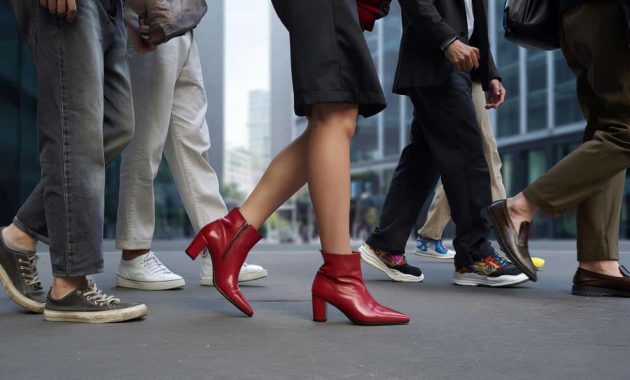
The first thing you noticed wasn’t her face.
It was the way her red boots hit the pavement outside the office, a tiny, defiant drumbeat on an otherwise gray Tuesday morning. The rest of her outfit was simple, almost quiet. But those boots? They announced themselves before she even said hello.
As she walked past the glass doors, a guy in worn-out sneakers shuffled by, eyes on the floor, laces frayed, soles half gone. Same city, same weather, completely different story at ground level.
Psychologists say that story isn’t random at all.
Your shoes are talking long before you open your mouth.
What psychology really sees when it looks at your shoes
A few years ago, a group of psychologists did something a bit sneaky.
They asked people to send photos of the shoes they wore most often, then tried to guess things like age, income, anxiety level, and even how extroverted they were.
The results were unsettlingly accurate.
From a single pair of shoes, strangers could predict things like whether someone was emotionally stable, how open they were to new experiences, and how worried they were about what others think.
Not perfectly, of course, but well enough to suggest that our shoe choices follow patterns we don’t fully see.
Picture a crowded café.
Near the window, a woman in spotless white sneakers, minimal but clearly expensive, leans over her laptop. Not far away, a guy in beat-up skate shoes taps his leg to the music, coffee ring on his notebook, attitude loose and unbothered.
Now imagine pausing that scene and asking ten people: who is more detail-oriented, who is more laid-back, who cares more about social approval?
Most people would give similar answers, and research shows they wouldn’t be guessing entirely at random. Clean, well-kept shoes tend to be linked with conscientiousness. Quirky, colorful shoes? Often worn by more extroverted or creative personalities.
We read these cues even when we swear we “don’t judge”.
Psychology explains this with a simple idea: shoes are both protection and performance.
They keep us physically safe, yes, but they also broadcast our taste, our status, and our comfort with being seen.
People with higher anxiety often choose safer, more neutral footwear, hunting for something that won’t draw criticism. Those who feel confident in their skin move more easily into bolder colors, thicker soles, unusual shapes.
It’s not about price, it’s about risk.
*Every pair you own is a tiny decision about how much of yourself you’re willing to put on display.*
➡️ This creamy dinner is the kind you come back to quietly
➡️ Starship V3 explodes during tests and slows the race back to the Moon
What your favorite shoes quietly say about your confidence
If you want a surprisingly honest snapshot of your confidence, open your closet and pull out the shoes you actually wear, not the ones waiting for “one day”.
Lay them on the floor in a row. Step back. Look at them like they belong to a stranger.
Are they mostly neutral, practical, almost invisible?
Are they spotless, or do you wear them until the soles nearly give up? Do you own one pair you adore but rarely dare to wear because it “draws too much attention”?
This simple inventory works like a personality test you’ve already been taking for years.
The colors, heights, and conditions of your shoes trace a pretty clear line between comfort, caution, and quiet boldness.
Many people have a “double life” in their shoe rack.
There’s the confident version they bought during a rush of courage: the sharp heels, the chunky boots, the bright loafers that felt like a new version of themselves. And then there’s the default: the flat, shy pair that goes on every rushed morning because it feels safe and familiar.
We’ve all been there, that moment when you put on the daring pair, look in the mirror, then switch back to something less noticeable just before leaving.
That tiny switch is a real-time measurement of confidence. Not the loud kind you post about online, but the everyday courage of taking up a little more space, click by click on the pavement.
Psychologists talk about “enclothed cognition” — the way what you wear changes not only how others see you, but how you feel and behave.
Shoes play a special role, because they affect posture, speed, and sound.
Heels, even low ones, literally lift you. You stand taller, walk slower, assert more presence. Solid, heavy boots ground you, making each step feel deliberate. Flexible sneakers invite movement, spontaneity, last-minute plans.
Your brain registers all of this and adjusts your attitude in real time.
Let’s be honest: nobody really analyzes this every single day.
Yet your body does, automatically. Every walk down the street becomes a quiet negotiation between comfort, style, and courage.
How to use your shoes to gently boost your self-confidence
There’s a simple method if you want your shoes to reflect a more confident version of you without feeling like you’re wearing a costume.
Think in “one level up”.
Take the pair you usually wear to work or to go out. Then choose another pair that is just one notch bolder: slightly thicker sole, a touch more color, a sharper shape, a small heel if you’re usually flat, or a cleaner, more structured sneaker if you’re usually casual.
Not a complete transformation. Just one step.
Wear that “one level up” pair on a low-stakes day — a coffee, a short errand, a familiar meeting. Let your body get used to how you sound and move in them.
Confidence grows best in small, repeatable experiments.
The biggest mistake many people make with shoes is going straight from ultra-safe to “who is this person in the mirror?”
They buy extreme heels when they normally live in trainers, or neon sneakers when their whole wardrobe is muted. The gap is so huge that they feel like an actor on stage, and the shoes end up gathering dust in the back of the closet.
If this is you, there’s nothing wrong with that.
You weren’t “too weak” to own the look — the jump was just too brutal. A gentler path is to introduce bolder shoes in environments where you already feel relatively at ease: brunch with a friend, a familiar office, a neighborhood you know.
Confidence attaches more easily to routine than to big, dramatic gestures.
Psychologist Omri Gillath, who studied the link between shoes and personality, put it simply: “People tend to pay attention to their shoes, and the shoes they wear can tell a lot about them.” Shoes are not just an accessory, they’re a story your feet tell on your behalf.
- Start with one “power pair”
Choose a pair that makes you feel 10% more alive, not 100% different. This keeps it wearable, not theatrical. - Retire the “shame shoes”
Those broken, collapsing, forever-postponed pairs quietly drag your self-image down. Replacing just one can shift how you walk through your day. - Match the shoe to the mood you want
Need grounding? Solid soles and darker tones. Need courage? Color, shine, or a bit of height. Need freedom? Flexible, light sneakers that invite motion.
Looking at your shoes differently from tomorrow morning
Next time you’re about to leave the house, pause for a few seconds at the door.
Don’t ask “Which pair goes best with these jeans?”
Ask instead: “What do I want to feel when I walk into that room?”
Your answer will change the pair you pick more often than you think.
Some days you’ll still choose the quiet, comfortable option, and that’s perfectly fine. Other days you’ll feel a nudge toward the boots that click on tiles, or the sneakers that make you walk just a bit faster.
If you start paying attention, you’ll see patterns: the shoes you wear when you’re tired, the ones that come out when you secretly need support, the pair that shows up every time you’re ready to be seen.
Your shoe rack is not just storage.
It’s a diary written at ground level, full of clues about who you are, who you’ve been, and who you’re slowly becoming with each step.
| Key point | Detail | Value for the reader |
|---|---|---|
| Shoes reflect personality traits | Studies show people can guess traits like conscientiousness, anxiety, and extroversion from footwear | Helps you understand what your current shoes may be “saying” about you |
| Shoe choices mirror confidence | Neutral, invisible pairs often signal caution; bolder, distinctive pairs align with higher self-assurance | Gives you a practical way to spot your own confidence patterns |
| Small shifts build real confidence | Using the “one level up” method makes bolder shoes feel natural, not fake | Offers a realistic strategy to feel stronger and more authentic in daily life |
FAQ:
- Do psychologists really study shoes when analyzing personality?
Yes, several studies have explored how accurately people can infer traits from shoes. While it’s not a full psychological assessment, footwear does offer surprisingly reliable clues about traits like age, anxiety, and social awareness.- What do worn-out shoes say about someone?
Worn-out shoes can signal different things: financial constraints, low concern for appearance, or simply deep comfort and attachment. Context matters: if everything else is neat and only the shoes are neglected, it can suggest exhaustion, stress, or low priority on self-presentation.- Are expensive shoes always a sign of high confidence?
Not necessarily. They can reflect income or status focus rather than inner confidence. Some very confident people live in inexpensive but distinctive shoes. The key is choice and ease, not cost.- What kind of shoes make people feel more confident?
Shoes that fit well, feel stable, and align with how you want to see yourself. For some, that’s a clean white sneaker; for others, a boot with a solid heel or a colorful loafer. The best “confidence shoe” quietly supports your posture and reflects your personality.- Can changing my shoes really change how I behave?
Yes, to a degree. Through enclothed cognition, wearing certain items can influence posture, mood, and behavior. A slightly sharper pair of shoes can make you walk slower, stand taller, or speak more clearly, especially if you associate them with a stronger version of yourself.