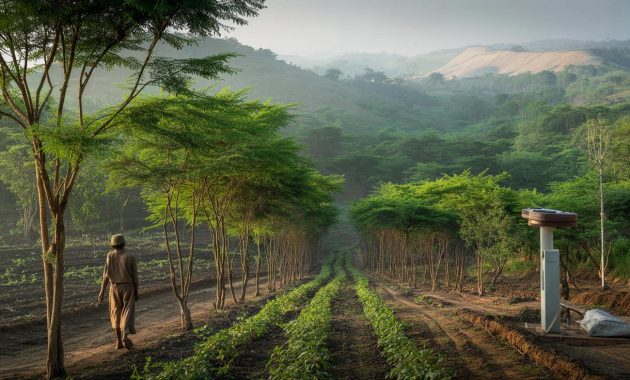
At first light, the hills looked like they were steaming. Thin ribbons of mist floated above young tree canopies, catching the sun in small, quiet flashes. Twenty-five years ago, this same valley was raw earth and dust, a place where goats picked through stubble and the wind scraped across cracked soil with nothing to slow it down. Today, the air feels heavier, cooler, almost damp, as if the land has remembered how to breathe. A farmer walks along a narrow path between lines of acacia and native shrubs, hand resting on a trunk no thicker than his arm, but tall enough to cast a decent shade. Birds shout from somewhere inside the greenery. On a nearby slope, a small sensor blinks, silently counting what humans can’t see: the carbon now held inside these trees. The once-barren land is quietly running a climate tab.
Something big is shifting, and most people haven’t noticed yet.
From empty dust to carbon vaults
Fly over certain parts of northern China, Ethiopia, or Costa Rica today and the view feels almost unreal. Where satellite photos from the late 1990s show beige scars and skeletal fields, you now see swathes of green stitched across hills and valleys. The color isn’t just pretty; it’s doing serious work. Each patch of forest, even the scrappy young ones, is acting like a giant sponge, pulling carbon dioxide from the sky and locking it away in trunks, roots, and soil.
These landscapes, written off as “lost” a generation ago, are now quietly absorbing millions of tons of CO₂ every year.
Take the Loess Plateau in China, often cited in environmental textbooks but still shocking when you see it in person. In the 1990s, this region was a dust bowl on steroids: deep erosion gullies, harvests failing, rivers choked with mud. Then came a massive land restoration push — terracing, tree planting, and simply letting slopes rest. Two and a half decades later, satellite data show vegetation cover has surged. Researchers estimate that reforestation and ecosystem recovery there now capture millions of tons of CO₂ annually, on top of reduced soil erosion and better water retention. Farmers who once watched their topsoil blow away now harvest from cooler, moister fields shaded by trees. What was a climate problem has quietly become a climate asset.
The same story, with local twists, repeats in parts of Rwanda, Vietnam, Brazil’s Atlantic Forest, and beyond. When trees and shrubs return to degraded land, carbon uptake doesn’t rise in a straight, predictable line. Young, fast-growing forests can gulp CO₂ at impressive rates, especially in the first 20–30 years. Root systems deepen, soil organic matter builds up, microbial life kicks back into gear. All of that is carbon being pulled out of the air and held in living and non-living biomass. Scientists call these places “carbon sinks,” but that phrase almost hides the drama. These are landscapes that flipped their role in the climate story — from emitting CO₂ through deforestation and erosion, to steadily absorbing it season after season.
What made these forests actually work?
Behind the hopeful numbers, there was no magic wand. There was patient, gritty work and a few key methods that kept showing up across countries. One of the most effective was surprisingly simple: stop fighting nature’s own seedlings. In parts of the Sahel, instead of planting millions of nursery trees, farmers began protecting and pruning naturally sprouting shoots from old root systems. This approach, known as Farmer-Managed Natural Regeneration (FMNR), allowed trees to regrow quickly at scale, with local species already adapted to harsh conditions. Add basic soil measures — small earth bunds, stone lines, mulching — and suddenly water stayed in the ground longer.
The land didn’t just turn green; it began to hold and process carbon at depth.
Of course, not every project followed a gentle, nature-led script. There were mass planting campaigns with impressive photo ops and disappointing survival rates. We’ve all been there, that moment when a community is handed glossy tree seedlings that wilt before the next rainy season. The projects that stuck tended to be the ones that listened to local people and looked beyond the first two years. Farmers needed reasons to care about those trees: fruit, fodder, firewood, shade for crops, protection from floods. When those benefits clicked, survival rates jumped and so did long-term carbon storage. Let’s be honest: nobody really tracks a random tree they planted at a one-off volunteer day for the next 25 years. Communities, on the other hand, track what feeds and protects them.
*The most effective reforestation efforts turned out to be the least glamorous from the outside.* Long meetings under tin roofs to agree on land rights. Arguments over which species belonged. Tough calls about fencing grazing animals out of certain hills for a few years. But from those messy decisions grew forests that stayed. As one restoration expert told me on a scorching site visit in Madagascar:
“Carbon is what donors talk about. Dignity is what keeps trees alive.”
To make that more concrete, the projects that thrive tend to combine:
- Local decision-making over land and tree use
- Mixes of native species and income-generating trees
- Support over decades, not just the planting year
- Simple monitoring tools that communities can actually use
Behind every graph of rising carbon absorption, there’s this unglamorous scaffolding of trust, time, and steady care.
➡️ This “easy” plant is taking over French gardens – and it’s not always good news
➡️ A legendary rock band steps away after 50 years “the hit everyone knows”
So what does this mean for us now?
These once-barren landscapes, now pulling millions of tons of CO₂ from the air every year, don’t cancel out fossil fuels. They don’t give anyone a free pass to keep burning. They do something subtler and maybe more powerful: they show that climate damage isn’t always a one-way street. A hillside that was written off as dead can become a functioning, breathing part of the planet again. That shift is already reshaping local weather patterns, water cycles, biodiversity — and, quietly, the carbon math that underpins global climate models. For people living in these areas, it’s not an abstract story. It’s cooler nights, fewer sandstorms, streams that last a bit longer into the dry season.
The next chapter might not be about headline-grabbing “trillion tree” slogans, but about thousands of grounded, slightly imperfect restoration efforts that slowly add up. Some will mix wild regeneration with targeted planting. Some will focus on mangroves or peatlands, which hold mind-bending amounts of carbon out of sight. A few will fail, and that will sting. Yet from a climate perspective, the direction of travel is clear: more land that once leaked CO₂ is starting to hold it, steadily, year after year. The question now is less “Does this work?” and more “Who gets to decide how and where it happens, and who actually benefits?”
If there’s a quiet lesson from these 25-year stories, it’s that time can be an ally when we let ecosystems rebuild instead of constantly tearing them down. Forests, woodlands, and recovering scrub don’t move at the pace of news cycles; they move in seasons and decades. That can feel frustrating in an emergency. It can also be strangely reassuring. The landscapes that are now absorbing millions of tons of CO₂ annually were once written off by experts and locals alike. Imagine what other “lost” places could look like in another 25 years if we gave them space, patience, and the right kind of human help. This is still a live experiment, and we’re all, knowingly or not, part of it.
| Key point | Detail | Value for the reader |
|---|---|---|
| Reforested lands now absorb massive CO₂ | Decades-long projects are capturing millions of tons of carbon each year in trees and soils | Shows that damaged places can become climate allies, not just climate victims |
| Local communities are central | Long-term success depends on land rights, useful tree species, and shared benefits | Highlights why social justice and climate solutions are tightly linked |
| Patience beats quick wins | Natural regeneration, mixed species, and steady support outperform flashy one-off plantings | Helps set realistic expectations and spot which climate projects are worth backing |
FAQ:
- Question 1How much CO₂ can reforested areas realistically absorb each year?
- Question 2Are these new forests enough to solve the climate crisis on their own?
- Question 3What’s the difference between planting trees and letting forests regenerate naturally?
- Question 4How do we know these landscapes will keep storing carbon over decades?
- Question 5What can someone living in a city do to support this kind of long-term reforestation?