The next wave of artificial intelligence wants to step off the screen and walk among us.
In just a few years, AI has shifted from a niche tool to a daily companion in apps, offices and homes. Now a new ambition is emerging: giving algorithms a body, eyes, arms and legs so they can act in the real world, not just talk about it.
From chat windows to real‑world actions
Since late 2022, large language models have grown from experimental curiosities to mass‑market software. They write reports, analyse images, summarise meetings and even trigger basic automated tasks online.
Tech leaders are already talking about the next step: “Physical AI”. The idea is simple to state and hard to execute. Instead of limiting AI to digital tasks, companies want systems that understand physics, move safely around humans and manipulate real objects with precision.
Physical AI aims to merge advanced reasoning with capable bodies, so robots can work alongside people in ordinary environments.
This shift depends on robotics, sensors and new kinds of chips as much as it depends on clever algorithms. The goal is not just more realistic avatars in your browser, but machines that can stock shelves, carry patients, or assemble products while responding intelligently to constant change.
Why 2026 is seen as a turning point
Industry roadmaps point to the middle of this decade as the moment when Physical AI moves from lab demos to early mass deployments. Several trends converge around 2026:
- Cheaper, more powerful AI chips specifically built for robots
- Humanoid robots moving from prototypes to small production runs
- Improved simulation tools that accelerate training
- Early commercial deployments in warehouses, hospitals and elder care
Nvidia, already central to the generative AI boom, is positioning itself as the “brain supplier” for a future robot population. Its compact Jetson-style modules cram thousands of trillions of operations per second into a device small enough to fit inside a torso. The price tag around a few thousand dollars is high for a home gadget, but viable for a professional workmate expected to operate around the clock.
On the manufacturing side, firms in China and Japan are racing to prove they can build humanoid robots not just as one‑off showpieces but in series, with reliability close to that of industrial machinery.
Humanoid robots move from sci‑fi to factory lines
Analysts at Morgan Stanley have thrown out a provocative forecast: up to a billion humanoid robots in service by 2050. That number raises eyebrows, yet early signs show robotics entering a scaling phase.
➡️ This small money rule helped me save $5,000 in a year without feeling restricted
Chinese company Ubtech recently showcased warehouses filled with lines of its Walker S2 humanoid, signalling that batch production has begun, not just small pilot runs. The aim is to sell these robots as general‑purpose workers able, eventually, to move through buildings designed for humans: doors, stairs, lifts, handle heights.
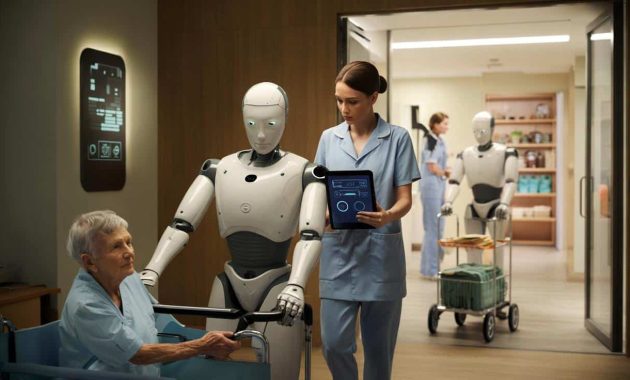
In Japan, Enactic is targeting one of the toughest possible environments: chaotic human spaces where conditions shift minute by minute. The firm wants to introduce robots that can “live alongside people”, particularly in elder care facilities where staff struggle with physically demanding tasks.
Care homes are seen as early testbeds for Physical AI: high need, repetitive heavy lifting, and a shortage of human workers.
In that context, robots are not designed to replace nurses, but to take on the back‑breaking jobs of lifting and repositioning patients who can no longer move on their own. If the machines can do this safely and reliably, staff can focus more on medical and emotional care.
Inside the new robot brain
The push towards Physical AI is not just about building legs that do backflips. The brain inside the robot has to fuse several layers of intelligence:
- Perception: cameras, depth sensors and microphones feeding into AI models that recognise objects, people and spoken commands
- Planning: software that breaks down tasks like “tidy this room” into step‑by‑step actions
- Control: low‑level algorithms that keep balance, adjust grip strength, and adapt to unexpected contact
- Learning: the ability to improve from feedback rather than depending on rigid scripts
Modern language models play a key role at the planning and interaction levels. They can interpret messy human requests and translate them into sequences of actions that the control systems can execute.
The safety gap: when powerful robots meet fragile humans
Despite the glossy demo videos, today’s humanoid robots are still clumsy and potentially dangerous in close quarters with people. Their motors are strong enough to cause injury, and their awareness of surroundings is imperfect.
Several incidents in industrial settings show what happens when a robot misreads a situation or when sensors fail. A missed object, a slippery floor, or a mislabelled tool can trigger a fall or a sudden, forceful movement in the wrong direction.
The challenge is not just making robots strong and smart, but making them predictable, gentle and fail‑safe around ordinary people.
Some companies experiment with soft coverings, padding and compliant joints that give way when they hit something. Others rely on geofenced zones and strict rules that keep robots at a distance. None of these measures alone are enough for a humanoid that is supposed to share a crowded corridor with nurses, patients and visitors.
For now, many physical tasks are still executed with human operators in the loop. Teleoperation — where a person remotely controls the robot’s limbs — allows the machine to learn from demonstration. AI systems watch and record how skilled operators move in tricky situations, then attempt to imitate and generalise.
Why robots learn faster than humans
A key advantage of Physical AI lies in how robots can share experience. A human carer might need months to master safe lifting techniques. A robot can be taught once, then broadcast that skill to every unit of the same model.
Training often happens first in simulation. Virtual warehouses, apartments and hospitals are built inside powerful computers. Robots try thousands of variations of tasks, from stacking boxes to assisting a person into a wheelchair. Failures that would be catastrophic in real life become harmless data points.
| Training method | Strengths | Weaknesses |
|---|---|---|
| Teleoperation | High realism, human intuition, captures rare edge cases | Slow, expensive, depends on expert operators |
| Simulation | Scales to millions of trials, safe to fail | Gaps between virtual physics and messy reality |
| On‑device learning | Adapts to specific environments and users | Risky if mistakes happen near humans |
Once a robust set of behaviours emerges, updates can be rolled out over the air, in the same way phones get operating system upgrades. A new safety tweak, balance algorithm or lifting technique can spread worldwide within hours.
Why flashy videos don’t tell the full story
Clips of humanoids dancing, doing backflips or making coffee circulate widely on social media. Robots from Tesla, Boston Dynamics and others perform stunts that look effortless — yet these are usually highly choreographed sequences.
Engineers often need dozens of takes to get one smooth routine on camera. The robot follows a narrow script in a tightly controlled setting. Change the floor texture, move an object, or bring a child running across the room, and many of those routines would break down.
The messy unpredictability of homes, streets and hospitals is the real benchmark for Physical AI, not a polished demo reel.
That is why the leap from stunning viral clips to dependable, everyday co‑workers remains so large. The software stack must handle misheard instructions, obstructed cameras, and objects in the wrong place, yet still avoid risky improvisations.
Practical risks and realistic benefits
Physical AI raises obvious safety concerns, but also social and economic questions. Factories that already use industrial robots may add humanoids to handle tasks previously reserved for humans. That can boost productivity, yet also reshape local job markets.
Home and care settings bring different dangers. Poorly regulated devices could collect intimate data about residents, from medical routines to daily schedules. A badly designed robot might knock over a frail person, or fail to detect pain and distress.
At the same time, there are potential benefits if deployments are carefully supervised. Ageing societies in Europe and East Asia face shortages of carers and hospital staff. Physical AI could relieve some of the most exhausting duties: lifting, cleaning, fetching equipment, monitoring falls.
One realistic near‑term scenario for 2026 and the years after looks like this: a care home where each ward has one or two humanoid assistants. They are not independent “carers”, but heavy‑duty tools under the direction of medical staff. Robots handle the lifts, laundry and night‑time patrols, while people handle diagnosis, medication and emotional support.
Key terms and what they actually mean
Several phrases are already becoming buzzwords around Physical AI. A quick unpacking helps cut through the hype:
- Humanoid robot: a machine with a body broadly shaped like a person, usually with two arms, two legs and a head‑like sensor cluster. The aim is compatibility with buildings, tools and furniture designed for humans.
- Embodied AI: AI systems that have a physical presence, or at least a representation of a body in simulation, so they can reason about movement and interaction, not just language.
- Safety envelope: the range of motion, force and behaviour a robot is allowed to use when near humans. Software constantly checks that actions stay inside this envelope.
Understanding these concepts helps frame the debate. A humanoid working in a warehouse with strict safety envelopes and constant monitoring is very different from a cheap, unregulated unit wandering a home with children.
As 2026 approaches, the key question is not whether AI can step into the physical world — that process has clearly begun — but how societies will shape its role. Choices about regulation, labour, liability and public spaces will decide whether Physical AI feels like an invisible infrastructure upgrade or a daily, noticeable presence in homes and workplaces.