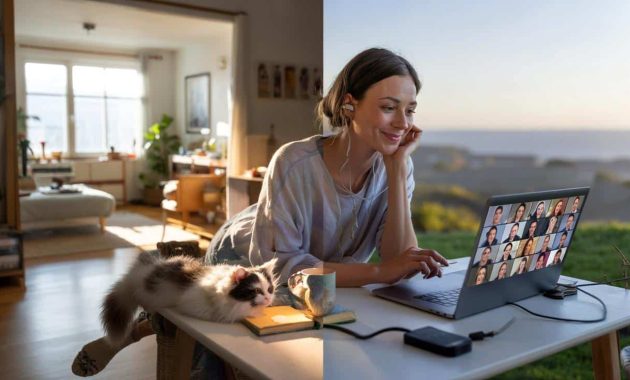
At 8:59 a.m., Anna is still in her slippers. Laptop open on the kitchen table, coffee going lukewarm, cat aggressively sitting on her notes. On the screen, 23 little circles with initials: the Monday team meeting. Her manager appears, slightly backlit, slightly annoyed. “I’d like to see more cameras on,” he says. Half the circles stay dark. Anna unmutes for exactly 14 seconds, delivers her update, then slips her headphones off and breathes out. No crowded subway, no badge to scan, just a quiet apartment and a day she can shape a little more on her own terms.
She’s not lazy. She’s just… happier.
And that’s starting to worry a lot of bosses.
Four years later, the verdict is in
Since 2020, working from home has passed through every possible label: emergency fix, passing fad, productivity killer, mental health savior. While leaders argued on LinkedIn, researchers quietly collected data. Real data. Cross-continental surveys, time-use diaries, well-being indices, performance metrics.
What they’re finding lines up with what many people feel when they close the door on their home office: less stress, more control, a life that doesn’t shrink to commute–office–commute–collapse.
The scary part, for managers attached to the old model? These numbers are now solid enough to be hard to dismiss.
A large analysis by economists from Stanford and several European universities followed hundreds of thousands of workers over multiple years. They tracked job satisfaction, perceived autonomy, burnout symptoms, and even intent to quit. Across sectors and countries, the trend was the same: people with regular remote days reported significantly higher overall happiness and lower stress, without notable drops in output.
Some countries even saw a small productivity gain, mostly because people suddenly gained back those 60–120 minutes lost every day in traffic jams, crowded trains, or dragging themselves between meetings. One French worker quoted in the study summed it up bluntly: “I stopped being tired of my own life.”
For HR teams, that line hit harder than any graph.
So why the constant fight to “bring people back” three days, then four, then almost full-time? Part of the answer is psychological. Offices used to be the visible proof that work was happening. Rows of desks looked like control, like seriousness, like money well spent. When those desks emptied out, many managers suddenly realized their main management tool had been… proximity. Not coaching. Not clear goals. Just physical presence.
➡️ Why soaking onions in cold water for 10 minutes changes everything in the kitchen
➡️ This 5-minute fridge reset trick helps food stay fresh noticeably longer
➡️ An unexpected underground treasure: China uncovers a lithium deposit worth an estimated €600 billion
➡️ A biotechnologist reveals how edible vaccines are being developed inside bananas and tomatoes
➡️ It’s confirmed Up to 30 cm of snow : here is the list of states and, most importantly, when
➡️ This everyday kitchen item can remove odors faster than any spray
➡️ A study links the gut microbiome to autism, anorexia and ADHD
Remote work exposes fragile leadership. You can no longer confuse “seeing people stay late” with “having a high-performing team.” You actually have to define what good work is. For some, that’s terrifying.
How to turn this tension into something workable
One practical shift that works surprisingly well: replace “time supervision” with “results rituals.” Instead of obsessing over who’s online at 9:02, define together what a good week looks like. Three deliverables? Two client calls? One bug fixed? Put it in writing.
Then anchor it in short, structured check-ins. Fifteen minutes at the start of the week for priorities. Ten at the end for a quick review: what went well, what got stuck, what needs unblocking. Cameras optional, clarity non-negotiable.
Suddenly, home is no longer a black box. It becomes the place where agreed work gets done, on a schedule that finally respects how different brains function.
The biggest trap for employees is trying to recreate the office at home like a cosplay of productivity. You don’t need rigid 9–6, a “fake commute,” and a perfectly styled desk unless that genuinely helps you. Let’s be honest: nobody really does this every single day.
What matters more is a handful of stable anchors. A clear start signal (closing the kitchen door, a certain playlist, a first task that’s easy). Two or three protected focus slots when notifications are off and messaging apps can wait. A hard stop in the evening, even if it’s just shutting the laptop and throwing a dishcloth over it.
Without those limits, remote work slowly expands until it eats into nights, weekends, and your ability to enjoy the freedom you fought for.
Managers have their own learning curve, and yes, some are frankly resisting it. They miss the open space where you could read the “mood” at a glance. They feel powerless behind a screen, afraid of being judged useless if they’re not constantly calling meetings. One team leader told me something that many think but rarely admit out loud:
“I realized how much my authority depended on people seeing me walk around. Online, I had to earn their respect with something else. That was… humbling.”
For those ready to evolve, a few simple moves change everything:
- Set two or three **non-negotiable team moments** per week, and leave the rest truly flexible.
- Communicate expectations in writing, not hints, not vibes.
- Track outcomes, not “green dots” on a messaging app.
- Protect asynchronous work: fewer live calls, more clear messages.
- Use the office as a **collaboration hub**, not a surveillance hall.
*When that switch happens, remote days stop feeling like a tolerated exception and start functioning as part of a coherent system.*
What this says about us, and what comes next
The fact that so many people feel happier at home says something a bit uncomfortable about how offices were run. Not just the fluorescent lights and noisy open spaces. The politics. The performative busyness. The endless time lost in meetings that produced nothing but follow-up meetings.
We’ve all been there, that moment when you leave the office at 7:30 p.m. wondering what you actually accomplished beyond being seen. The contrast with a quiet, concentrated afternoon at the kitchen table is brutal. Research only confirms what bodies and brains have been signaling for years: control over your time is an actual health factor, not a luxury.
Managers who hate this new reality are not all villains in ties. Many feel stuck between employees wanting freedom and leaders demanding “energy in the building” to justify huge leases and glossy headquarters. Some are measured, unfairly, on office attendance instead of team results. They’re trapped in metrics that belong to the previous decade.
But the data keeps arriving, persistent, boringly consistent: hybrid setups chosen by workers reduce turnover, burnout, and sick leave. People don’t become lazy. They become selective. They come to the office for genuine collaboration, not to reply to emails under neon lights.
That shift is cultural, not just logistical. And culture tends to outlast any memo.
The next few years will probably look messy. Some companies will impose harsh return-to-office rules and quietly lose their best talent. Others will swing to “remote forever” and then rediscover the value of occasional in-person time. Somewhere between the extremes, a new normal will stabilize: fewer days in the office, more intention when we’re there, less guilt when we’re not.
The real frontier won’t be technology, but trust. Who trusts whom? On what basis? With which guardrails? Those questions go way beyond the debate over pajamas on Zoom. They touch on how we define adult work, responsibility, and respect.
If working from home makes us happier and managers hate it, maybe the real question isn’t who wins. It’s what kind of work life we collectively decide not to tolerate anymore.
| Key point | Detail | Value for the reader |
|---|---|---|
| Remote work increases happiness | Long-term studies show higher satisfaction, lower stress, and stable productivity for workers with regular home-office days | Validates your lived experience and helps you argue for flexible arrangements |
| Old-style management is cracking | Control based on physical presence no longer works; managers must shift to clear goals and outcome tracking | Helps you understand your boss’s resistance and push for better practices |
| Simple rituals make home work sustainable | Anchors like start/stop signals, focus slots, and limited meetings protect your time and energy | Gives you practical levers to enjoy remote work without burning out |
FAQ:
- Question 1Are we really more productive at home or just less watched?Most large studies find no significant drop in output and in some sectors a small gain, mainly thanks to less commuting and fewer interruptions. The “less watched” feeling can actually free mental energy that you reinvest into real work.
- Question 2Why do some managers still push so hard for the office?Many learned to manage by proximity and feel stripped of their tools online. They’re also under pressure from upper management to justify office costs and maintain a visible “company culture,” even when that culture mostly lives in documents and chats now.
- Question 3How can I ask for more remote days without sounding uncommitted?Anchor the request in outcomes: show what you deliver on home days, mention specific tasks that benefit from quiet, and propose clear communication rules. Framing it as a performance argument, not a comfort plea, changes the tone.
- Question 4Is full-time remote better than hybrid?It depends a lot on your personality, home setup, and need for social contact. Many people feel best with 2–3 office days for bonding and brainstorming, and the rest at home for focused work and life balance.
- Question 5How do I stop my remote job from leaking into my evenings?Create visible stop signals: close the laptop, leave the room, change clothes, go for a short walk. Tell your team your offline hours. Without those small boundaries, remote work easily becomes “always on” work.