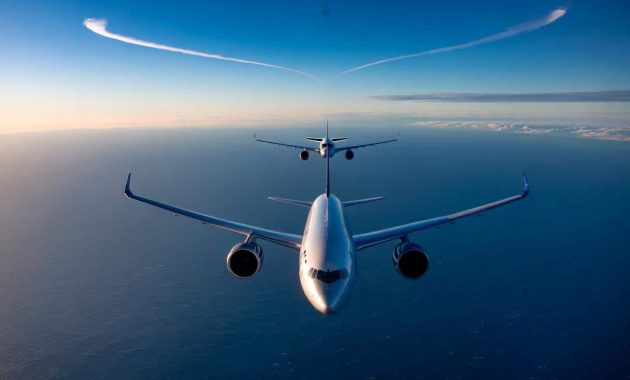
What looked like a routine long‑haul crossing secretly hosted a quiet shift in aviation: Airbus and several airlines proved they can choreograph a perfectly timed meeting between two aircraft, at cruise altitude, without bending any air traffic rules.
A silent milestone in the sky
Between September and October 2025, Airbus ran eight test flights over the North Atlantic. Each mission had a clear objective: bring two commercial aircraft to the same waypoint, at the same second, while keeping them fully compliant with current air traffic control procedures.
This may sound almost trivial on paper. In the real world of jet streams, traffic constraints and strict separation rules, it borders on nerve‑racking. Long‑haul flights constantly adjust speed and routing. Any change in wind, traffic or workload can throw timing off by minutes.
For the first time, two commercial jets converged on a single point in cruise while respecting standard separation rules and existing procedures.
Why bother? Because this level of precision opens the door to something airlines have dreamt about for years: wake energy retrieval, known inside Airbus as the fello’fly project.
The idea borrows from migrating geese. One aircraft flies slightly behind and offset from another, positioning itself in a rising swirl of air generated by the leader’s wingtip vortices. That extra lift reduces the follower’s fuel burn, with Airbus aiming for savings of up to around 5% on long‑haul routes.
How wake energy retrieval really works
Wake energy retrieval does not mean flying dangerously close. The follower remains at safe distances, but in a specific “sweet spot” inside the leader’s wake. That zone provides extra lift, so the trailing aircraft needs less engine thrust.
The target: around 5% less fuel on long‑haul flights, without changing airframes or engines, just by flying smarter in formation.
In commercial aviation, a 5% reduction is huge. On a single transatlantic rotation, that can mean several tonnes of fuel saved. Scaled across a fleet for a full year, the cut reaches tens of thousands of tonnes of kerosene and the associated CO₂ emissions.
➡️ The cleaning habit that keeps mess from piling up silently
➡️ Pellet stove vs heat pump: which heating system will actually save you money this winter?
➡️ Why chefs always add a pinch of sugar to their tomato sauces
➡️ Jogger stops in disbelief when a friendly wild deer calmly walks beside her for several minutes
➡️ Psychology reveals why your mood shifts after certain interactions without obvious reasons
➡️ The reason your cleaning efforts don’t translate into lasting results
According to the latest IPCC estimates, aviation generates roughly 1% of global CO₂ emissions. Pressure on the sector keeps rising, especially for long‑haul, where short‑range electric aircraft offer no immediate relief. Technologies like wake energy retrieval aim to squeeze more efficiency out of today’s jets while waiting for deeper breakthroughs.
A full‑scale rehearsal over the Atlantic
Airlines and air traffic control in the same cockpit
To test the concept, Airbus assembled a coalition that looked more like a multinational exercise than a simple trial. Air France, Delta Air Lines, French bee and Virgin Atlantic supplied the aircraft and crews. On the ground, air traffic control centres across Ireland (AirNav Ireland), France (DSNA), the UK (NATS) and the pan‑European network manager EUROCONTROL joined the experiment.
The comparison to two cyclists in a mountain pass works quite well. Each cyclist talks to their own support car; each pilot talks to their own controller. Both have separate constraints, separate clearances. Yet they need to arrive at the same bend at the same instant, without breaking any rules.
For crews, the main novelty came from the Pairing Assistance Tool, or PAT. Developed by Airbus, this software module constantly computes the optimal trajectories of both flights and suggests speed and routing changes to align their arrival time on the rendezvous point.
Instead of chasing the current position of the other aircraft, PAT targets where it will be several minutes later. It behaves like a high‑precision GPS that navigates toward the future position of another jet, taking into account wind, planned flight levels and existing constraints.
- The PAT calculates a feasible pairing between two flights.
- It proposes speed and routing adjustments to both crews.
- Controllers validate or reject these adjustments against traffic and safety rules.
- The system keeps updating as conditions change along the route.
On the ground, controllers used a dedicated interface to coordinate. Every instruction still followed standard safety margins and vertical separation rules. The experiment did not bend regulation; it worked within it. That matters if the concept is to scale in real traffic, not only in clean simulations.
A four‑step protocol to keep risk under control
The flight trials validated a strict, repeatable sequence.
| Step | What happens |
|---|---|
| 1. Computation | PAT calculates the new trajectories for both aircraft, with a common rendezvous point and time. |
| 2. Validation | Airlines, flight crews and air traffic control examine the proposal to check feasibility and safety. |
| 3. Flight plan update | One aircraft changes its flight plan, under normal procedures, to converge toward the other. |
| 4. Cockpit commitment | Both crews activate a cockpit function that commits the aircraft to reach the shared waypoint at the agreed time. |
The rendezvous must be accurate down to seconds and nautical miles, but never at the cost of safety margins. Vertical separation remains standard. Lateral and longitudinal spacing follow existing rules. Airbus focuses first on the ability to time and shape trajectories; close‑formation flight comes later.
Borrowing tricks from geese, with more math
From birds to algorithms
Geese flying in a V formation reduce their energy use by taking turns at the front and riding each other’s upwash. Airbus wants to translate that into jet travel, through physics instead of instinct.
When a large aircraft flies, its winglets generate swirling air masses at the tips. Those vortices create a region of slightly rising air off to each side of the leader’s path. A following aircraft, positioned just right and slightly offset, benefits from that lift and can throttle back.
Formation flight in commercial service will not look like military jets wingtip‑to‑wingtip. Distances stay large enough to preserve comfort and redundancy.
The trick lies in placing the follower precisely in that upwash region while still giving controllers plenty of room. Wind gradients, turbulence, traffic and procedural constraints all limit how tight the formation can be. Airbus argues that, with enough data and automation support, the follower can sit in a safe, predictable zone of benefit.
These recent flights did not yet activate the wake energy gain itself. They only proved that two real‑world commercial flights can be brought together in a controlled way that paves the road for formation phases. Think of it as aligning train carriages before coupling them for the first time.
GEESE, SESAR and a mosaic of partners
Fello’fly does not exist in isolation. In Europe, the SESAR programme (Single European Sky ATM Research) supports several projects dealing with wake operations, new procedures and automation. One of them, named GEESE, includes a long list of organisations: Boeing, ENAC, Indra, CIRA, DLR, Bulatsa, Frequentis, UAB, Oro Navigacija, WaPT, UCLouvain and others.
The message is clear: wake‑based eco‑flight will only work if manufacturers, airlines and air navigation providers coordinate. Procedures need global recognition, not just a single country’s approval. Data links between aircraft and between aircraft and control centres must handle new layers of information without adding confusion.
Not the only path to lower‑carbon flight
Aviation’s multi‑track transition
Wake energy retrieval adds another tile to the climate strategy of aviation, but it cannot carry the full load. The sector already invests in several complementary paths:
- Sustainable aviation fuels (SAF) that can slash lifecycle CO₂ emissions by up to about 80%, depending on feedstock and production methods.
- New‑generation engines with higher bypass ratios and refined aerodynamics, which cut fuel burn on every flight.
- Lighter airframes through composite materials, redesigned cabins and more efficient onboard systems.
- Hybrid‑electric and fully electric aircraft for regional routes and emerging air mobility concepts.
- Hydrogen propulsion, either through combustion or fuel cells, for a potential zero‑CO₂ long‑term solution.
No single technology solves aviation’s climate equation. Gains stack: better engines, cleaner fuels, smarter operations and, in the case of fello’fly, aerodynamic cooperation between flights that used to ignore each other.
What comes next for Airbus and fello’fly
From rendezvous to real formation
The logical next phase will involve actual energy‑recovery segments during commercial‑style missions. That means the follower aircraft will move into the leader’s wake sweet spot while passengers sit in their seats, hopefully unaware of the complex geometry unfolding outside.
Engineers will watch a few key metrics closely:
- Measured fuel savings over full flight profiles.
- Impact on flight times and flexibility for dispatchers.
- Comfort and turbulence levels in the follower aircraft.
- Controller workload and radio traffic in busy airspace.
Operational realism will matter as much as aerodynamic theory. Airlines will not accept a 5% fuel saving if it means chronic delays or reduced capacity on key routes. Controllers will resist procedures that complicate already dense traffic flows over the North Atlantic, one of the world’s most carefully managed corridors.
New questions around risk and responsibility
As formation‑style flying moves closer to everyday use, regulators and insurers will face new questions. Who holds responsibility if a wake‑related upset occurs in the follower aircraft? How do pilots train for rare, but potentially confusing, situations where they must leave the wake benefit abruptly? What happens if one crew needs to divert mid‑ocean while paired with another?
Simulation will play a large role here. Full‑flight simulators can recreate the geometry and turbulence patterns of wake operations, allowing crews to practice normal and abnormal scenarios. Air traffic simulations can stress‑test procedures with heavy traffic, diversions and weather deviations to see how fello’fly interacts with real‑world chaos.
The technology also links to other operational concepts. Dynamic pairings might optimise not only fuel burn, but also contrail formation by nudging aircraft to altitudes and tracks that reduce persistent contrails, which contribute to aviation’s non‑CO₂ climate impact. In the longer term, AI‑driven dispatch systems could match flights from different airlines to share wake benefits across alliances, or even across competitors.
For now, the image that stays is simple: in the empty air above the Atlantic, two jets reaching the same point at the same time, not by chance, but by design. A small shift in how they meet could later reshape how they travel together across the planet.