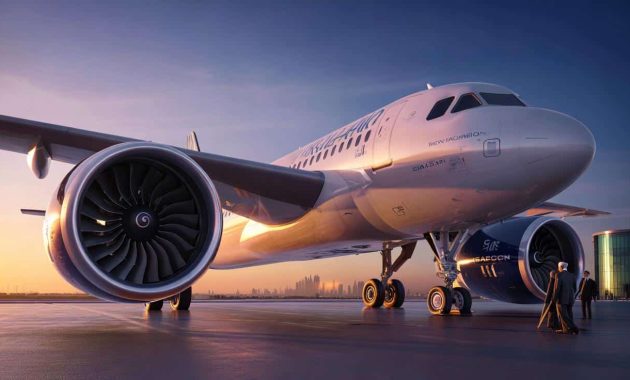
The agreement, sealed in front of industry heavyweights and political strategists, gives a French engine maker a powerful advantage in a race that mixes technology, climate pressure and regional ambition.
Riyadh Air’s big bet on a Franco-American engine
Riyadh Air, created in 2023 as part of Saudi Arabia’s “Vision 2030” transformation plan, has chosen the LEAP‑1A engine from CFM International to power its future fleet of Airbus A321neo aircraft.
During the 2025 Dubai Airshow, the carrier confirmed a firm order for 120 LEAP‑1A engines to equip 60 A321neo jets. The deal positions the still‑unknown airline as a serious new player among Gulf carriers and sends a strong signal about the technology it wants under its wings.
Riyadh Air’s LEAP‑1A order is valued by sector analysts at around €1.4 billion for engines alone, with total lifetime services likely taking the package well beyond that figure.
CFM International, the supplier behind the LEAP‑1A, is a 50‑50 joint venture between US group GE Aerospace and France’s Safran Aircraft Engines. Every new contract for LEAP engines therefore directly reinforces Safran’s standing in the single‑aisle aircraft segment, where most of the world’s commercial flights take place.
Why Safran’s LEAP‑1A is becoming the default choice
A high-efficiency engine built for crowded skies
The LEAP acronym stands for “Leading Edge Aviation Propulsion”. Launched in commercial service in 2016, the engine was designed as the successor to the hugely popular CFM56 that powered generations of Boeing 737 and Airbus A320 aircraft.
For airlines under pressure from fuel prices and climate regulation, the gains are tangible.
- Fuel burn cut by roughly 15% compared with previous CFM56 engines.
- CO₂ emissions reduced by a similar proportion on each flight.
- Lower noise footprint, easing pressure from communities around major airports.
- 3D‑woven composite fan blades that save weight while boosting resilience.
- Advanced ceramic matrix composite (CMC) parts able to tolerate higher temperatures.
These features matter especially in the Gulf, where temperatures routinely rise well above 40°C and sand ingestion can punish older engine designs. High heat pushes components to their limits, while fine dust can erode internal surfaces and fan blades.
To address this, Riyadh Air’s engines will include the latest durability upgrades in the high‑pressure turbine. That package specifically targets harsh desert conditions, extending time between overhauls and reducing unexpected groundings.
➡️ A rare environmental event has scientists paying close attention
➡️ This conversation topic instantly destroys your credibility
➡️ A400M: Airbus bets on a “mother ship” aircraft for drones
In hot, sandy environments, engines that run cooler and cleaner on the inside can translate directly into fewer cancellations and better on‑time performance.
Technical snapshot of the LEAP-1A
| Feature | Detail |
|---|---|
| Fuel consumption | ~15% less than CFM56 generation |
| CO₂ emissions | ~15% reduction per flight |
| Fan diameter | 1.98 m |
| Engine weight | Around 2,900 kg |
| Maximum thrust | 15,000–35,000 lbf depending on configuration |
| Key technologies | 3D‑woven composites, CMC hot-section parts, optimised nacelles |
| Maintenance | Real‑time health monitoring, predictive analytics |
| Main assembly sites | France (Villaroche, Saint‑Quentin) and US (Durham) |
This mix of technologies aims to squeeze more thrust out of less fuel while keeping reliability high, a balance that airlines track very closely in their route economics.
A contract that strengthens Safran’s grip on a crucial market
Why analysts see €1.4 billion as just the starting point
Safran has not disclosed the precise value of the Riyadh Air deal. Yet previous contracts in the sector give a rough benchmark. Industry estimates put the price of a single LEAP‑1A at around €12 million in 2018, before inflation and optional features.
On that basis, 120 firm engines represent roughly €1.4 billion in hardware. That number only covers the installed engines. Airlines typically also buy spare engines, large stocks of replacement parts and multi‑year support packages.
Those extras often include:
- On‑site technical assistance and rapid-response teams.
- Long‑term maintenance and overhaul contracts.
- Training for pilots and engineers on operation and troubleshooting.
- Digital services for engine health monitoring and fuel optimisation.
Once those are factored in, the lifetime value of Riyadh Air’s commitment could easily rise far beyond the notional €1.4 billion headline figure. For Safran, that means recurring revenue for decades.
Single‑aisle engine contracts often behave less like one‑off purchases and more like long marriages, locking manufacturer and airline together through the life of every aircraft.
LEAP-1A’s commercial momentum
The Riyadh Air order lands in an already crowded sales book for the LEAP‑1A. In less than ten years of service, over 4,000 LEAP engines have been delivered worldwide, making it one of the fastest industrial ramp‑ups in civil aviation.
Today, more than 1,700 Airbus A320neo and A321neo aircraft fly with LEAP‑1A powerplants. The backlog still stands near 10,000 engines, securing production lines in France and the US well into the next decade.
For Safran, this steady stream of work underpins jobs in facilities around Paris and in regional plants that manufacture fan blades, casings and turbine parts. The Riyadh Air deal reinforces that pipeline at a time when rival engine makers also chase orders from fast‑growing airlines in Asia and the Middle East.
Riyadh Air’s role in Saudi Arabia’s aviation ambitions
From newcomer to regional hub challenger
Riyadh Air aims to turn the Saudi capital into a major global transfer hub, joining the ranks of Doha, Dubai and Abu Dhabi. Backed by the Saudi sovereign wealth fund, the airline’s strategy hinges on a young, fuel‑efficient fleet and a premium passenger experience.
The Airbus A321neo sits at the heart of that plan. As a single‑aisle aircraft with long range, it can serve both regional services and thinner long‑haul routes that would be uneconomical for wide‑body jets. Fitting those airframes with LEAP‑1A engines allows Riyadh Air to stretch range, cut fuel bills and market a greener profile.
This aligns closely with Vision 2030, which seeks to diversify Saudi Arabia’s economy away from oil by building up tourism, logistics and aviation. An efficient, modern engine fleet is a practical lever in that shift, as it supports new routes, higher reliability and lower operating costs.
The choice of LEAP‑1A is as much a branding decision as an engineering one: it signals that Riyadh Air wants to be seen as modern, efficient and internationally credible from day one.
How this contract fits into aviation’s climate and cost puzzle
Incremental gains in a decarbonising industry
Aviation faces growing pressure to cut emissions, yet fully electric commercial jets remain a longer‑term prospect. In that context, engines such as the LEAP‑1A act as a near‑term bridge.
A 15% reduction in CO₂ per flight does not make an aircraft carbon‑neutral, but across thousands of flights a year it moves the dial. The engine is also certified to run on blends of sustainable aviation fuel (SAF), which can reduce lifecycle emissions further when available.
For airlines, the climate angle connects directly with financial risk. As more regions discuss carbon pricing, airport noise restrictions and green taxes, operating older, thirstier engines could quickly become a liability.
Key terms behind the deal, briefly explained
For readers less familiar with aviation jargon, a few concepts help clarify the stakes:
- Single‑aisle aircraft – Planes such as the Airbus A321neo with one central aisle. They dominate short and medium‑haul routes and represent the bulk of global airline fleets.
- Joint venture – CFM International is owned 50‑50 by GE Aerospace and Safran. Both partners share technology, investment and profits from engine programmes like LEAP.
- Health monitoring – Sensors inside the engine send real‑time data on temperature, vibration and pressure. Algorithms flag unusual patterns so maintenance teams can intervene before a fault leads to an in‑flight shutdown or cancellation.
- Ceramic matrix composites (CMC) – High‑tech materials that handle higher temperatures than metal alloys while remaining lighter. That allows hotter, more efficient engines without the same cooling penalties.
To picture the economics, imagine a typical A321neo flying six sectors per day. If each flight burns 15% less fuel thanks to its engines, the annual saving can reach millions of dollars once global fuel prices and carbon costs are factored in. Multiply that by 60 aircraft and the business case behind Riyadh Air’s engine decision becomes clearer.
At the same time, the order underlines how European industrial groups such as Safran can stay central in a market increasingly shaped by Gulf capital, US technology and climate constraints. The LEAP‑1A, quietly spinning under the wing, sits at the crossroads of all three forces.