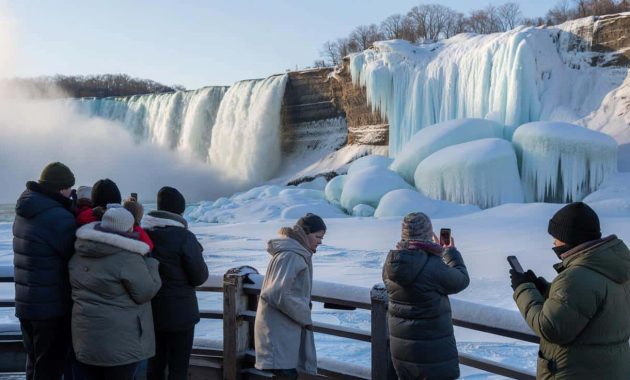
The wind hits first.
A hard, metallic gust that slices through every layer of clothing and bites straight into your bones. People arriving at Niagara Falls this week pull their scarves tighter, phones already in hand, drawn forward by a sound that feels… wrong. The usual deafening roar of water is muted, replaced by an eerie, muffled rumble, like a distant engine under thick blankets of glass.
At minus 55 degrees with wind chill, the great falls are almost frozen solid.
Water that normally crashes and foams in wild chaos now slides under vast chunks of white and blue, trapped mid-motion like a paused video. Tourists stare in silence, some whispering, others swearing they’ve never seen anything like it. Online, the photos have exploded, racing across feeds from Tokyo to Toronto.
Some people are calling it a miracle.
Others, a warning.
When a roaring giant suddenly falls quiet
Stand by the railings and you feel it first in your chest.
The falls aren’t silent, not exactly, but the sound is muffled, wrapped in ice and steam. Huge icicles hang from the cliffs like crystal daggers, catching the pale winter sun. Thick mist rises and instantly freezes on anything it touches: eyelashes, hats, camera lenses.
On the American side, sheets of ice stretch across the river, locking boulders and branches in place. On the Canadian side, familiar viewpoints have turned into surreal balconies over a frozen canyon. *It’s like nature pressed pause on one of the loudest places on Earth.*
A family from Texas huddles together, cheeks red, fingers shaking as they try to take a selfie.
“This is insane,” the dad laughs, his voice almost drowning in the wind. “Back home we close schools if it hits 20 degrees Fahrenheit.” Behind him, two teenagers from Montreal roll their eyes and walk further toward the edge, chasing the perfect shot for Instagram.
This winter snap sent temperatures in the region plunging to wind chills around minus 55. On TikTok and X, clips of the falls have racked up millions of views in a matter of hours. Some users add dreamy music and captions like “Real-life Narnia.” Others stitch the same clips with graphs of global temperatures and words like “collapse,” “climate chaos,” and “last warning.”
This split reaction says as much about us as it does about the weather.
For one group, the frozen falls are pure spectacle, another item on the bucket list, proof that nature still has the power to surprise and delight. For another, the same images feel like a postcard from a planet under stress, a reminder that extreme cold can exist right alongside record-breaking heat waves elsewhere.
Scientists point out that the falls aren’t fully frozen. Beneath the ice, roughly 168,000 cubic meters of water per minute are still thundering through, invisible but unstoppable. What we see at the surface is a thin crust of beauty laid over something far more turbulent. That tension between calm and chaos is exactly why the photos feel so haunting.
How a frozen wonder becomes a global argument
What turns an icy waterfall into a viral flashpoint?
It starts with that first shaky video from a bundled-up visitor, breath clouding the screen, voice cracking as they pan over the ice. Thirty seconds, maybe less. Within minutes, it’s reposted with a dramatic caption, then re-edited with intense music, then clipped again with a hot take stitched on top.
➡️ Why your body feels tense when recovery is irregular
➡️ This tiny hidden button will make your life easier
➡️ Psychology explains why emotional calm doesn’t always feel safe at first
➡️ Why lending land to a beekeeper could be the biggest financial mistake a retiree can make
If you’re watching on your phone, lying on the couch or commuting, you’re not just seeing a landscape. You’re absorbing a mood. A frozen Niagara Falls is the perfect blank canvas for whatever story people want to tell: wonder, apocalypse, nostalgia, denial. The image stays the same. The meaning shifts with every share.
One Canadian influencer posts a reel of herself walking along the icy boardwalk in a white parka, slow-motion flakes drifting around her. She calls it “the most magical day of my life” and plugs a link to her winter packing checklist. The comments flood in: heart emojis, travel plans, people asking what boots she’s wearing.
Scroll down a bit and the tone whiplashes. An environmental activist duets the same shots, overlaying footage of burning forests in Chile and dried-up riverbeds in Spain. “This isn’t magic,” he writes. “This is the flip side of the same climate coin.” His video doesn’t look as polished, but the anger in his voice is raw. Views climb just as fast.
Both sides latch onto the same plain truth: **we’re living through weather we don’t fully understand yet**. Meteorologists explain that polar vortex disruptions can drag Arctic air much farther south than usual, even as average global temperatures keep rising. So yes, you can have brutal cold snaps in a warming world. Both are real. Both are linked.
Yet that kind of nuance rarely goes viral. People gravitate toward the simplest story that fits their feelings. Either this is proof the planet is fine (“See? Still freezing!”) or proof the planet is broken (“Nature is glitching, wake up!”). Between those extremes, there’s a quieter, less cinematic reality: a complex system flailing a little more each year, while we argue in the comments.
What this icy spectacle really asks of us
If you ever find yourself at Niagara during a deep freeze, there’s one small thing you can do first.
Don’t take out your phone immediately. Just stand there. Feel your eyes water in the wind. Listen to the muffled thunder under the ice and the strange stillness above it. Let your body register that this is not a normal Tuesday.
Then, when you do hit record, think about the story you’re about to send out into the world. A simple caption change can shift a clip from “pretty background” to “moment in history.” You don’t have to lecture anyone or drop a full climate report. A short, honest line about how it made you feel can carry more weight than a dozen reposted infographics.
We’ve all been there, that moment when you repost something just because it looks cool, without really thinking what you’re endorsing.
Let’s be honest: nobody really reads every thread or checks every source before hitting share every single day. Life is busy, our thumbs move faster than our brains, and social platforms reward speed over care.
Still, when nature shows us something this extreme, it’s worth pausing for half a second. Maybe you add a question mark where you’d usually drop an exclamation point. Maybe you mention that locals say they’ve never seen it this way. That tiny shift turns a frozen waterfall from a passive backdrop into a conversation starter.
“Standing there, I felt two things at once,” a local guide told me, pulling his scarf up to his nose. “Pride that I live near this incredible place. And a kind of quiet fear that we’re pushing the world into stranger and stranger shapes.”
- Look beyond the postcard
Ask how often locals see freezes like this, and what’s changed over the years. - Notice your first reaction
Is it awe, fear, denial, excitement? That feeling says a lot about what you’re already carrying. - Use your platforms softly
You don’t need to shout. A calm, personal note under a viral image can still reach far. - Stay curious, not paralyzed
Read one solid explainer about the weather pattern before you decide what it “proves.” - Protect your own sense of wonder
You’re allowed to find it beautiful and unsettling at the same time.
When the ice melts and the feed moves on
In a few days or weeks, the temperatures will climb.
The thick shells of ice hugging the cliffs will crack and drip. Those ghostly white mounds at the base will sag, then burst, releasing the water they’ve been holding prisoner. The roar will return to full volume. Tourists will still come, but their videos will look more like the thousands posted every summer.
Online, the frozen-falls frenzy will fade under the next wave of spectacular headlines. A new storm, a new celebrity drama, a new crisis somewhere else. The world scrolls forward, attention following the loudest thing in the room. What stays, if we let it, is the memory of that strange silence over one of the noisiest places on Earth.
Maybe that’s the quiet gift of this moment. Not just the beauty of blue-white ice and frozen spray, but the uncomfortable question it leaves behind: what do we choose to feel, and say, when the planet does something we can’t file neatly into “normal” anymore? Long after the ice has slipped back into the river, the way we answered that question will still be with us.
| Key point | Detail | Value for the reader |
|---|---|---|
| Frozen spectacle | Niagara Falls partially freezing at minus 55 wind chill creates rare, surreal landscapes | Helps readers visualize the event and understand why the images went so viral |
| Split reactions | Some see a magical winter wonderland, others see a disturbing sign of climate instability | Invites readers to reflect on their own instinctive reaction and what shapes it |
| Story responsibility | The way we caption and share these scenes influences public perception of climate and nature | Gives readers a simple, concrete role in handling viral content more thoughtfully |
FAQ:
- Question 1Are Niagara Falls really freezing completely solid at minus 55 degrees?
- Question 2How often do the falls look this icy and dramatic in winter?
- Question 3Does a deep freeze like this mean global warming isn’t happening?
- Question 4Is it safe to visit Niagara Falls during extreme cold snaps?
- Question 5What’s the most respectful way to share these images on social media?