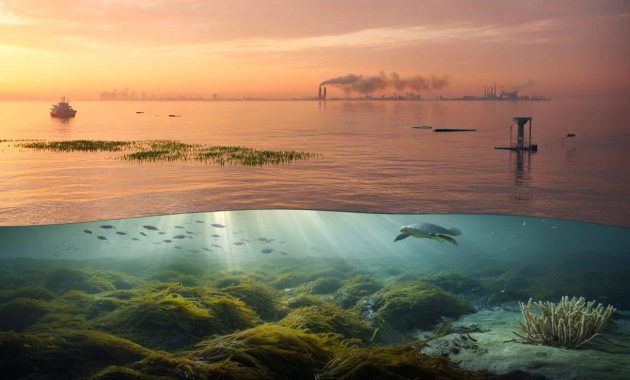
Under pressure from accelerating global heating, governments and companies are eyeing the ocean not just as a victim, but as a potential tool to pull carbon dioxide out of the sky. A new European assessment warns that while the idea sounds tempting, turning the seas into a planetary carbon vacuum could rewrite ecological and geopolitical balances in ways we barely understand.
The ocean, climate shock absorber now pushed to its limits
For thousands of years, the ocean has quietly buffered the planet’s climate. It absorbs heat, takes in CO₂ and stores it in the deep, softening the impact of our emissions. Today, scientists estimate that seas capture around a quarter of the CO₂ we release each year, roughly 10.5 billion tonnes.
This natural “service” is one reason global temperatures have not risen even faster. But it comes with a cost: warmer waters, growing acidification, coral bleaching and stressed marine life from plankton to whales. Into this fragile system, a wave of new ideas is arriving with a bold promise: if nature’s ocean sink is not enough, why not scale it up artificially?
Turning the ocean into engineered climate infrastructure could change how the planet breathes, far beyond the human timescale.
From fertilising plankton to “supercharging” seawater
Researchers are investigating several families of techniques, often grouped under the term marine carbon dioxide removal (mCDR). They all share one goal: increase the amount of CO₂ that the sea can capture and hold for long periods.
- Ocean fertilisation: adding iron or other micronutrients to stimulate phytoplankton blooms that absorb CO₂ through photosynthesis.
- Alkalinity enhancement: dissolving alkaline minerals in seawater so it can hold more dissolved carbon.
- Large-scale seaweed farming: growing macroalgae, then sinking the biomass into deep waters to lock away the carbon.
- Nutrient pumping: using mechanical pumps to bring nutrient-rich deep water to the surface, boosting biological productivity.
On paper, potential is huge. Some modelling studies suggest that, in theory, a portfolio of these methods could remove billions of tonnes of CO₂ per year by mid-century. That prospect starts to look attractive when fossil fuel emissions still tick upwards. The Global Carbon Project expects another 1.1% rise in 2025, despite decades of climate talks.
When the cure starts changing the patient
A flagship report from the European Marine Board, focusing on “Monitoring, Reporting and Verification for Marine Carbon Dioxide Removal”, offers a more sobering view. It stresses that nearly all these technologies are immature and largely untested in the real ocean on meaningful scales.
Deliberately modifying the chemistry or biology of the sea could trigger side-effects that are hard to control. Fertilising plankton might, for instance, increase emissions of other greenhouse gases such as methane or nitrous oxide, partly cancelling the CO₂ benefit. Shifts in plankton communities could ripple up the food web, altering fish stocks and regional oxygen levels.
Every tonne of CO₂ claimed as “stored” in the ocean must be weighed against potential knock-on impacts on marine life and climate.
➡️ This haircut gives men a cleaner profile without sharp lines
➡️ After Pausing BRICS, Saudi Arabia Invests $600 Billion in the US
The challenge of proving carbon is really locked away
One technical headache runs through the whole debate: how to show that the carbon captured by these methods truly stays out of the atmosphere for decades or centuries. The ocean is not a static tank. Currents, storms and biological processes constantly move and recycle carbon.
If artificially stimulated plankton are quickly eaten, or their carbon-rich remains are mixed back into surface waters, the CO₂ may re-emerge into the air in a few years. In that case, glossy claims of “permanent” storage would be misleading at best.
The European report argues that any credible scheme must track three elements with precision:
| Question | Why it matters |
|---|---|
| How much CO₂ is captured? | Determines whether the project has climate relevance or just symbolic impact. |
| How long is it stored? | Long-term storage (centuries) counts more for climate than short-term uptake. |
| What are the side-effects? | Damage to ecosystems or added greenhouse gases can reverse climate gains. |
Achieving this level of monitoring in a dynamic, three-dimensional environment is far harder than checking a forest carbon project on land. It demands new sensors, satellites, models and, crucially, transparent data sharing between states and companies.
Who owns the ocean’s climate service?
Beneath the science lies a political struggle. If the sea becomes a gigantic carbon removal platform, who decides where, when and how the technology is used? And who takes responsibility when something goes wrong?
Most proposals would operate in international waters, beyond any single country’s control. That raises uncomfortable questions. Could a tech firm or a wealthy nation start fertilising a remote patch of ocean, generating carbon credits to offset its emissions, while neighbouring coastal states bear the ecological risks?
The rush for ocean-based carbon credits risks turning shared seas into a new frontier for climate geopolitics.
Green alibi or real climate tool?
The report warns against a scenario in which marine carbon removal becomes a convenient “get-out-of-jail card” for polluters. If oil producers or airlines can claim large quantities of cheap ocean credits, the pressure to cut emissions at source may weaken.
Scientists involved in the assessment argue that robust standards are non-negotiable: independent verification of results, public access to monitoring data and strict rules for claiming any carbon benefit. Without that, the risk grows that ocean interventions will be marketed aggressively while their real climate performance stays opaque.
The authors also stress the risk of technological lock-in. Once major investments flow into specific mCDR methods, powerful interests will emerge to defend them, even if new evidence points to ecological harm or disappointing performance.
When to say no: setting red lines for ocean engineering
One of the thorniest debates is not about which technique is most efficient, but about where the red lines should sit. Some scientists argue for a “go slow” approach focused on small, carefully monitored pilot studies. Others, alarmed by mounting climate damage, claim that delaying large-scale tests might leave humanity with no viable tools later this century.
Any decision to scale up marine carbon removal will hinge on trade-offs:
- Local versus global benefits: a cooler climate globally does not comfort a coastal community facing toxic algal blooms.
- Short-term relief versus long-term risk: rapid CO₂ drawdown today might create persistent disruptions to nutrient cycles.
- Private profit versus shared responsibility: revenue from carbon markets can clash with collective stewardship of the seas.
Climate ethicists point out that people most affected by interventions may have the least say. Small island states, artisanal fishers and Indigenous communities often rely heavily on marine ecosystems but rarely sit at the design table for high-tech projects.
Making sense of the jargon: sink, storage, permanence
Public debates on ocean carbon often get tangled in technical terms. Three concepts shape the discussion.
A carbon sink is any system that absorbs more CO₂ than it emits. The ocean already plays this role naturally. Storage refers to where that absorbed carbon physically ends up – in deep water, sediments, seaweed biomass or dissolved as bicarbonate.
Permanence is about timescale. From a climate perspective, keeping carbon out of the air for a few years is far less valuable than doing so for centuries. Many proposed ocean methods wrestle with this issue: they may look promising on short experiments, but long-term fate of the carbon remains uncertain.
What a cautious path could look like
Several research groups in Europe and North America are sketching out how a responsible testing phase might unfold. It would likely involve limited-area trials under strict conditions: full baseline measurements before intervention, continuous monitoring during and after, clear plans for halting activities if harmful effects appear.
Public funding, rather than carbon markets, may be better suited to this early stage. It reduces pressure to oversell climate benefits and allows scientists to publish negative results without fear of undermining a commercial product.
Scenarios modelled by climate researchers suggest that even optimistic ocean removal contributions cannot replace rapid emissions cuts. At best, they might help balance out the hardest-to-eliminate sources, such as certain industrial processes or residual aviation emissions, in the second half of the century.
The ocean cannot bail out a fossil fuel system that keeps expanding; at most, it can assist a deep, sustained phase-out.
Everyday connections to a vast, hidden debate
Though the technology feels remote, decisions taken now could shape everyday life within decades. The cost of flying, the credibility of “carbon neutral” labels, the health of fisheries and coastal tourism may all, indirectly, hinge on whether ocean removal projects succeed, stall or backfire.
For coastal residents, vigilance matters. Local monitoring of fish stocks, algal blooms and water quality can act as an early warning system if large-scale projects begin nearby. Citizen science – from smartphone photos of unusual blooms to community sampling of coastal waters – can complement official data and put pressure on regulators to demand transparency.
As the climate clock keeps ticking, the ocean is rising as both shield and battlefield. Treating it as a last ecological rampart against global warming could buy precious time. Done carelessly, it could also shift risks from the atmosphere to the seas, trading one crisis for another.