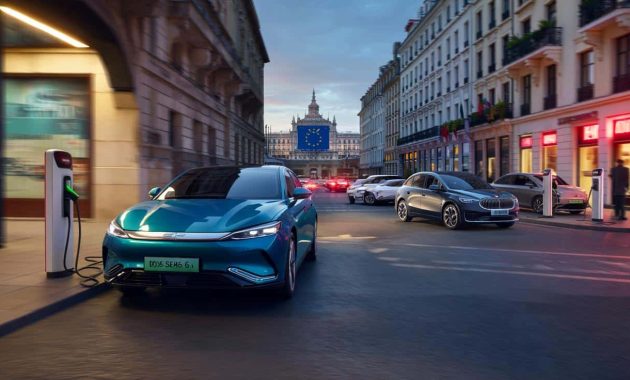
Long‑range plug‑in hybrids from Chinese brands are landing in Europe with price tags that undercut homegrown rivals, just as many traditional manufacturers scale back their mid-size saloons. That clash between policy and market reality is starting to look like a fault line in Europe’s green transition.
China’s long‑range hybrids crash the European party
While European policymakers debate bans on combustion engines, Chinese groups are focusing on a more flexible proposition: plug‑in hybrids that can drive hundreds of kilometres on electricity but keep a petrol engine for long trips.
BYD, already one of the world’s largest EV makers, is pushing hard into this space. Its new Seal 6 DM-i, now on sale in France, is a plug‑in hybrid saloon roughly the size of a Volkswagen Passat, but priced closer to a compact SUV.
Launched at under €39,000 in France, the BYD Seal 6 DM‑i claims up to around 1,500 km of total range on a full tank and full battery.
The car combines an efficient 1.5‑litre petrol engine with an 18.3 kWh battery – far bigger than the typical PHEV battery sold in Europe. On official tests it can cover up to 140 km using electricity alone, enough for a full week of commuting for many drivers.
Brussels wants full electric, drivers want flexibility
The timing of this offensive is not accidental. From 2035, the EU plans to effectively end sales of new combustion cars, nudging buyers towards full electric models. At the same time, low-emission zones are spreading across European cities, from Paris and Lyon to Milan and Madrid.
Those twin pressures were supposed to push motorists into battery‑only vehicles. Instead, a growing share of buyers still hesitate, citing charging infrastructure, high upfront prices and range anxiety on holiday trips.
For urban weekdays, drivers want zero‑emission running; for summer motorway slogs, they still want the safety net of a fuel pump.
That is exactly the gap Chinese long‑range hybrids aim to fill: vehicles that can glide silently through city centres in electric mode and still drive from Paris to Barcelona without a charging stop.
➡️ NASA confirms new propulsion tests that could allow interstellar travel within a human lifetime
➡️ The definition of aging like fine wine? Just ask the Princess of Wales
➡️ Excessive rainfall could transform the Sahara and upend Africa’s balance, study warns
Three Seal 6 versions: range that embarrasses European PHEVs
In France, the Seal 6 DM‑i launches straight away in three trims, all with plug‑in hybrid power and a strong focus on range rather than outright performance.
| Version | Electric range (WLTP) | Total range (claimed) | Price (France) |
|---|---|---|---|
| Boost | 80 km | 1,200 km | €38,490 |
| Comfort Lite | 120 km | 1,400 km | €42,490 |
| Comfort | 140 km | 1,500 km | €43,490 |
For context, a Peugeot 508 Hybrid – one of the rare remaining French PHEV saloons – starts above €46,000 and typically offers about 60 km of electric range and under 800 km combined. The delta is stark, especially when you look at how Europeans actually drive.
Designed around real‑world commuting
On average, French drivers cover around 30 km per day. In that scenario, the Seal 6 Comfort version can operate for several days in full electric mode before the petrol engine is needed. In dense, low‑speed city traffic, owners might see more than 100 km of electric driving between charges.
| Typical use | Fuel consumption (claimed) | Electric range |
|---|---|---|
| Urban commuting | 1.5 L/100 km | 120–140 km |
| Suburban / mixed | 1.8 L/100 km | 100–120 km |
| Motorway | around 5.5 L/100 km | under 80 km |
Those numbers depend heavily on owners plugging in regularly, but they show why this format looks attractive in Europe’s maze of low‑emission rules. A hybrid that behaves like an EV in town, yet still runs like a petrol car on long journeys, sidesteps many of the frictions that hold back pure EV adoption.
French brands retreat just as China advances
The strategic contrast is striking. Stellantis and Renault have been pruning their traditional D‑segment saloons. The Peugeot 508 is nearing the end of its career in hybrid form. Renault’s Talisman, once pitched as a family and fleet workhorse, has already disappeared from catalogues.
At the same time, Chinese makers are deploying a full line‑up of plug‑in saloons and estates into that space. BYD’s Seal 6 is just one example among several upcoming models aimed directly at European company‑car drivers and motorway families.
Where French brands see a shrinking segment, Chinese manufacturers see a wide‑open lane with little competition and strong margins.
This shift matters because D‑segment fleet cars, often leased by employers, play an outsized role in shaping what ordinary drivers see on the road and later pick up second‑hand. If Chinese hybrids become the new default company car, their presence in the used market will follow a few years later.
Interior, practicality and tech aimed at families
On paper, the Seal 6 is sized exactly for that role. At around 4.78 m long with a generous wheelbase, it matches the footprint of many European estates and fastbacks. Rear legroom is described as ample for two adults, and boot capacity of roughly 450 litres places it in classic family car territory.
Equipment is pitched high to tempt drivers out of German and French models:
- Large 15.6‑inch central touchscreen, often rotatable between landscape and portrait
- Digital instrument cluster and head‑up display
- Adaptive cruise control and lane‑keeping systems
- 360‑degree cameras and parking assistance
- Heated front seats from the base trim, with ventilation and faux‑leather upholstery on higher versions
BYD is also proposing a Touring estate variant with a bigger boot and extended roofline, clearly targeted at long‑distance family users and high‑mileage business drivers who still prefer a wagon over an SUV.
Brussels’ policy headache: hybrids versus pure EVs
The success of these high‑range PHEVs could turn into a political headache. EU regulations have so far treated plug‑in hybrids as a transitional step, with incentives already being cut back in several countries. Lawmakers worry that some owners rarely charge their cars and use them mainly on petrol, undermining climate goals.
Long‑range hybrids change that equation slightly. A 140 km electric range makes it entirely plausible to cover daily needs almost exclusively on battery power, provided drivers can charge at home or at work. That puts pressure on regulators to refine how they measure real‑world emissions and usage patterns.
If Chinese PHEVs become common, Brussels may need new rules to distinguish between hybrids that replace fuel and hybrids that simply add weight.
There is also a trade angle. European carmakers argue that state‑backed Chinese rivals benefit from easier access to raw materials, cheaper batteries and lighter regulation at home, allowing them to undercut prices abroad. The arrival of high‑spec hybrids below €40,000 adds fuel to that debate.
What does “plug‑in hybrid” really mean for drivers?
For many car buyers, the jargon surrounding electrification is still confusing. A few key distinctions help unpack what is happening:
- Hybrid (HEV): cannot be plugged in; a small battery assists the engine but offers only a few kilometres of electric running.
- Plug‑in hybrid (PHEV): has a larger battery that can be charged from a wallbox; can typically cover 40–140 km on electricity alone.
- Battery electric vehicle (BEV): has no engine at all; runs exclusively on electricity, usually with 300–600 km of range.
Long‑range PHEVs sit in a grey zone between the two ends of that spectrum. With a battery above 15 kWh, they behave like a compact EV for city use but keep a fuel tank as backup. For many households, that mix can reduce fuel bills sharply without forcing a switch to full electric.
Scenarios: who actually benefits from a 1,000 km hybrid?
Consider a family living outside Lyon, commuting into the city and doing two or three long trips per year. With a long‑range PHEV, most working days would be charged overnight at home and driven in electric mode. Fuel use would cluster around holidays and occasional motorway weekends. Over a year, their petrol consumption could fall dramatically compared with a regular petrol SUV, without the anxiety of planning every long journey around fast chargers.
For company‑car drivers, the picture is similar. A sales rep covering regional routes might recharge at home and at the office, using the engine only on the longest legs. Fleet managers care about official CO₂ numbers and fuel costs. If Chinese hybrids can demonstrate genuine electric usage, not just theoretical capability, they could become very hard to ignore in corporate procurement.
There are risks too. If charging is neglected, these cars carry the weight of a big battery without using it, pushing fuel consumption up. That is why some governments are shifting tax breaks away from plug‑ins and towards fully electric models, or tying incentives to verified charging behaviour through telematics.
Yet the direction from China is clear: keep selling what people feel comfortable using today, not what policy documents would like them to buy tomorrow. As Brussels holds the line on its all‑electric target, Europe’s streets may fill with a different compromise – 1,000 km Chinese hybrids quietly taking market share while the charging network catches up.