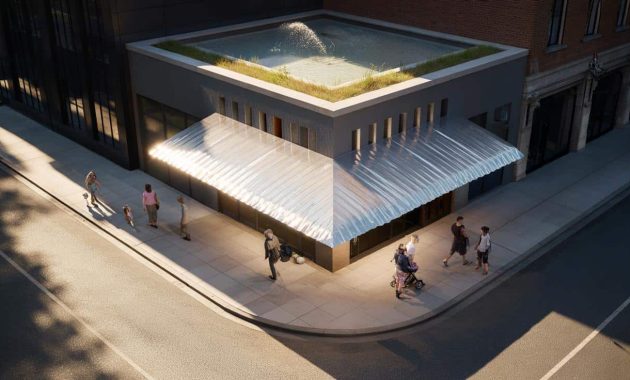
Engineers are hanging bright, reflective canopies over streets and courtyards, then quietly guiding hot air upward into roof ponds that sip it away at noon. The result on the worst days: a local heat island that softens by three, sometimes four degrees — not theory, but footsteps that feel cooler and breath that comes easier.
I’m standing on a block where shade is an active verb. A silver canopy spans the sidewalk like a sail, its underside scattering daylight into a gentle glow. You can see the air move: a soft draw toward the building’s edge, a hush that makes the street sound calmer.
On the roof, there’s a shallow sheet of water, no deeper than a hand, rippling under a high sun. A small baffle guides the rising warmth across this mirror, and then the heat disappears as vapor. People below don’t know the choreography, but they feel it when a stroller rolls from hot to kind. It feels like walking under a lid that’s been lifted. The shadows are working.
Shadows that steer the wind, and ponds that drink heat
Watch a reflective canopy and you start to notice patterns. Bright surfaces bounce away solar energy that asphalt would swallow, but they also create temperature contrast. That contrast sets a tiny engine in motion: air under the canopy stays cooler, air beyond the edge warms, and the warm air rises in a slow plume that the canopy’s shape nudges toward the roofline.
In one test block, crews aligned the canopy’s highest ridge with the afternoon breeze. The hottest air slid toward narrow vents at the façade, climbed through a channeled gap, then crossed the roof pond like a whisper. Street sensors recorded a midday air drop of roughly 2°C, and surface temperatures underfoot fell by 6–10°C compared with the bare sidewalk next door. **On the worst days, the difference is not subtle.** Kids stopped hopping from shade patch to shade patch. They simply walked.
The logic feels almost too simple. Reflect more sunlight so surfaces don’t superheat. Guide the rising convective flow so it doesn’t stagnate over people’s heads. Spread a few centimeters of water where that flow arrives at noon, when humidity is low and evaporation packs the biggest punch. A millimeter of water that evaporates from one square meter absorbs about 2.45 megajoules of heat — enough to nudge air temperatures down when multiplied across rooftops. Do it block by block, and a neighborhood’s daily peak shifts to something survivable.
The playbook: map, angle, sip, repeat
Start with a summer map. Walk a route at 1 p.m., mark the sting points where asphalt radiates and glass throws glare. Measure if you can, but your skin is a decent guide. Then hang canopy panels so their ridges and openings line up with the prevailing afternoon wind. Give heat somewhere to go — narrow slots at building edges, not a dead end over the sidewalk. **Start where people gather, then connect the dots.**
On the roof, build a shallow pond, 3–5 cm deep, using light-colored, UV-stable liners and a rough, wicking mat so water spreads evenly. Add a low lip and a tiny overflow to a downspout cistern. The pond should breathe at midday and be gently covered at night with a floating mesh to suppress unnecessary losses. A small pump can nudge circulation during the highest sun, then rest. Let gravity and the sun do most of the work. Let’s be honest: no one does that every day.
Common mistakes come from good intentions done fast. Too low a canopy can trap hot breath at head height; too high and you lose the draft. Black shade cloth looks cozy but bakes; choose high-albedo materials with diffusing textures to cut glare. Don’t leave roof water stagnant — keep it moving a little, keep it shallow, and prevent mosquito habitat with flow and mesh. People worry about water use; audits show these systems can run on captured rain plus small top-ups, especially when paired with drought-tolerant landscapes. **You’re designing a rhythm, not a machine.**
“We stopped trying to cool the whole sky,” an urban designer told me. “We cool the space where people live, then we shepherd the rest to a place that can handle it.”
➡️ The phrase Albert Einstein told his 11-year-old son that every parent should repeat
➡️ The mental reason people seek meaning during stressful periods
➡️ A400M: Airbus bets on a “mother ship” aircraft for drones
➡️ Why some people still go to work despite the cold
➡️ Goodbye Lidl and Action: an even cheaper discount chain is opening a new store in this major city
- Typical midday air drop on pilot blocks: 1.5–3.5°C; surface temp drop: 6–12°C
- Target canopy height: 3.2–4.5 m; ideal gap at façade: 20–40 cm for a steady draw
- Roof pond depth: 3–5 cm; add wicking mat and floating mesh for even evaporation
- Water budget: prioritize rain capture; top-up needs are modest in most climates
- Maintenance: monthly rinse, quick mesh check, seasonal liner inspection
What cooler streets unlock
When heat backs off, the city changes tempo. Bus stops become reading rooms again, street food lines reappear, lunchtime basketball returns. Shops along shaded routes report longer dwell times, and morning-only parks get an evening second life. It’s not just comfort; it’s the return of spontaneity.
Health departments like what they see: fewer heat stress calls near the pilots, more older adults walking in late afternoons. Schools with reflective shade and roof ponds report calmer playgrounds. We’ve all had that moment when you cut across a blinding plaza and feel the sun flatten your will. Cooling with shadows isn’t a luxury upgrade. It’s dignity.
The next wave looks communal. Blocks syncing their canopy angles to pass the draft along. Rooftops co-managing their ponds like an urban commons. Local makers swapping in modular sail panels with art, not just engineering. The underlying physics might be ancient, but the civic practice is new. It asks a simple question that sparks neighbors to act: where should the shade fall first?
| Point clé | Détail | Intérêt pour le lecteur |
|---|---|---|
| Reflective canopies steer convection | Angle ridges with afternoon wind; vent warm air toward roofs | Cooler sidewalks without heavy machinery |
| Roof ponds evaporate at noon | 3–5 cm water over wicking mat; floating mesh at night | Removes heat where it gathers, cuts peak stress |
| Block-by-block rollout works | Start with stops, schools, markets; then connect corridors | Actionable, affordable plan for your street |
FAQ :
- Doesn’t this waste water in a drought?The systems are shallow and can run mostly on captured rain, with small top-ups. Evaporating a few millimeters at noon delivers big cooling per liter.
- Will reflective canopies create glare?Choose high-albedo fabrics or panels with diffusing textures. They bounce light softly instead of beaming it like a mirror.
- What about mosquitoes in roof ponds?Keep water moving across a wicking mat, stay shallow, and add floating mesh. That combination disrupts breeding without chemicals.
- Does this work in humid climates?Shade and reflection help everywhere. Evaporative cooling is strongest in dry heat, yet even in humidity, moving hot air away from people still pays off.
- How much does a pilot block cost?Budgets vary, but modular canopies and simple roof liners are far cheaper than new mechanical cooling. Start with one corner and scale by season.