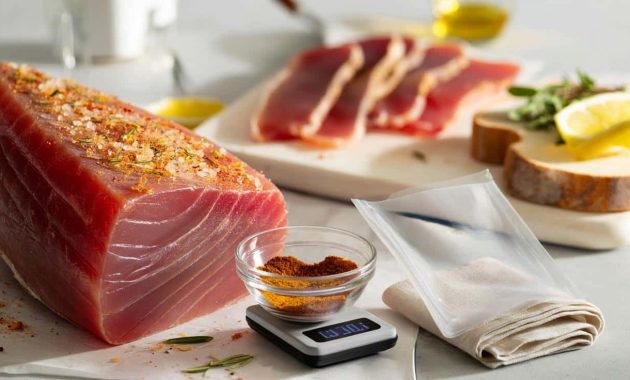
Across social feeds, one simple method is turning a single tuna steak into something closer to a marine charcuterie, without a smoker or specialist gear.
From viral trend to home staple
Scroll through food Instagram in 2025 and you see a pattern: creators move away from complicated gadgets and focus on slow techniques you can manage in a flat kitchen. Drying tuna in the fridge fits that mood perfectly.
Belgium-based creator Greg from CookAndRoll has helped push the method into the mainstream. His video shows an entire curing process happening in an ordinary refrigerator, with no dehydrator, no professional vacuum chamber, and no fermentation cave. Just a piece of tuna, a digital scale, and a bit of patience.
This “fridge-cured” tuna acts like a sea-born cousin of cured ham: dense flavour, firm texture, paper-thin slices.
The concept sounds niche, but it taps into wider food trends: people want less waste, more control over ingredients, and flavours usually reserved for restaurants. Cured tuna checks all three boxes.
What makes dried tuna so interesting?
When you remove moisture from tuna in a controlled way, flavours concentrate. The texture tightens but still keeps some tenderness, giving you something between sashimi and Italian bresaola. In Japan, shaved katsuobushi plays a similar role, adding depth to broths and toppings. Home-dried tuna feels more accessible and less technical, but the goal is similar: extract umami.
Nutritionally, you keep the protein load of fresh tuna, while salt and aromatics shape the final profile. You lose a small share of heat-sensitive nutrients during the longer fridge time, but you also gain a product that lasts longer and reduces the risk of throwing away an expensive piece of fish forgotten in the back of the fridge.
The basic method: salt, sugar and patience
Choosing the right cut
Start with a fresh, high-quality tuna steak. Look for:
- Firm flesh, with no mushy patches
- A clean, marine smell, not overly fishy
- A uniform thickness to help even curing
- A deep, bright colour without grey edges
Albacore, yellowfin or bluefin all work, but home cooks often reach for yellowfin because it sits at a reasonable price point and appears widely in supermarkets.
➡️ This simple change supports physical ease without exercise
➡️ A new study reveals most people get leg training wrong: here’s why
➡️ Wood-burning stove: the object to place near your firewood
The curing formula
The method circling social media relies on precise ratios based on the tuna’s weight. The creator’s rule of thumb goes like this:
| Ingredient | Percentage of tuna weight | Role in curing |
|---|---|---|
| Fine salt | 4% | Draws out water, seasons, protects |
| Sugar | 2% | Balances salinity, softens texture |
| Ground spices | 1% | Adds aroma and character |
For a 500 g tuna steak, that means 20 g of salt, 10 g of sugar and 5 g of spices, mixed thoroughly before coating the fish. Pepper, smoked paprika, chilli flakes, fennel seed, citrus zest or dried garlic all appear regularly in home versions. The mix needs to wrap every side of the tuna, including the edges.
Weighing each element keeps the cure predictable: too much salt and the tuna hardens; too little and you risk spoilage.
Bag, chill, wait
Once coated, the tuna goes into a vacuum bag if you have one. No machine? A simple freezer bag with the air pressed out by hand or using the water displacement method works surprisingly well. The aim is close contact between fish and cure, without large pockets of air.
The bag then rests in the fridge for around four days. During this time, the salt and sugar draw moisture out, while flavours soak in. You can flip the bag once a day to keep the cure working evenly.
The slow drying stage in the fridge
After several days, a small pool of brine collects inside the bag, and the tuna feels firmer to the touch. At this point, the creator rinses the fish under cold water, removes all remaining cure, and dries it thoroughly with kitchen paper.
The next move surprises many viewers: instead of hanging the fish in a specialised cabinet, he wraps it in a clean cloth and returns it to the fridge for at least ten more days. The fridge acts as a basic curing chamber, provided it stays cold and relatively dry.
Wrapped in fabric, the tuna keeps breathing while it dries; moisture leaves slowly, flavour hangs back.
The cloth prevents the surface from overdrying too fast, softens odours in a shared fridge, and gives the exterior a more even finish. The wrap needs changing if it becomes very damp in the first days, which signals that the fish is still losing a lot of water.
By day ten to fifteen, the tuna usually reaches a stage where the outside feels firm, the inside still shows some give, and the smell stays clean and marine. At that point, many home cooks start slicing.
How to serve dried tuna like a chef
Fine slices, big payoff
Dried tuna shines when you slice it razor-thin. A sharp knife or mandoline helps. You can serve it:
- On toasted sourdough with a drizzle of olive oil and lemon zest
- Shaved over steaming pasta, in place of grated hard cheese
- On top of warm potatoes with herbs and a light vinaigrette
- Alongside tomatoes, olives and capers for a Mediterranean-style plate
- As a garnish for creamy scrambled eggs or a soft omelette
Some cooks grate fully dried ends of tuna over ramen or broth, much like a shortcut to smoky stock. Others fold small cubes into butter to spread over grilled corn or roasted vegetables.
A zero-waste angle
Dry-curing offers a practical response to a modern kitchen problem: what to do with a large piece of fish when plans change. Instead of freezing it for months until texture suffers, you convert it into a long-keeping condiment. Wrapped tightly after curing, the tuna can hold for several weeks in the coldest part of the fridge, as long as you inspect colour and smell before each use.
Safety, storage and sensible limits
Homemade curing always raises a basic question: how do you keep things safe? Three factors help here: enough salt, consistent cold and common sense. Using weighed ingredients, keeping the fridge below 4 °C (around 39 °F), and avoiding cross-contamination with raw meat all reduce risk.
If the tuna smells sour, feels slimy or shows suspicious discolouration, it belongs in the bin, not on a plate.
Because the product contains salt and concentrated protein, health professionals often suggest moderation for people with high blood pressure or kidney issues. Portions stay small anyway, since dried tuna works more like a seasoning than a main course. A few shavings over a dish already bring a noticeable impact.
Beyond tuna: other fish and future trends
The method does not have to stop at tuna. Home cooks already test similar ratios on salmon, mackerel or swordfish, adjusting times and thickness. Oily fish bring stronger flavours and a different, sometimes more buttery, texture. Leaner species need careful watching so they do not dry out too much.
Food analysts see this kind of technique-driven, low-equipment cooking as part of a broader shift. After years of air fryers and elaborate gadgets, people seem ready to slow down and let time do some of the work again. Fridge-cured tuna sits right in that lane: accessible, visually striking on camera, and manageable even in a shared kitchen.
For anyone curious about fermented, cured or aged foods, a small piece of tuna in a cloth offers a low-stakes starting point. It costs less than a full charcuterie setup, teaches how salt and time reshape texture, and can quietly change the way you think about a single piece of fish.