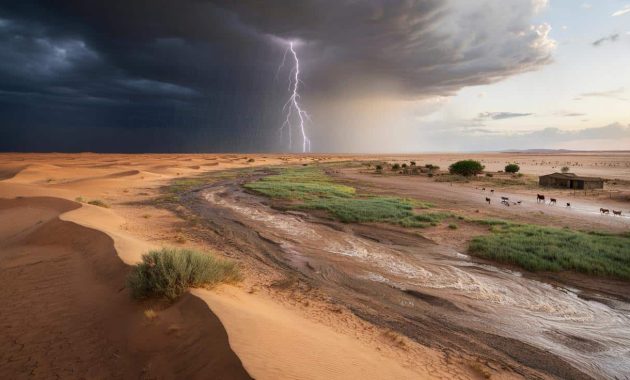
New climate projections suggest the Sahara may not stay the vast, bone-dry desert we know today, with far-reaching consequences for African societies, ecosystems and weather patterns across the continent.
A wetter Sahara sounds hopeful – but comes with a catch
For decades, climate risk in Africa has meant one thing above all: not enough rain. Scientists now say the problem may increasingly be the opposite in some regions. A study published in 2025 in the journal npj Climate and Atmospheric Science finds that parts of the Sahara could see rainfall increase by up to 75% by the end of this century.
The research team, led by scientists at the University of Illinois Chicago, combined data from 40 global climate models. They compared records from 1965–2014 with projections out to 2099 under two different greenhouse gas scenarios: a mid-range pathway (SSP2‑4.5) and a high-emissions future (SSP5‑8.5).
The headline result: even in a mid-range warming scenario, large areas of North Africa shift towards a far wetter climate than today.
Rising temperatures load the atmosphere with more water vapour. Warmer air can hold more moisture, so when conditions line up for storms, there is simply more water available to fall as rain. Over the Sahara, this leads to more frequent and often more intense rainfall events, driven mainly by convective storms – violent downpours linked to towering thunderclouds.
How changing winds push moisture into the desert
The study points to a major reshuffle in the circulation of air above Africa. Two features are central here: ocean moisture flows and the so‑called Hadley cells.
Today, much of the Sahara lies beneath descending dry air that suppresses clouds and rain. As the planet warms, this zone of sinking air shifts. The Hadley circulation, a huge loop of air rising near the equator and sinking in the subtropics, moves slightly northward.
As the belt of tropical rain creeps poleward, regions that once sat under dry, sinking air start to feel the edge of monsoon systems and storm tracks.
The models suggest that moist air from both the Atlantic and the Indian Ocean will penetrate deeper into North Africa during certain seasons. That means more days when humid air collides with scorching desert heat – perfect fuel for thunderstorms.
➡️ “I was losing $90 a month without even noticing it”
➡️ The mental shortcut that causes people to misjudge effort
➡️ [News] France orders 2 GlobalEye Awacs from Sweden, but must transform its kill web
Not just the Sahara: Africa’s rain map is being redrawn
The projected changes extend well beyond the dunes of Libya, Algeria and Chad. Across the continent, the patterns look like this:
- Central and southern Africa: projected rainfall increase of around 17–25%
- Parts of the Sahel: potential gains in seasonal rainfall and pasture growth
- Far south of the continent (including parts of Namibia, Botswana, South Africa): slight drying, with rainfall losses of up to about 5%
Instead of a simple “wetter Africa”, scientists see shifting contrasts. Some farmers might welcome extra rain. Others could face shorter, more erratic wet seasons, or unwelcome downpours that destroy crops and infrastructure.
A ‘green Sahara’ – or a landscape of flash floods?
The idea of a greener Sahara is not science fiction. Geological records show that during past warm periods, North Africa hosted lakes, rivers and savanna-like vegetation. The new study indicates parts of the region could begin moving in that direction again.
More than 70% of the new rainfall is expected to come from convective storms. These are the kind of short, explosive events that can turn dry wadis into raging torrents within hours.
On paper, more rain suggests new farmland and revived grasslands; in practice, poorly absorbed deluges can carve away soil and overwhelm fragile settlements.
Most Saharan soils are not built to handle persistent, heavy rain. Decades of intense heat and sparse vegetation have left hard crusts at the surface, which shed water quickly. Instead of soaking into the ground to replenish aquifers, much of the rain may race off as surface runoff.
Ecological shifts with uncertain winners
As rainfall creeps into the desert’s margins, scientists expect major changes in vegetation and wildlife. Semi-arid shrubs could advance northward. Temporary wetlands might appear in low-lying basins. Migratory birds, insects and mammals may alter their routes to match new food and water sources.
But these new ecosystems could be unstable. A few wetter decades followed by renewed drying would leave species stranded in habitats they cannot sustain. The transition period could also favour invasive plants or pests that thrive in disturbed, water-stressed landscapes.
Monsoon timing: a few weeks that decide harvests
Beyond total rainfall, timing is critical. African agriculture, especially smallholder farming, depends on fairly predictable wet and dry seasons. Even a shift of a few weeks in monsoon onset or retreat can make or break a harvest.
Farmers plan planting, herders plan migration and governments plan water storage around when, not just how much, rain arrives.
The study’s projections suggest that as the Sahara wets, the broader African monsoon system may become more erratic. Some regions could get shorter, more intense rainy seasons. Others might see the rains start later but end with prolonged storms, raising flood risk.
For millions living close to the edge, these subtle calendar shifts determine whether there is enough food, fodder and drinking water to get through the dry months.
Social and economic fault lines across the continent
Changing rainfall patterns can aggravate existing tensions. In the Sahel, pastoralist communities already clash with farmers as grazing routes overlap farmland during drought years. A return of richer pastures might ease some strain, but only if governance keeps pace.
In southern Africa, where some regions may lose rain, pressure on shared rivers such as the Zambezi or Orange could climb. Hydropower dams designed for past flow patterns may deliver less electricity, especially during regional droughts.
| Region | Projected rainfall change | Key risks | Potential opportunities |
|---|---|---|---|
| Sahara and Sahel margins | Strong increase (up to ~75% locally) | Flash floods, erosion, infrastructure damage | New grazing areas, possible expansion of rain-fed crops |
| Central and southern tropics | Increase (~17–25%) | Crop losses from heavy storms, disease spread | Higher hydropower potential, fuller reservoirs |
| Far southern Africa | Slight decrease (up to ~5%) | Drought stress, water-sharing conflicts | Incentive for efficiency, diversification of livelihoods |
Adapting to an Africa where “too much” and “too little” coexist
The authors of the study argue that adaptation planning cannot focus just on drought any longer. Many places will need to manage both extremes: downpours and dry spells, often in the same year.
Managing water becomes less about chasing scarcity alone and more about dealing with volatility.
Researchers and policymakers are already talking about a set of combined strategies:
- Building flood-resilient infrastructure in towns that sit along dry riverbeds likely to see flash floods
- Upgrading drainage and early warning systems to handle more intense storms
- Promoting drought and flood-tolerant crop varieties that can survive erratic seasons
- Protecting and restoring vegetation belts that slow runoff and limit erosion
- Designing flexible grazing agreements so herders can adjust routes as pastures shift
These choices influence whether extra rain becomes an asset or a hazard. A wetter Sahara could theoretically support solar-powered irrigation, new trade routes and reforestation projects. Without planning, the same rains could wipe out roads, contaminate wells and deepen rural poverty.
What the climate jargon actually means
The scenarios used in the study, labelled SSP2‑4.5 and SSP5‑8.5, often sound abstract. In practice, they represent different futures for emissions and policy choices.
SSP2‑4.5 assumes some climate action and a middle-of-the-road development path. Emissions peak and then decline slowly. SSP5‑8.5 describes a world that stays hooked on fossil fuels, with rapid economic growth but weak climate policies. Both show a wetter Sahara, although the higher-emissions path produces stronger changes and greater uncertainty.
Another key term is “convection”. This simply refers to warm, moist air rising quickly, cooling as it goes, and condensing into clouds and rain. In a hotter climate, convection can become more powerful, so when storms form over the Sahara, they may look more like tropical downpours than the rare light showers of the past.
Future scenarios: from new oases to climate migration
Looking ahead, researchers are sketching out contrasting futures for North Africa. In an optimistic scenario, countries invest in climate-resilient roads, dams and early-warning systems while emissions fall. Increased rainfall supports carefully managed oases, new farming belts on the desert’s margins and restored ecosystems that lock away carbon.
In a more chaotic scenario with high emissions, the same rainfall shifts arrive faster and hit harder. Flash floods repeatedly damage settlements built for dry conditions. Farming gambles on unstable rainy seasons. People move, within and across borders, chasing more reliable water and shelter from extreme heat and storms.
Either way, the message from the science is stark: the Sahara is not fixed in stone. As global temperatures climb, the desert’s climate stretches and twists. The question for the rest of Africa is whether societies can adapt fast enough to live with a sky that gives too much, too late, or in the wrong place.