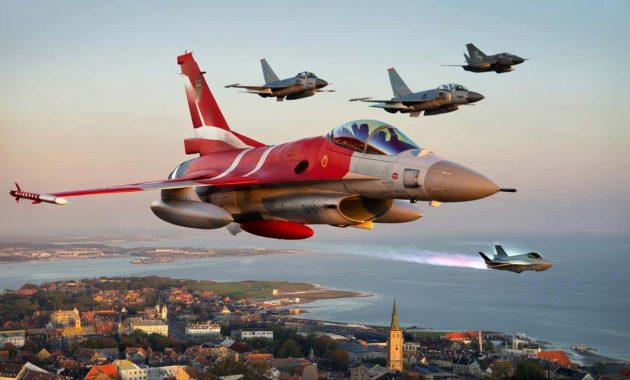
After nearly half a century on duty, Denmark is preparing a heartfelt farewell to the F‑16 Fighting Falcon, the compact American-built jet that guarded its airspace through the Cold War, Balkan crises and Baltic tensions. The departure closes a 46‑year chapter for the Royal Danish Air Force and signals a new era dominated by the F‑35A stealth fighter – and by a surprising second life for many Danish F‑16s in Argentina and Ukraine.
The end of a 46‑year partnership
Denmark’s relationship with the F‑16 began in the late 1970s, when the country joined a major NATO procurement deal often dubbed “the contract of the century”. At that time, the Royal Danish Air Force, or Flyvevåbnet, was juggling three different types of fighter aircraft.
Danish pilots flew ageing American North American F‑100 Super Sabres, sleeker Lockheed F‑104 Starfighters, and Swedish-built Saab J35 Drakens. Maintaining three separate fleets meant three sets of spare parts, three training pipelines and three support systems. For a small country, this was a logistical headache.
The arrival of the F‑16A/B Fighting Falcon changed that. Once the first airframes reached Danish bases, the F‑100s were quickly retired and scrapped. The Starfighters followed a few years later. As the Soviet Union collapsed and the Cold War ended, the Drakens also faded from the flightline.
By the early 1990s, the F‑16 had become the sole front‑line fighter under Denmark’s red‑and‑white roundel.
From that point on, if you saw a Danish combat jet overhead, chances were it was an F‑16.
A jet pilots genuinely loved
Ask Danish pilots and many will tell you the same thing: the F‑16 felt like an extension of their own body. Its bubble canopy gave superb visibility, its fly‑by‑wire controls made it agile and responsive, and its single engine delivered serious punch for its size.
Aviation fans across Europe came to know Danish F‑16s through airshows. One aircraft in particular, painted in a striking red‑and‑white “Dannebrog” scheme inspired by the national flag, became a star attraction. Its solo display routines showcased the jet’s tight turns, high‑G manoeuvres and rocket‑like climbs.
The Dannebrog‑painted F‑16 turned a workhorse interceptor into a crowd‑pleasing symbol of national pride.
➡️ Invisible scaffolding of the universe’ revealed in ambitious new James Webb telescope images
➡️ Farewell to happiness : the age when it fades, according to science
➡️ You would die in space in 15 seconds:You would die in space in 15 seconds.
➡️ Fast walkers are not healthier they are just more anxious and unstable
➡️ No air freshener needed how hotels keep bathrooms smelling fresh
Behind the displays, though, the jet remained a combat machine first and foremost. Modernised over the years to F‑16AM/BM standard, Denmark’s fleet carried advanced radars, precision weapons and modern communications, allowing it to integrate with other NATO forces with ease.
From home defence to Baltic patrols
For 46 years, the F‑16’s core mission stayed the same: protect Danish airspace. That meant quick‑reaction alert duties, intercepting unidentified aircraft near national borders and shadowing Russian bombers or reconnaissance planes approaching NATO territory.
The jets also deployed abroad. Denmark was an early contributor to NATO’s Baltic Air Policing mission, which provides fighter cover for Estonia, Latvia and Lithuania. Danish F‑16s first took on the task in summer 2004 and returned repeatedly over the years.
Key Baltic Air Policing rotations for Danish F‑16s
- Summer 2004: first Danish rotation over the Baltic states
- January 2009: renewed deployment amid rising tensions with Russia
- September 2011 and January 2013: continued presence to reassure allies
- May 2014: mission during the crisis following Russia’s move in Crimea
- January 2018 and September 2019: regular NATO deterrence patrols
- August 2021 and January 2022: among the final F‑16 Baltic rotations
Danish jets also flew combat operations over the Balkans, the Middle East and North Africa as part of wider NATO and coalition efforts, striking ground targets and enforcing no‑fly zones.
Farewell flights above Denmark
The emotional peak of this long story comes on Sunday, 18 January 2026. On that day, the Flyvevåbnet schedules a series of farewell flights, sending formations of F‑16s over major cities and small towns across the country.
People in Copenhagen, Aarhus, Odense and smaller communities island‑hopping along the coasts will look up and see the familiar silhouette one last time. For older Danes, it will recall Cold War air‑raid drills and newspaper headlines about NATO. For younger generations, it will trigger memories of noisy childhood airshows and holiday photos with the Dannebrog jet in the background.
On 1 February 2026, the F‑16 will be formally removed from the Royal Danish Air Force’s active inventory.
A handful of aircraft will stay operational for a few extra days after the farewell flights to cover transition needs. Then the type will officially vanish from Danish order of battle charts, even if a few airframes end up in museums or as gate guardians outside bases.
Enter the F‑35A Lightning II
The F‑16’s successor in Danish service is the Lockheed Martin F‑35A Lightning II. This new jet is a stealth fighter designed to evade radar, gather vast amounts of data and act as a flying sensor hub for other aircraft and ground forces.
Where the F‑16 was built around agility and clear‑day dogfights, the F‑35 emphasises information dominance. Its pilots fly with helmet‑mounted displays that project sensor feeds directly in front of their eyes. The airframe is shaped to reduce radar reflections. Its software fuses inputs from multiple sensors into a single tactical picture.
For Denmark, the shift to the F‑35A also fits into a broader NATO trend. Countries that once relied on the F‑16 – such as Norway, the Netherlands and Belgium – are moving to the same stealth platform. That creates common training pipelines and easier cooperation during joint missions.
| Feature | F‑16AM Fighting Falcon | F‑35A Lightning II |
|---|---|---|
| First Danish deliveries | Late 1970s / early 1980s | Mid‑2020s |
| Engines | 1 × turbofan | 1 × more powerful turbofan |
| Design focus | Agility and multirole flexibility | Stealth and information fusion |
| Main role in Denmark | Air defence, Baltic patrols, ground attack | Air defence, strike, networked operations |
A second life in Argentina and Ukraine
Retirement from Danish service does not mean the F‑16 design is finished. On the contrary, the aircraft is finding new life in other air forces.
Denmark has agreed to transfer a portion of its F‑16 fleet abroad. Argentina is acquiring modernised aircraft to rebuild its fighter capability after decades without a comparable fast jet. For Buenos Aires, the F‑16 offers a relatively affordable entry back into modern air combat, with access to NATO‑standard avionics and weapons.
Ukraine is also set to receive Danish F‑16s, alongside jets from other European partners. For Kyiv, these aircraft promise a major upgrade over its Soviet‑era MiG‑29s and Su‑27s, especially for air‑to‑air engagements and precision strikes against high‑value targets.
From Danish skies to new front lines, the same F‑16 airframes will serve under different flags and in very different strategic environments.
The transfers underline how robust the original 1970s design has proved. With upgrades, the F‑16 can still carry cutting‑edge missiles and guided bombs, and its systems remain compatible with many modern NATO assets.
What “retirement” really means for a fighter jet
When a country retires a combat aircraft, several paths are possible for each airframe:
- Active service abroad via sale or donation
- Conversion into a training aid for mechanics or emergency responders
- Placement in museums or as static displays at bases
- Storage for potential cannibalisation of spare parts
- Eventual scrapping and recycling of materials
Danish F‑16s will likely follow all of these routes. A few high‑profile jets may end up under museum spotlights. Others will quietly keep working on distant runways, far from their original North Sea weather and Baltic patrol zones.
Understanding key terms: Baltic Air Policing and stealth
Two expressions around this story deserve a quick explanation. The first is “Baltic Air Policing”. This is a NATO mission launched in 2004 to protect the airspace of Estonia, Latvia and Lithuania, which lack their own modern fighter fleets. NATO members take turns sending jets and crews to bases in the region, providing 24/7 interception coverage.
The second is “stealth”. In aviation, this refers to design features that reduce an aircraft’s visibility to radar and other sensors. On jets like the F‑35A, this includes angular surfaces that deflect radar waves, special coatings, and careful placement of weapons inside bays instead of on external pylons. Stealth does not make an aircraft invisible, but it can force enemy radars to detect it later and at shorter ranges, giving pilots more options.
Risks, benefits and what comes next for Danish air power
Switching from the F‑16 to the F‑35A comes with clear benefits and some risks. Danish pilots gain a far more capable sensor suite and closer integration with allied forces, especially in contested airspace. They also move to an aircraft designed for future software upgrades and new weapons.
On the risk side, the F‑35A is more complex and expensive to operate. Training new pilots and technicians takes time. During the transition period, Denmark must juggle retiring jets, incoming deliveries and ongoing NATO obligations, such as potential new Baltic rotations.
For ordinary Danes, though, the most visible change will be noise and shape. The sharp‑nosed F‑16, with its distinctive air intake under the fuselage, will fade from daily life. In its place, a chunkier, stealthier silhouette will occasionally roar overhead.
Some years from now, a child watching an F‑35A streak across a Danish sky might ask a parent what came before. The answer will include Cold War patrols, Baltic deployments, overseas combat – and a January day in 2026 when people across the country looked up and said, with a touch of nostalgia: “Farvel, F‑16.”