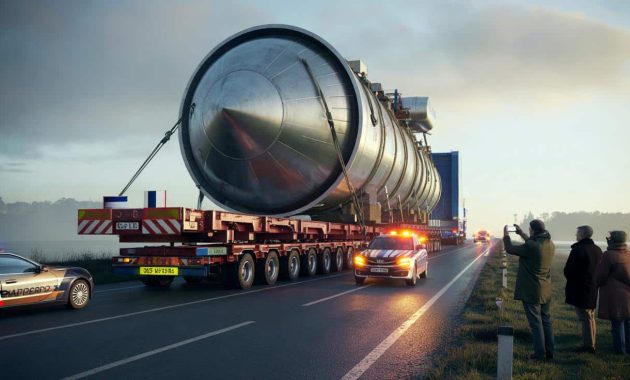
In the grey half-light of a Norman morning, a strange procession rolled out of Framatome’s plant at Saint-Marcel. On a low-loader as long as a city street, 500 tonnes of perfectly machined steel crept forward at walking pace. Engineers in hard hats walked alongside like anxious parents escorting a child’s first steps, glancing up at the gigantic cylinder that will one day sit at the heart of Britain’s newest nuclear reactor at Hinkley Point C. Lorries were stopped. Villages froze. Phone cameras came out.
Somewhere between the diesel rumble and the nervous smiles, you could feel it: this wasn’t just an industrial shipment.
It was a piece of the future inching down a country road.
France’s steel giant on the road to Somerset
The “colossus” leaving France is no marketing exaggeration. The reactor pressure vessel destined for Hinkley Point C weighs roughly 500 tonnes, about the same as a fully loaded Airbus A380. It has been forged, welded and polished in a highly choreographed process that took years and cost more than most small towns’ annual budgets.
When it moves, nothing else does. Police escorts clear junctions, electricity lines are checked and rechecked, and bridges along the route are quietly inspected days in advance.
On the roadside, the scene feels oddly personal. A couple in their seventies stand at the edge of a farm track, wrapped in scarves, watching the convoy pass. The man lifts his phone but keeps forgetting to hit record, distracted by the unreal scale of what’s coming towards him. Behind them, a teenager leans on a bike, broadcasting the whole thing live on TikTok, his audience asking if this is “some kind of rocket”.
For locals, it’s a one-off spectacle. For the UK, it’s the start of 60 years of low‑carbon electricity quietly humming from the Somerset coast.
The reason this shipment matters so much is simple: without this vessel, there is no reactor. It’s the core steel shell that will hold the superheated water and the fuel assemblies of the EPR, the so‑called generation III+ design at Hinkley Point C. More safety systems, more redundancy, thicker steel, more sensors.
The UK has bet tens of billions that this technology, largely designed and manufactured in France, will underpin its energy security long after the last gas boilers are scrapped.
Inside the “colossus”: what’s really being shipped
Behind the photos of the mega‑convoy lies an almost obsessive manufacturing ritual. The steel for Hinkley’s reactor vessel is melted, refined and poured into enormous ingots, then forged under presses that can crush a car like a soda can. Sections are heated and reshaped again and again, until the metal’s internal grain runs smoothly, with no dangerous weak points.
➡️ One of the world’s most reliable brands admits it: electric cars aren’t their goal after all
➡️ It’s the worst washing-machine program and even repair techs warn against it: a real waste of water
➡️ France and Rafale Lose €3.2 Billion Fighter Jet Deal After Last?Minute U?Turn
Each weld is X‑rayed, ultrasound-tested, recorded, argued over. A tiny anomaly can trigger weeks of rework.
There’s a reason these components are rare. Only a handful of sites in the world can forge steel pieces this large and this precise, and Framatome’s Saint‑Marcel plant is among the few with the track record to reassure anxious regulators in London and Brussels. At Flamanville in France and Olkiluoto in Finland, earlier EPR projects were hit by delays partly linked to component quality and paperwork.
Everyone involved at Saint‑Marcel knows those stories by heart, and nobody wants a sequel.
Once finished, the vessel’s journey is an engineering project in its own right. From the plant, it travels by road, crawling through villages at a speed that would frustrate a jogger. Then it’s loaded onto a barge or heavy‑lift ship, crossing the Channel under close watch. At Hinkley Point C’s specially reinforced jetty, cranes that look tiny from the cliffs swing into action.
This is where the calm choreography meets the messy unpredictability of weather, tides and British bureaucracy. *A single missed tide window can push everything back by days.*
What this means for the UK’s power – and your bills
The arrival of the reactor vessel signals a shift from abstract policy to physical reality. For years, Hinkley Point C has been a construction site with more mud than machinery visible to the public: trenches, concrete, rebar forests. Once this 500‑tonne heart is lowered into place, the project starts to look like an actual power plant.
Engineers talk about “installation milestones”, but what they really mean is: from this point on, the idea of nuclear electricity in 2030 stops feeling like a promise and starts feeling like a date.
Energy planners in Whitehall are watching this very closely. The UK’s old nuclear fleet is ageing fast; several AGR reactors have already shut or are close. Wind and solar have boomed, but calm, cloudy weeks still happen and gas prices can spike overnight. So the government’s plan has been to blend renewables with *firm* low‑carbon power that doesn’t care if the sky is blue or not.
This 500‑tonne vessel is the physical expression of that plan: baseload power to back up a renewables‑heavy grid.
Of course, none of this is neutral. The contract for Hinkley Point C guarantees EDF and its partners a *strike price* far above the wholesale electricity price when the deal was signed, locked in for decades. Critics have called it an expensive mistake. Supporters counter that recent gas price shocks show why locked‑in, predictable nuclear costs are not the worst deal on the table.
Let’s be honest: nobody really reads the small print on their energy bill unless something goes terribly wrong.
France, Britain and the uneasy marriage of nuclear ambition
The Franco‑British partnership at Hinkley is both deeply pragmatic and politically charged. On one side, you have France: decades of nuclear expertise, state‑backed giants like EDF and Framatome, and factories that still know how to forge 500‑tonne components. On the other, the UK, which once had a proud nuclear programme and then largely let it wither, now scrambling to rebuild capacity without starting from scratch.
This colossus is France exporting not just steel, but confidence that it still knows how to play at the top tier of the nuclear league.
We’ve all been there, that moment when you outsource a task you once prided yourself on doing alone. That’s the emotional undercurrent some British engineers quietly feel as they watch French‑built hardware roll into Somerset. The design is French. The operator is French. The UK brings the site, the politics, the money, the workforce, the regulatory culture.
It’s a partnership born as much from necessity as from shared vision, stitched together across the Channel by cables, contracts and sheer mutual need.
“Without France’s heavy nuclear industry, Hinkley Point C simply wouldn’t exist,” says one senior UK engineer who has worked on the project since its early days. “But without the UK’s political will and financing, these EPRs would stay on paper. It’s a marriage of convenience that might just work.”
- Cross‑Channel dependence – The UK relies on French tech and manufacturing, France relies on UK money and political cover.
- Shared nuclear brand – Hinkley’s success or failure will echo back on both countries’ future projects.
- Geopolitical signal – Europe can still build enormous, complex infrastructure, even in an age of doubt and delays.
What this steel cylinder says about our future
Seen from a drone, the reactor vessel is just another piece of industrial hardware being nudged into place by cranes and men in hi‑vis. Seen up close, it feels like a bet. A bet that we’ll still want huge, centralised power plants in 2060. A bet that long‑term waste can be managed responsibly. A bet that climate anxiety will one day feel slightly less sharp because of machines like this quietly doing their work on stormy nights.
Every tonne of that steel is carrying not just pressure and heat, but a whole bundle of hopes and fears.
Around Hinkley Point, local reactions are more down‑to‑earth. Some people talk about jobs, housing pressure, traffic. Others say the site looks like science fiction carved into the cliffs. A few remember when the older Hinkley B was new, and find the déjà vu oddly comforting. Nuclear power, for them, isn’t a philosophy war. It’s a neighbour.
The France‑built vessel at the centre of all this is just the most visible symbol of a choice that’s already been made.
If you stand on the Somerset coast on a cold evening a decade from now, you might not think about Saint‑Marcel, or the heavy‑lift ship in the Channel, or the welder in Burgundy whose work passed one last ultrasound test. You’ll probably just notice that the lights are on, the kettle boils, the data centre down the road hums softly.
Somewhere deep inside Hinkley Point C, that 500‑tonne colossus from France will be doing exactly what it was built to do, and you won’t feel a thing.
| Key point | Detail | Value for the reader |
|---|---|---|
| French‑built reactor vessel | 500‑tonne steel “colossus” manufactured at Framatome’s Saint‑Marcel plant and shipped to Hinkley Point C | Helps understand how international the UK’s new nuclear programme really is |
| Role in Hinkley Point C | Core component of the EPR generation III+ reactor, essential for 60 years of low‑carbon electricity | Connects a distant mega‑project directly to future energy bills and grid stability |
| Franco‑British partnership | EDF, Framatome and UK authorities blending expertise, financing and political will | Offers context for debates on energy security, sovereignty and cross‑border dependence |
FAQ:
- Is this the first French component shipped to Hinkley Point C?Not at all. Many components, from steam generators to control systems, are sourced from France, but the 500‑tonne reactor vessel is one of the most critical and visible pieces.
- What exactly does the reactor pressure vessel do?It houses the nuclear fuel and circulating water in the core, containing the high temperatures and pressures that drive the turbines which generate electricity.
- Is the EPR design at Hinkley Point C different from older UK reactors?Yes. It’s a generation III+ design with thicker steel, more passive safety systems, multiple backup cooling loops and advanced monitoring compared with older AGR and PWR units.
- Will this shipment affect when Hinkley Point C starts generating power?It’s a key milestone on the critical path. Delays to the vessel’s manufacturing or delivery could have pushed back the schedule, so its arrival helps keep the project on track.
- Does this mean the UK is fully committed to large nuclear rather than small reactors?The UK is backing both: huge plants like Hinkley and Sizewell, plus a parallel push for small modular reactors. This French‑built colossus is part of the “big plant” strategy, not the only path being explored.