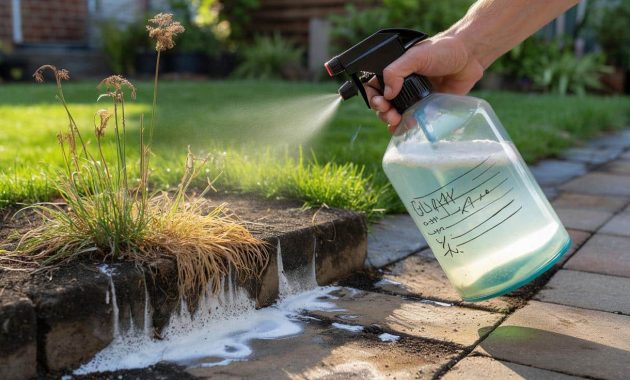
On a quiet suburban street one recent Saturday, three neighbors stood at their front fences, each holding the same thing: an old spray bottle filled with cloudy white liquid. One had scribbled “WEED KILLER” on the side with a black Sharpie. You could smell the vinegar from the pavement. A few minutes later, the first dandelions and crabgrass along the path began to wilt and curl, their leaves turning a sad, sickly brown under the midday sun. The gardeners smiled. The internet trick had worked.
They didn’t see what was happening below the surface of the soil.
Why the viral vinegar weed hack has gardeners suddenly on edge
Scroll through gardening groups on Facebook and TikTok and you’ll trip over the same homemade recipe again and again. White vinegar, plus salt and dish soap. “No chemicals,” the captions promise. “Safe for pets and kids.” People spray it between paving slabs, over gravel driveways, even along the edges of vegetable beds. It feels thrifty, clever, a small rebellion against big-brand herbicides.
Then the experts started chiming in, and the mood shifted fast.
In a UK gardening forum, one retired horticulturist posted photos that jolted a lot of smug DIY weed killers. The first picture showed a driveway treated with the vinegar–salt–soap mix: weeds dead within a day. The second, taken five weeks later, showed something else. The soil at the edges was bare, pale and crusted. No new seedlings. The moss was gone. Nearby ornamental grasses looked scorched at the tips, like they’d been singed with a lighter.
A Canadian extension service followed with a dry, blunt warning about “acetic acid and sodium build-up,” but the comments underneath were anything but dry. “Have I poisoned my soil?” one woman wrote. “I’ve been spraying this ‘natural’ stuff for three summers.”
What’s going on is simple chemistry disguised as a wholesome kitchen hack. White vinegar in most homes is around 5% acetic acid. That acid burns the soft tissues of leaves on contact. Add dish soap and the mixture clings better, breaking down the protective waxy coating that keeps plants from drying out. Toss in salt and you’ve got a brutal combo that sucks moisture from cells and lingers in the ground.
From the plant’s perspective, it’s like a triple-hit: burned, stripped, then dehydrated. From the soil’s perspective, it’s more like a slow, quiet poisoning.
The hidden damage: what really happens in your soil
The act itself looks harmless enough. A quick spritz along the patio, a satisfying sizzle on a hot day, and by the time you’ve had lunch the weeds are already flopping over. The trouble is, the spray doesn’t politely stay on “bad” plants. It drips, runs, seeps. It slips into cracks where the tiniest weed roots and fungal threads live. It soaks the surface where earthworms and beneficial nematodes move and feed.
Salt and acid don’t care which side of the “good plant / bad plant” line you stand on.
➡️ Bad news for balcony bird lovers: this “harmless” winter habit may be slowly killing songbirds
➡️ 5 health benefits of persimmons: here’s why we should eat more of them
➡️ Chinese Fleet Sails Into Contested Waters as US Aircraft Carrier Approaches
Gardeners testing their soil after a couple of seasons with the homemade mix are starting to see how deep the impact goes. One French allotment holder described how her gravel path, treated every month with vinegar and salt, turned into a dead strip. “Nothing grows there at all now,” she wrote. “Not even self-seeded poppies, which usually sprout everywhere.” A small soil test revealed high salinity levels and a damaged structure that repelled water instead of absorbing it.
We’ve all been there, that moment when a quick shortcut feels easier than kneeling down and pulling weeds by hand. So the bottle comes out again and again, month after month, and the damage quietly piles up under your feet.
Scientifically, the explanation is unnerving but straightforward. Salt ions don’t magically vanish once the weed looks dead. They bind to soil particles and build up, especially where there’s limited rain to wash them away. As salinity rises, soil microbes struggle. Fungi that help transport nutrients to plant roots shrink back. Earthworms move elsewhere. The soil becomes less like a living sponge and more like a tired crust.
Vinegar alone, even at household strength, can acidify the surface zone, stressing delicate root hairs and germinating seeds. Repeat that week after week and you’ve quietly turned your top layer of soil into hostile territory. *Not toxic enough to be classed as hazardous waste, but harsh enough that life starts to thin out.*
How to fight weeds without turning your garden into a dead zone
Gardeners who’ve stepped away from the vinegar–salt–soap mix almost all say the same thing: they went back to basics. Instead of spraying, they changed the battlefield. Dense ground covers between paving stones, layers of wood chips or bark mulch on beds, even simple cardboard sheets under gravel. These smother light, which most annual weeds desperately need to germinate. Less light means fewer weeds before they even appear.
Where a spray feels like a quick win, these quieter methods work like a slow, steady pressure.
For the stubborn clumps in cracks or around fence lines, the method looks old-fashioned and a bit annoying: manual removal. A narrow weeding knife, a crack weeder, or even an old butter knife can loosen roots so they slide out instead of snapping. A kettle of boiling water poured directly on a tuft in the driveway is brutal but quickly neutralized by the soil. The difference is, hot water doesn’t leave behind a chemical legacy.
Let’s be honest: nobody really does this every single day. Life’s too busy, backs get sore, and yes, weeds win some rounds. But spacing your efforts, tackling one strip at a time, keeps the garden alive instead of slowly salted.
Experts who study soil health are blunt about the cost of shortcut sprays, whether synthetic or homemade.
“People hear the word ‘natural’ and they relax,” says Dr. Hannah Mills, a soil ecologist who advises community gardens. “Vinegar, salt and soap all sound safe because we cook and clean with them. In concentrated form, and repeated across seasons, they can strip life from the top few centimetres of soil. By the time you see bare, crusting patches, you’ve already lost a lot of invisible allies.”
To shift habits, many gardeners now keep a small “weed toolkit” by the back door:
- A handheld crack weeder or old knife for paving gaps
- A bucket of wood chips or shredded bark to top up thin patches of mulch
- A kneeling pad and gloves to make short weeding sessions less of a chore
- A watering can reserved for boiling-water spot treatments on hard surfaces
- A bag of clover or low-growing ground cover seeds for areas that keep sprouting weeds
A different way to see weeds, and what’s really at stake in your soil
Once you understand what that “harmless” vinegar cocktail is doing below ground, it becomes hard to unsee. The weeds curling up on the patio are only the visible part. The rest is microscopic. It’s the mycelium threads fraying, the bacteria communities shrinking, the soil particles clumping into hard, lifeless plates. A garden that looks neat from the path can be quietly starving under the surface.
There’s another path. One that accepts some weeds as living signals rather than enemies, and sees the ground as a habitat, not just a surface to sanitize.
Some gardeners now let soft clovers, alyssum or creeping thyme fill in where they once sprayed. Driveways get narrowed with planting strips. The “perfect” weed-free look gets replaced by a softer, more alive one. It’s not about becoming purist or saintly. It’s about asking a simple question each time you reach for that bottle: am I killing this plant, or am I slowly killing the place it grows?
Next time you see a viral hack promising to “nuke weeds naturally,” you might pause, just for a second, and picture the soil under your shoes. That pause is where a different kind of garden starts.
| Key point | Detail | Value for the reader |
|---|---|---|
| Vinegar mixes harm soil life | Acetic acid and salt damage microbes, fungi and earthworms near the surface | Helps readers avoid slowly sterilizing their garden without realizing it |
| Salt builds up over time | Repeated “natural” spraying raises salinity and stops new plants from thriving | Explains why areas treated for years become bare, crusted weed deserts |
| Gentler methods work long-term | Mulch, boiling water, hand weeding and ground covers reduce weeds without residue | Gives practical, realistic alternatives that protect soil health and biodiversity |
FAQ:
- Can I use plain white vinegar alone as a weed killer?Household vinegar without salt or soap will burn foliage on contact, especially on sunny days, but it still stresses soil life and usually doesn’t kill deep-rooted perennials. It’s less damaging than the full viral mix, yet repeated use can still acidify the surface layer.
- Is rock salt or table salt really that bad for the ground?Yes, when used repeatedly. Salt doesn’t disappear, it accumulates. High salinity dehydrates plant roots and disrupts soil microbes, eventually turning affected patches into zones where very little will grow.
- What should I do if I’ve already used vinegar and salt for years?Stop adding more salt-based mixes and start rebuilding life in those areas. Add organic matter like compost, leaf mold or well-rotted manure, mulch lightly, and water deeply to help leach excess salts where drainage allows.
- Are commercial ‘natural’ herbicides safer?Some products based on acetic acid or plant oils still burn plant tissue on contact, and strong concentrations can harm soil life if overused. They may be safer than salt cocktails, but they’re not a free pass to spray without restraint.
- What’s the best strategy for paths and driveways full of weeds?Combine mechanical and design fixes: scrape or knife out existing weeds, use boiling water for tough spots, then add a weed barrier (like cardboard) under fresh gravel or plant low-growing ground covers in wider joints to outcompete new seedlings.