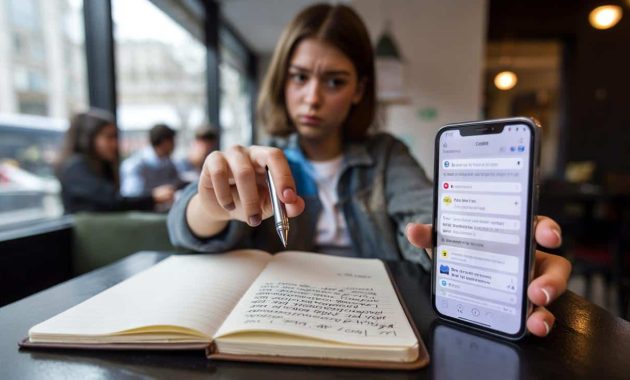
On a grey Tuesday morning in a London café, a 19‑year‑old student slowly turns a pen between her fingers like it’s a museum object.
Her phone is unlocked beside her, glowing with unfinished notes, half-written texts, and three open chats.
She’s supposed to copy a quote from a book for a class assignment, by hand, onto a sheet of paper.
After two lines, her wrist hurts, the letters sink into each other, and she laughs quietly: “My handwriting looks like Wi‑Fi signal.”
She’s not the only one.
Across campuses and high schools, notebooks are half-empty while screens are full.
A human skill that carried our stories for 5,500 years is fading into a glitchy scrawl, right under our thumbs.
The silent disappearance of a 5,500‑year habit
Scroll through any Gen Z study group on TikTok or Discord and you’ll notice something strange.
Endless talk of productivity, apps, Notion templates, voice notes, but almost no ink on paper.
What used to be a default human gesture – hand, tool, surface – now feels almost optional.
Teachers report that many 16‑ to 24‑year‑olds struggle to write more than a paragraph without cramping.
Some admit they can’t easily read their own notes from a year ago.
A recent survey in the US and UK suggests around **40% of young adults barely use handwriting outside of signatures and exam forms**.
For a species that has traced symbols since the first clay tablets of Mesopotamia, that’s a quiet revolution.
Take Emma, 21, a business student who proudly runs her life from her phone.
Her lecture notes live in Google Docs, her to‑do list in three apps, her ideas in random chat threads.
When her grandmother passed away last year, Emma found a box of old letters, handwritten in sloping blue ink.
She tried to write a reply to her grandfather the “same way”.
She bought a card, sat at her desk, and stared at the blank space.
“My hand didn’t know what to do,” she told me. “I typed the text in Notes first, then copied it. It felt… fake.”
The message was real, the grief was real, but the movement had become foreign.
Handwriting is not just about neatness or nostalgia.
Neurologists point out that writing by hand activates networks in the brain linked to memory, emotion, and comprehension in a way typing doesn’t fully replicate.
The slowness forces us to choose, to feel the sentence forming before it hits the page.
When we skip that stage, our communication becomes faster, yes, but also flatter.
Shorter words, fewer nuances, more copy‑paste.
We move from drawing our thoughts to tapping them out, and something in the depth of what we say – and how we remember it – quietly thins.
That’s the hidden cost behind the 40% figure: it’s not just a lost skill, it’s a shallower conversation with ourselves.
How to keep your handwriting alive without living like it’s 1999
You don’t need to become a calligraphy influencer to keep this ancient skill alive.
Start absurdly small: one handwritten thing a day.
A sticky note on your mirror.
A two‑line quote in a notebook.
The first three ideas for a project, scribbled before you open your laptop.
Set a three‑minute timer.
Write without judging the shape of your letters or correcting every curve.
The goal is not beauty, it’s contact.
Pen on paper, brain on idea.
Over a few weeks, that tiny daily friction starts to build a lost muscle back.
➡️ In 2026, these four zodiac signs are set to become millionaires
➡️ This is why some items always end up out of place
➡️ Psychology says people who sleep in the same bed as their pets often have these 10 quiet strengths
➡️ Which colours make us look older according to psychology?
➡️ Meet Whipped Lemonade: The 3-Ingredient Drink Everyone’s Making This Summer
Most people quit because they expect Instagram‑worthy pages from day one.
The letters wobble, the lines drift, the ink smudges, and the shame kicks in.
We’ve all been there, that moment when your own handwriting looks like someone else’s bad day.
Let’s be honest: nobody really does this every single day.
Life gets in the way, the pen rolls under the sofa, your notes app feels quicker.
So lower the bar.
Aim for “legible for future me”, not “pretty enough to post”.
If a full journal feels overwhelming, keep a “messy notebook” that no one will ever see, where the only rule is: keep the hand moving.
At some point, it helps to reconnect handwriting with emotion, not duty.
Write lyrics you love.
Copy a DM that moved you, but by hand.
Send a one‑sentence postcard just because it feels oddly rebellious in the era of read receipts.
“I thought my generation didn’t care about handwriting,” says Lucas, 18, who started leaving handwritten notes in his friends’ lockers at school. “Then people began keeping them in their phone cases like talismans. That’s when I realised: it’s not that we don’t care. We just stopped being offered the chance.”
- Keep a cheap, small notebook in your bag or pocket so handwriting is always reachable.
- Use handwriting only for “slow thoughts”: ideas, reflections, letters, not grocery lists.
- Once a week, write a short note to someone you care about and actually give it to them.
- When you study, rewrite one key concept by hand instead of rereading slides.
- *Treat your handwriting as a fingerprint of your mind, not a design project.*
The deeper loss behind messy letters and three‑word texts
The real story isn’t just that Gen Z is losing cursive.
It’s that a whole way of relating to others – slower, more deliberate, more embodied – is slipping quietly into the background.
If you’ve ever opened an old letter and felt your chest tighten at the curve of someone’s “g”, you know that ink carries a kind of presence a blue bubble never quite reaches.
When 40% of young people rarely write by hand, we don’t just lose a tool.
We lose a channel.
A way to say: I took time, I sat down, I thought of you, I shaped each word knowing you would touch it.
There’s no upgrade for that in any software update.
| Key point | Detail | Value for the reader |
|---|---|---|
| Handwriting activates deeper thinking | Engages memory, attention and emotional processing more strongly than typing | Better retention for studies, projects and personal reflections |
| Gen Z use handwriting far less | Roughly 40% rarely write outside of exams and signatures | Awareness of what’s being lost and where to reclaim it |
| Small habits keep the skill alive | One handwritten note a day, “messy notebook”, emotional letters | Simple ways to reconnect with slower, more meaningful communication |
FAQ:
- Question 1Is Gen Z really worse at handwriting than previous generations?
- Question 2Does losing handwriting actually affect the brain?
- Question 3Can typing ever fully replace handwriting for learning?
- Question 4How can parents or teachers encourage handwriting without forcing it?
- Question 5What’s one easy habit to start today if my handwriting is terrible?