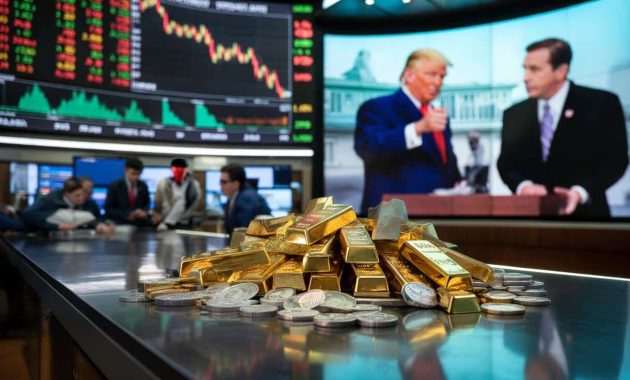
After days of frantic buying of safe havens, investors hit the sell button on precious metals on Friday, reacting to Donald Trump’s choice of a new Federal Reserve chair and a perceived return to central bank orthodoxy.
Gold and silver hit hard in a single session
The move was brutal. In early afternoon trading, spot gold was down 6.27% at $5,037.91 an ounce after briefly falling more than 8%. Silver fared even worse, dropping 14.30% to $99.1537 an ounce, having earlier been down more than 17.6%.
Within hours, two of the market’s favourite safety plays flipped from record highs to one of their sharpest sell-offs in years.
This fall followed a spectacular rally earlier in the week, driven by mounting global uncertainty and political tension in the United States. Both metals had notched record prices on Thursday, with gold touching $5,595.47 an ounce and silver hitting $121.6540.
For many traders, Friday’s drop looked less like panic and more like an excuse to cash in profits after a parabolic rise.
Trump’s bet on Kevin Warsh steadies Wall Street
The catalyst for the reversal came from the White House. Donald Trump announced he intends to nominate Kevin Warsh, a former Federal Reserve governor, as the next chair of the US central bank once Jerome Powell’s term ends in May.
Markets had worried that Trump might choose a loyalist willing to bend to political pressure on interest rates. Warsh, while conservative and market-friendly, is widely seen as a more conventional figure with a track record inside the Fed.
Investors read the pick as a sign the Fed will keep a degree of independence, blunting the case for hoarding gold as protection against political interference in monetary policy.
Analysts argued that a less confrontational relationship between the White House and the Fed reduces the risk of policy missteps and runaway inflation, two key drivers of gold’s appeal.
➡️ Country in turmoil as government plans to tax parents for adult children still living at home
➡️ Heating: the 19 °C rule is over, here’s the temperature experts now recommend
➡️ Why you should keep a bar of soap in your car overnight
➡️ Find of the century: gold bars discovered over a kilometer underground, all tied to one nation
➡️ Heavy snow according to forecasts expected starting tonight
Why central bank independence matters for metals
For months, Trump has publicly pressured Jerome Powell to cut interest rates more aggressively. That campaign unsettled many investors who feared the Fed could be pushed into easy money to boost short-term growth, even at the cost of long-term stability.
Gold and silver benefited directly from those fears. When trust in institutions weakens, investors often prefer assets that cannot be printed or devalued by politicians.
Kevin Warsh is seen by many as a defender of the Fed’s institutional role. His reputation as someone who respects the central bank’s mandate has reassured traders who had positioned for a more radical, politically driven choice.
From record highs to profit-taking
The pace of the correction suggests that traders were ready for a pullback. After climbing almost vertically, any credible reason to reduce risk was likely to trigger heavy selling.
The violence of the move signals not just a change in mood, but also how crowded the “buy gold at any price” trade had become.
Since the start of the year up to Thursday’s peak, gold had surged nearly 30%. Silver, supported both by safe-haven demand and its role in solar panels and electronics, had jumped close to 70%.
Industrial metals such as copper had joined the ride, gaining ground as investors rotated into tangible assets and away from currencies and some parts of the bond market.
How investors use gold and silver
For many market participants, precious metals serve different purposes within a portfolio:
- Gold: primarily used as a hedge against inflation, currency debasement and severe geopolitical shocks.
- Silver: acts as both a safe-haven asset and an industrial metal, sensitive to manufacturing and green technology demand.
- Mining stocks: offer leveraged exposure to metal prices but with higher company-specific risks.
When anxiety rises, these assets can jump as investors seek protection from falling stock markets, unstable governments or policy errors. When the perceived threats recede, so do prices.
What the move says about market psychology
The speed of Friday’s drop underlines how sentiment-driven the recent rally had become. Many short-term traders were not buying gold as a long-term store of value, but as a quick trade on politics and fear.
Once the Warsh nomination reduced the perceived risk of an overly politicised Fed, some of those positions suddenly looked stretched. Funds that had chased the rally used the news as an opportunity to lock in gains.
| Asset | Change year-to-date (to Thursday peak) | Move on Friday |
|---|---|---|
| Gold | ≈ +30% | -6.27% (after -8% intraday) |
| Silver | ≈ +70% | -14.30% (after -17.6% intraday) |
The mix of political headlines and fast money trading creates an environment where price moves frequently overshoot. Gains can appear exaggerated on the way up, and corrections can look just as extreme on the way down.
What could happen next for precious metals
The longer-term path for gold and silver will still depend on classic drivers: inflation expectations, interest rates, and the outlook for global growth.
If Warsh confirms a relatively orthodox stance – respecting the Fed’s inflation target, moving rates gradually, and communicating clearly – some of the speculative froth could keep fading. That would mean a calmer, more fundamental-driven market for metals.
Yet risks have not vanished. Political tension in the US, fragile government finances in several countries, and ongoing geopolitical flashpoints leave plenty of reasons for investors to keep some exposure to safe-haven assets.
Key concepts for everyday investors
For readers following this story from the sidelines, a few terms help make sense of the moves:
- Safe-haven asset: an investment that tends to hold or gain value during periods of stress, such as gold or high-grade government bonds.
- Profit-taking: when traders close winning positions to secure gains, which can trigger broad sell-offs after a strong rally.
- Fed independence: the idea that the central bank sets monetary policy based on economic data, not on pressure from politicians.
Imagine a saver who bought gold at the start of the year. A 30% rise to Thursday’s peak would have significantly boosted their holdings. The temptation to sell part of that position after such a run is strong, especially if the event that fuelled the rally – in this case, fears about the Fed – suddenly looks less threatening.
On the other side, a long-term investor who uses gold as insurance against currency weakness might decide to ride through the volatility. For that person, Friday’s plunge is less a shock and more a reminder that metals behave like any other market: they swing sharply when too many people crowd into the same trade at once.