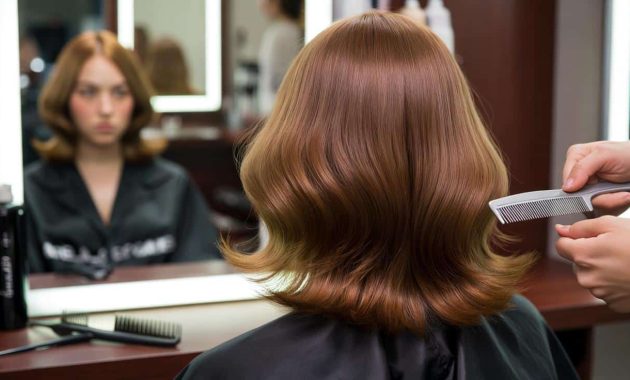
You spot it in every bathroom mirror. That defeated little gesture when the brush hits the back of your head and just stops. The more you pull, the more your hair tightens into tiny knots, like invisible Velcro. You didn’t sleep in a hurricane. You just… have hair that tangles at the slightest excuse. By the time you free one strand, another bunch has already formed a new snarl.
One day a hairdresser watches you struggle and says, almost casually: “You know this could be 80% better with the right cut?”
That sentence stays with you.
The cut hairdressers swear by for tangle-prone hair
Ask three good hairdressers what to do with hair that tangles all the time and you’ll hear the same word come back: **blunt**. A clean, blunt cut, slightly structured, not too thinned out. The opposite of those super-layered, wispy styles from early-2000s magazines.
Why? Because the more uneven the lengths, the more “hooks” your hair has to catch onto itself. A strong baseline gives your hair weight and direction, so it falls instead of knotting. It’s not about cutting everything short, it’s about cutting everything smart.
Take Léa, 29, who thought her knots were just “how my hair is”. Mid-back, fine, a bit wavy, always in a messy bun because detangling felt like a full-time job. She’d tried every miracle spray on TikTok and spent small fortunes on masks that promised “glass hair” but delivered sticky lengths and more tangles.
Her stylist finally convinced her to switch to a long blunt cut, just above the bra strap, with very light internal shaping and zero aggressive thinning. Two weeks later, she came back almost shocked: detangling time had dropped from fifteen minutes to three. Her scrunchie wasn’t coming out jammed in a hairball anymore.
There’s a simple reason behind this small miracle. Tangling often happens where the hair is weak, uneven or too light to fall smoothly. Over-layering, razoring and intense thinning create fragile ends that twist and snag on each other. Add friction from scarves, collars, or sleeping, and you get daily spaghetti.
A blunt, slightly heavier cut gives the strands enough density to slide past one another. The hair behaves like a sheet instead of a cobweb. The shape also grows out more predictably, so you don’t end up with random tails and wisps that grab on to everything. Less chaos in the cut means fewer knots in your brush.
How to ask for – and live with – an anti-tangle cut
In the chair, the magic sentence is simple: “My hair tangles really easily, and I’d like a blunt cut that reduces knots.” Then hold your hand where you’re genuinely okay seeing your length land. Show photos, but prioritise pictures where the bottom line of the hair is clean and straight, not overly shredded.
➡️ The everyday reason your recovery feels incomplete
➡️ The quick and effective method to restore your TV screen to like-new condition
➡️ Place this object near your orchid : blooming starts in just a few days
➡️ The United States turns to French expertise to revive a vital uranium enrichment industry
➡️ The “brain-eating” amoeba shrugs off chlorine and creeps through our water systems
Many stylists recommend a length between collarbone and mid-back for tangle-prone hair. Short enough to keep some weight, long enough to still feel like “long hair”. Then they’ll add **soft internal shaping around the face** and maybe a couple of long, subtle layers only where your waves or curls need movement, never randomly scattered.
The tricky part comes after the salon, when life resumes and you go back to sleeping badly, throwing your hair into a bun, skipping masks. We’ve all been there, that moment when you promise yourself “This time I’ll take care of my hair properly” and three days later you’re detangling in a hurry with half-dry shampoo still in.
Plain truth: your cut can save you, but it can’t do everything alone. The three biggest enemy habits for tangle-prone hair are going to bed with loose hair, rubbing with a regular cotton towel, and brushing like you’re late for a train. Change just those three, and your new cut suddenly feels five times more efficient.
“People think they have ‘bad hair’ when often they just have a bad cut for their texture,” explains Camille, a Paris-based hairdresser who sees tangle-prone clients almost every day. “Once we clean up the perimeter and stop over-thinning, they’re stunned by how cooperative their hair actually is.”
To support that smarter cut, stylists often suggest a simple, realistic routine:
- Sleep with your hair in a loose braid or low, soft scrunchie ponytail.
- Use a microfiber towel or an old T-shirt to gently squeeze out water.
- Detangle from the ends up, on damp hair, with a wide-tooth comb.
- Apply a light leave-in spray on mid-lengths and ends, not the roots.
- Schedule trims every 8–12 weeks to keep that clean, non-snagging line.
*Let’s be honest: nobody really does a 10-step routine every single day.*
That’s why the right cut is such a relief – it buys you margin for those chaotic mornings.
Living with hair that finally stops fighting you
Something subtle happens when your hair stops knotting every time you move. You touch it less aggressively. You stop dreading the shower. You wear it down on a windy day and don’t immediately regret it. That shift sounds minor, yet it changes how you show up in daily life, from video calls to Sunday brunches.
Maybe you won’t notice it right away. One morning you realise you’re already out the door and your brush is still sitting peacefully by the sink. Or you reach up at the end of the day and your ponytail comes out in one smooth motion. No half-hour of surgery in front of Netflix.
For people whose hair tangles at the slightest breeze, this isn’t about chasing some glossy, filtered “perfect hair” fantasy. It’s about reducing friction – literal and emotional. You save time, you lose less hair in the brush, you spend fewer moments muttering at your own reflection.
The blunt, anti-tangle cut won’t change your texture, your volume, or your personality. It simply gives your hair a bit of order so you can bring your chaos somewhere else, somewhere that matters more. And that small, practical comfort is exactly the kind of quiet luxury our routines are hungry for right now.
| Key point | Detail | Value for the reader |
|---|---|---|
| Choose a blunt base | Clean, straight line at the ends with minimal thinning | Reduces hooks and snagging, hair tangles less often |
| Adjust length strategically | Collarbone to mid-back, with very light, long layers only | Keeps movement without sacrificing weight and slip |
| Support the cut with small habits | Night braid, gentle towel, bottom-up detangling, regular trims | Makes the effect of the cut last and cuts detangling time dramatically |
FAQ:
- What exact cut should I ask my hairdresser for?Ask for a blunt cut with a strong, even perimeter and only soft, long layers if your texture needs them. Emphasise that your goal is to reduce tangles, not to thin out the ends.
- Will cutting my hair shorter really reduce tangles?Often yes, especially if your current length is mid-back or longer. The goal isn’t a bob at all costs, it’s to remove weak, overgrown, knot-prone ends and give your hair enough weight to fall smoothly.
- Is this cut suitable for curly or coily hair?It can be, but the “blunt” idea is adapted to your pattern. On curls and coils, you want a strong, rounded shape with balanced volume, not harsh straight lines or heavy thinning that creates frizz and single-strand knots.
- How often should I trim if my hair tangles a lot?Most stylists recommend every 8–12 weeks. If your ends feel rough sooner or your brush starts catching again, that’s your sign to bring the baseline back into shape.
- Do I need expensive products with this cut?No. Focus on one gentle shampoo, one decent conditioner, and a light leave-in detangler or spray. Technique and the right cut do more for tangles than a crowded shelf of products.