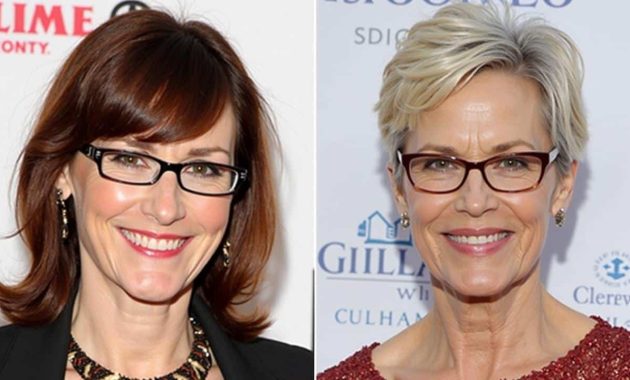
At the optician’s, the neon light is unforgiving. Anne, 72, slides on a new pair of frames and catches her reflection. The glasses suit her, the color softens her eyes. Yet something looks “off”. Her hair, still cut the same way it was ten years ago, suddenly feels heavy and a little sad. She tilts her head, pulls her fringe to the side, tucks a strand behind her ear. Nothing works. The frames shout “modern”, the haircut whispers “yesterday”.
The salesperson casually suggests, “With your new glasses, you could try a lighter, shorter cut.” Anne laughs it off, but the sentence sticks. At home, in front of her own mirror, she lifts her hair at the back, imagines shorter sides, a fringe that follows the line of her frames. Her face seems to change in seconds. Less tired. Sharper. Almost mischievous.
That’s when you realize: after 70, the right hairstyle and the right glasses don’t just coexist. They team up.
Why hair changes after 70 (and what it means when you wear glasses)
Around 70, hair rarely behaves the way it did at 40. It gets finer, flatter, sometimes more wiry. White hairs grow in different directions, volume disappears at the crown, and the lengths weigh things down. When you add glasses into the mix, every line on your face suddenly has a partner: the line of your fringe with the line of your frames, the curve of your cheek with the temple of your glasses.
The eye no longer sees your hair and your glasses separately. It reads a whole picture. A long, straight, flat cut with thick rectangular frames can pull your features down. A harsh, very dark bob with tiny metal glasses can harden the face. A soft, airy cut that hugs the frame, on the other hand, lifts the look. You don’t change your face. You simply change the architecture around it.
Think of your hair as the “background” of your glasses. A smooth, slightly rounded background will soften strong frames. A structured, layered background will energize simple, minimalist glasses. When hair and frames move in the same direction – both heavy, both straight, both dark – the result often ages the face. When one brings softness and the other brings structure, the whole look suddenly feels awake.
Four flattering haircuts that refresh the face (without fighting your glasses)
First ally: the soft layered pixie. Not the military crop, but a feminine, feathered version that follows the skull and frames the forehead. On hair that has thinned, layers at the crown create instant lift. Around the ears, subtle texture reveals the arms of your glasses instead of hiding them under a stiff mass. The effect is light, clean, almost airy.
On a woman with thick, dark plastic frames, a soft pixie with a slightly longer top draws the eye upward. It frees the neck, opens the jawline, and prevents the glasses from looking too “heavy”. For those who fear short hair, ask your hairdresser to leave a bit of length on the front to sweep over the forehead. The result: a subtle fringe that meets the top of the frame and blurs forehead lines without closing the face.
Second ally: the cheekbone-length bob with movement. Just below the cheek, just above the jaw, with the ends gently turned in or slightly waved. This length is magical with glasses. It creates a natural “frame within the frame”: your glasses frame your eyes; your bob frames your cheekbones. *The trick is to avoid sharp, ultra-graphic cuts that compete with the lines of your glasses.* A soft, rounded bob, a tiny bit layered, keeps things youthful instead of severe.
Third ally: the side-swept fringe connected to the frame. This one works on a short cut as well as a mid-length. The fringe starts a little higher, diagonally, and lands just on top of the frame, following its curve. It shortens a long forehead, masks a few wrinkles, and brings focus back to the eyes. On fine hair, ask for a “veil” fringe rather than a thick, dense one. The goal is transparency, not a heavy curtain that collides with your glasses.
➡️ Pellets: the little-known trick to save big on your heating before autumn
➡️ Why doing planks every day is a mistake: physiotherapists explain the right frequency
Fourth ally: the light, shoulder-skimming cut for those who don’t want to go short. Past 70, very long hair often drags the face down, especially with glasses that already draw attention to the center of your face. A cut that stops at the collarbone, with discreet layers around the face, brings movement. Paired with thin metal or translucent acetate frames, it can look lively, artistic, not “trying too hard to stay young”.
The plain truth: you don’t need more hair to look younger, you need better-placed hair. A few centimeters less at the back, a bit more softness at the front, and the geometry of your face changes. Cheekbones appear, under-eye shadows seem lighter, the jawline sharpens. The right cut does not scream “anti-aging”; it simply lets people see you again, not your haircut from 1998.
How to talk to your hairdresser (and avoid the “helmet with glasses” effect)
Walk into the salon with your glasses on, not tucked in your handbag. Sit down and look at yourself in the mirror exactly as you are in everyday life. Then, tilt your head, smile, frown, lift your chin. Watch where the frame sits on the bridge of your nose, where it cuts the cheek, where it ends at the temples. That’s the map your hairdresser should be working from.
Start the conversation not with “I want to look younger”, but with “I want my glasses and hair to work together”. Show your current issues: hair flattening against the arms of the glasses, fringe falling over the lenses, volume at the wrong place. Ask for three specific things: more lift at the crown, softness around the temples, and movement around the jawline. These three points almost always rejuvenate a face with glasses.
We’ve all been there, that moment when we nod politely while the hairdresser suggests “a bit shorter, it will be fresher”, and we leave with a helmet head that stiffens our features. The “helmet with glasses” effect happens when hair is cut one-length all around, with no lightness around the ears or temples. On short cuts, insist on small, tapered areas around the arms of your glasses. On mid-length cuts, ask that the layers start at the height of the frame, not below the chin.
Let’s be honest: nobody really does this every single day. But if your cut is built to sit well with your glasses, you won’t need 20 minutes of brushing every morning. A quick lift at the roots with your fingers as it dries, a tiny bit of styling cream on the ends, and you’re done. The goal is not a blow-dry straight out of a magazine. The goal is a shape that falls back into place even after a nap on the sofa.
“At 75, I stopped bringing photos of celebrities to the salon,” laughs Marie, who wears bold red frames. “I bring a photo of myself where I feel good, and I ask the hairdresser: how can we get this feeling back, with my glasses today?”
- Arrive with your glasses on and keep them on for the whole consultation.
- Ask your hairdresser to check the cut from the side, where the arms of the glasses meet the hair.
- Favor light, textured ends rather than stiff, blunt lines.
- Think “softness near the face, structure at the back” for a lifting effect.
- Book trims every 6–8 weeks so the cut doesn’t collapse onto your frames.
Hair, glasses and age: choosing a style that looks like you today
There is a silent pressure on women over 70: stay “natural”, but not too much. Look “your age”, but without “looking old”. Hair and glasses sit right at the crossroads of all these expectations. A very classic cut and discreet frames can erase you. A radically trendy haircut with oversized, eccentric glasses can feel like a costume. Somewhere between the two, there is your real style.
The question is less “Which haircut makes me look younger?” and more “Which haircut makes my eyes and smile shine, even with wrinkles and glasses?” The four cuts above are starting points, not rules. A soft pixie on someone timid might feel too exposed. A cheekbone bob on someone who loves scarves and earrings might be the perfect stage for their accessories. Thin, grey hair can look luminous with a transparent fringe that grazes round frames. Thick, wavy hair can be tamed into a shoulder-grazing cut that dances around light metal glasses.
The most flattering looks after 70 share the same ingredients: light around the face, lines that lift rather than drag down, and a dialogue between hair and frames instead of rivalry. There’s no age limit for changing your cut. There’s only a moment when the mirror stops matching how you feel inside. When that happens, a few centimeters of hair and a pair of frames can realign the picture.
| Key point | Detail | Value for the reader |
|---|---|---|
| Match haircut to frame lines | Soften strong glasses with rounded, textured cuts; energize simple frames with structured shapes | Instantly fresher, more balanced face without drastic change |
| Prioritize volume and lightness around the face | Lift at the crown, softness at temples, movement at jawline | Visual “lifting” effect that draws the eye to eyes and smile |
| Use salon consultation differently | Keep glasses on, show problem areas, ask for tailored layers near frames | Reduces risk of aging “helmet” cuts and saves time on daily styling |
FAQ:
- Which haircut is best if I have very fine hair and wear thick frames?Soft layered pixies or short, slightly graduated bobs work well. Layers at the crown create volume, and lighter ends soften the contrast with bold frames.
- Can I keep long hair after 70 if I wear glasses?Yes, but aim for collarbone or shoulder length with gentle layers around the face. Very long, straight hair can pull the features down, especially with glasses.
- Do bangs work with glasses at my age?Side-swept or “veil” fringes are ideal. They meet the top of the frame, blur forehead lines and keep the look light. Avoid very thick, straight fringes that sit on the lenses.
- How often should I trim my hair to keep a rejuvenating shape?Every 6 to 8 weeks for short cuts, every 8 to 10 weeks for bobs or shoulder-length styles. Beyond that, the cut tends to collapse onto the frames.
- What hair color suits women over 70 who wear glasses?Soft, luminous tones work best: natural grey enhanced with highlights, warm beige or light chestnut. Very dark blocks of color can harden the face, especially with dark frames.