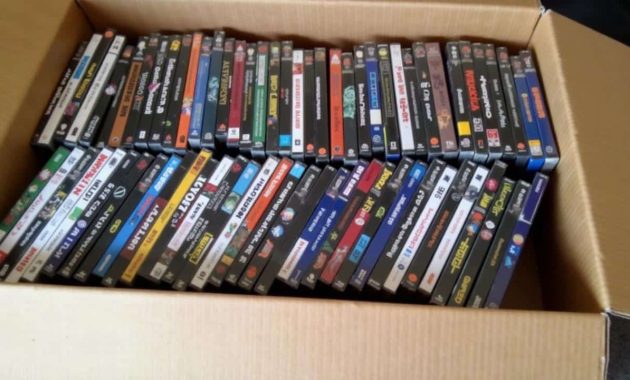
A faded cardboard cube, taped and retaped, filled with DVDs nobody in the house had watched in years. He carried it into the charity shop like you drop off old memories: with a shrug, a faint nostalgia, and the quiet satisfaction of having “decluttered”. Three weeks later, a friend sent him a screenshot. His DVDs. Lined up on an online marketplace. Sold as “rare editions” and “collector’s items”, at prices that made his stomach lurch. Had he just donated a small fortune without knowing it?
The more he scrolled, the stranger it felt. Titles he barely remembered now tagged as “out of print” and “hard to find”. A box he thought was junk had turned into a goldmine — for someone else.
He started to wonder what that box was really worth.
The day your old DVDs turn into someone else’s treasure
He remembered the day of the donation clearly. A rainy Saturday, the kind where the light never fully wakes up. His living room floor was covered in piles: “keep”, “maybe”, “give away”. That box of DVDs landed in the “give away” pile almost by reflex. Discs he’d bought in his twenties, special editions he queued for, a few series he’d hunted down in tiny video stores. It all felt like another life.
By the time he reached the charity shop counter, the DVDs had already turned into clutter in his head. The volunteer barely glanced at the titles. A brief smile, a thank you, and the box vanished into the back room. He walked out lighter, proud even, like he’d done something right. The story could have ended there.
Then came the screenshot.
His friend had been browsing a local reseller’s page when she noticed something familiar. Same charity shop sticker on the corner of the cases. Same titles. Same box in the background of a photo, if you looked closely. But now, the description read: “Rare limited editions, prices firm”. Some were listed at $40, $60, even $120. One old anime box set, which he’d thrown in without a second thought, was labelled “grail item”. Suddenly, his “junk” looked like a missed opportunity.
When he dug deeper, the pattern became clear. Those DVDs never hit the charity shop shelves. They’d gone straight into the hands of a reseller who knew exactly what to look for. The charity got a small, quick payment. The reseller got the real prize. And the original owner? He got the punch-in-the-gut feeling of realising he’d donated value he didn’t even know he had.
This isn’t some freak one-off. DVD and physical media forums are full of similar stories: that weird horror film you grabbed for $5 in 2008 now selling for $90 because the studio lost the rights. A limited steelbook bought on impulse suddenly triples in price because it’s out of print. The market for physical discs hasn’t just survived the streaming age, it’s quietly mutated into a niche economy where scarcity, nostalgia and licensing issues can turn a dusty box into a payday.
How to know if your “junk” DVDs are secretly worth money
There’s a simple move he wishes he’d made before dropping that box off: a ten-minute scan. Not a full spreadsheet, not a nerdy catalog, just a quick pass with his phone. Type the exact edition into an online marketplace. Look at “sold” listings, not just the hopeful prices. Anything regularly going for more than $15? That goes into a separate pile. Limited editions, steelbooks, box sets, foreign releases, out-of-print labels — those deserve a second look.
➡️ An AI-run company: what the results quietly reveal about our future at work
➡️ The plantings experienced gardeners never miss for a flourishing spring orchard
➡️ India watches nervously as its main rival moves to buy 50 new warships
➡️ One of the world’s most reliable brands admits it: electric cars aren’t their goal after all
➡️ Doctors reveal the “one glass before bed” habit that helps seniors wake up with less joint pain
➡️ 103,000 extra cancers: should CT scans be limited now?
➡️ I don’t boil potatoes in water anymore, ive switched to this aromatic broth
This tiny filter doesn’t kill generosity. It just means you’re not blindly giving away the few items that could actually help you pay a bill, fix your car, or fund next month’s groceries. The rest? Donate with a light heart.
Soyons honnêtes : personne ne fait vraiment ça tous les jours.
On a tous déjà vécu ce moment où l’on balance un sac entier à la déchetterie ou au secours populaire “pour faire de la place”, sans même le regarder une dernière fois. A guy in Manchester shared online how he’d dumped his old horror DVDs in a charity bin, then later saw the exact same titles in a Facebook group listed as “must-have OOP classics”. Another woman from Toronto told how she’d given away a box of Korean dramas that now sell for $70 a season because streaming lost the rights.
Data backs this up in a quiet way. Some secondary marketplaces show steady growth in “physical media” searches each year, even as streaming dominates. Buyers aren’t just film buffs. They’re people frustrated to see their favourite movies vanish from platforms overnight. When a title disappears, physical copies stop looking old. They start looking safe.
*That’s when yesterday’s clutter starts turning into today’s insurance policy.*
What happened with that box of DVDs says more about how we value things than about charity shops or resellers. We’ve been trained to see anything “non-digital” as obsolete. The streaming era gave us the illusion that everything is available all the time, for almost nothing. Yet the reality is messy: rights expire, catalogues shrink, and niche films vanish. Physical discs quietly become the last accessible version of certain stories, especially the weird ones, the cult hits, the small foreign films that never get renewed.
There’s also the emotional blind spot. When an object stops fitting our current life, we tend to mentally downgrade it to “worthless”. We forget what we once paid. We don’t connect our old collector habits with today’s collector markets. So we throw away value that our past self patiently built, then act surprised when someone else spots it in a heartbeat. It’s not stupidity. It’s just how our brain edits the past to cope with the present.
How to declutter without donating away a hidden fortune
He changed his method after that shock. Now, before any donation run, he does a “slow pile”. Instead of shoving everything into a box, he stacks potential collectibles on a separate chair for 24 hours. Only the items he still feel indifferent about after that delay go to charity. The rest get a quick online check. He searches title + “out of print DVD” or title + “rare edition”. He filters by “sold items only”. If a disc has multiple recent sales above $25, it goes into a “sell or keep” pile.
It’s a small ritual, almost like saying goodbye properly. He doesn’t do it for every book or every old T-shirt. Just for physical media, tech and anything that once felt special when he bought it. Ten minutes, twice a month. That’s all.
He also learned that not all “rare” labels are real. Some listings shout “RARE!!!” just to justify a high price, even when dozens of copies are available. The trick is to ignore the marketing adjectives and look at two hard signals: how often does it actually sell, and how many are listed. Lots of listings but few completed sales? That’s not a goldmine, that’s a graveyard. A handful of listings and a history of real, recent sales? That’s a different story.
The emotional side matters too. When you realise you once donated away potential value, shame can creep in fast. “I was so stupid.” “How did I not know?” That’s where people start hoarding again, afraid to part with anything. A healthier approach is to treat it like found knowledge, not a crime scene. You didn’t “lose” money; you gained the ability to spot value next time.
“I used to think my DVDs were basically trash,” he admits. “Then I watched a stranger make two months’ rent off my old collection. I don’t hate them for it. I just promised myself I’d never walk blind into a donation again.”
Here’s a quick mental checklist he now keeps near his front door, right next to the reusable bags:
- Pause once before donating boxes you haven’t opened in years.
- Scan special editions, box sets and foreign releases for recent sale prices.
- Separate “valuable but not loved” from “cheap and forgotten”.
- Give freely from the second pile, think twice about the first.
- Remember: generosity and financial awareness can live in the same box.
When giving, keeping and selling all have something to say
There’s a quiet irony in this story. The DVDs he donated ended up exactly where collectors wanted them: in circulation, in the hands of people who’d genuinely watch and cherish them. The route was just different from what he imagined. Money changed hands. More than once. The value he’d created by collecting, preserving and curating those titles didn’t vanish. It simply shifted to someone else’s balance sheet.
That’s what stings. Not that a reseller made money. But that he never paused long enough to ask, “What do I actually want to do with this value?” Maybe he would have still donated the whole lot, fully aware. Maybe he would have sold the top five rare pieces to fix his car, then given the rest away. Maybe he would have gifted a special edition to a friend who loved that film. All those options were on the table. He just didn’t look.
The next time you stand over a box, ready to cut ties with a slice of your past, you might feel that brief hesitation too. Not a paranoid fear of losing money. More like a quiet check-in: is there something in here that could change my month, or change someone else’s? Sharing this kind of story isn’t about turning everyone into a flipper chasing profit. It’s about granting ourselves permission to value what we once valued, even as we move on.
Some boxes deserve to leave your home without a second thought. Others deserve one last, curious glance.
| Point clé | Détail | Intérêt pour le lecteur |
|---|---|---|
| Vérifier la rareté | Rechercher le titre exact et l’édition, regarder les ventes réussies | Évite de donner par erreur un DVD qui vaut 30, 50 ou 100 € |
| Créer un “slow pile” | Mettre de côté les objets spéciaux 24 heures avant de les donner | Laisse le temps de réfléchir sans bloquer tout le désencombrement |
| Donner en conscience | Choisir ce qui part en don, en vente ou en cadeau ciblé | Allie générosité et bon sens financier, sans culpabilité |
FAQ :
- How do I quickly check if a DVD is valuable?Search the exact title and edition on a major marketplace, then filter by sold items. If multiple recent sales are above roughly $20–$25, it’s worth a closer look.
- Are most old DVDs actually worthless?Many common titles sell for very little, but specific editions, niche genres, foreign releases and out-of-print films can hold surprising value.
- Is it wrong if charity shops resell to professional dealers?Not inherently. Many rely on bulk buyers for steady income. The tension comes from donors not realising what they’re giving away.
- What categories of DVDs are most likely to be collectible?Horror, anime, cult classics, limited steelbooks, boutique labels, complete TV box sets and films that disappeared from streaming platforms.
- How can I stay generous without feeling I’m being “ripped off”?Do a fast value check on clearly special items, decide consciously what you want to donate or sell, then let the rest go with no second-guessing.