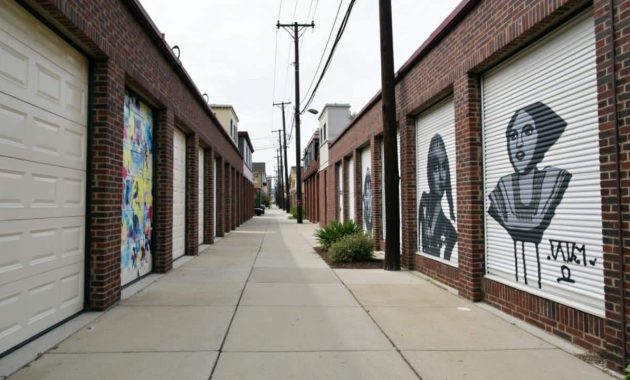
On a quiet Thursday evening on Chicago’s Near West Side, the alleys light up before the streets do. One by one, garage doors creak open, not to reveal SUVs and storage bins, but glowing canvases, spray-painted doors, and a guy in paint-splattered sneakers tuning a portable speaker. The smell of turpentine mixes with grilled onions from a neighbor’s back porch, and kids zigzag on scooters between chalk drawings and folding chairs. A couple walking their dog slows down, hesitates, then drifts toward the sound of laughter and clinking bottles. No flyers, no tickets, no velvet ropes. Just neighbors, concrete, and color.
Nobody planned for this to become a thing.
Yet somehow, an ordinary Chicago alley has turned into an accidental gallery.
From parking space to public space: the rise of the garage gallery
The Near West Side has always been a patchwork: old brick two-flats, new glass condos, a schoolyard, a boarded-up storefront. Lately, the most surprising transformation is happening off the main streets, behind the houses, where garages are slowly turning into semi-secret art spaces. Residents are hanging canvases on cinderblock walls, setting up string lights, and inviting friends to wander from door to door like a casual block party meets underground gallery crawl.
It feels improvised, almost fragile, like it could vanish the moment someone calls it a “scene.”
Take the 900 block of a side street near Racine. Last summer, a graphic designer named Laura cleared out half her garage to store her paintings. One Saturday, she left the door open while she worked. Her next-door neighbor brought over a beer. Then another neighbor wandered in with their teen, who’d been messing around with digital art. Within a month, three more garages on the alley had hung art on the walls “just to see what happens.”
By fall, nearly ten garages were opening once a month, with someone jokingly dubbing it “Artist Alley” on a hand-painted sign nailed to a fence.
What sounds like a quirky neighborhood anecdote is also a quiet response to a brutal reality: traditional gallery space is expensive, and many artists in Chicago are working two jobs just to stay put. Rents have climbed. Studio leases feel risky. Garages, on the other hand, are already there, already paid for, and sitting half-empty beneath fluorescent lights. So they’re being flipped into a kind of social currency.
The alley becomes a buffer zone: not quite private, not fully public, an informal stage where homeowners and artists can test ideas without red tape.
How residents are actually doing it (and what they’re learning on the fly)
The basic “method” behind these Near West Side garage galleries is surprisingly simple. People start small. They clear just one wall, sweep the floor, string up a cheap set of café lights from the hardware store, and lay an old rug to soften the concrete. A folding table becomes a bar for BYO drinks. An extension cord powers a Bluetooth speaker. That’s it. No velvet frames, no curated label cards, no lofty artist statements.
The low barrier is exactly what gives these spaces their energy.
The biggest lesson locals repeat is: don’t overthink it. The first time someone opens their garage, they’re nervous about everything being “good enough” or Instagram-perfect. They worry about not having enough pieces, or that nobody will come. Then a neighbor shows up with homemade cookies, another drags over a patio heater, and suddenly it’s a party. We’ve all been there, that moment when you realize community doesn’t care if your floor is dusty.
Let’s be honest: nobody really sands and repaints their whole garage every single time they hang two canvases for the neighbors.
“Honestly, I started because my landlord wouldn’t let me paint the apartment walls,” laughs Miguel, who lives in a coach house off Taylor Street. “The garage was the only place I could splash color around without losing my security deposit. Then my upstairs neighbor asked if her ceramics could sit on my workbench. After that, it stopped being ‘my’ space and turned into ‘our’ alley.”
- Clear one usable corner, not the whole garage.
- Hang work at eye level, even if it means nailing scrap wood into cinderblocks.
- Keep the door half-open so it feels inviting, not intimidating.
- Set a loose “open hours” so people know when to wander through.
- Treat every curious passerby as a guest, not a customer.
What this unexpected “artist alley” says about cities right now
Something subtle is happening between those cracked driveways and murals on roll-up doors. These garage galleries are filling a gap that zoning laws and big institutions rarely touch: everyday access to creativity, two steps from someone’s back gate. They’re not asking for permission, grants, or glossy sponsorships. They’re asking their neighbors, “Want to come see what I’ve been working on?”
*That tiny question changes the way a block feels at night.*
As more homeowners test the idea, they’re also renegotiating what home means in a city under constant pressure from development. A garage stops being just storage and turns into a flexible room: gallery one month, kids’ craft space the next, pop-up print sale during a summer street fest. On the Near West Side, where new construction and long-time residents often collide, this shared creativity softens the edges. People who might only nod on trash day now stand shoulder to shoulder, squinting at the same painting.
The alley becomes neutral ground, and that’s rare.
Not everything is dreamy, of course. Some neighbors worry about noise, or strangers wandering too close to their backyards. Artists debate pricing out loud, sometimes awkwardly, sometimes bravely. A few residents feel the twinge of whether this trend will attract the same attention that once priced artists out of nearby neighborhoods. Yet the plain truth is that these improvised art spaces give people control over at least one corner of their rapidly changing city. When a roll-up door becomes a canvas, the block stops being just “real estate” and starts to feel like a story.
➡️ Not 65 or 75 : the age limit to keep your driving licence in France has just been confirmed
➡️ “I became a training facilitator, and my income improved without longer hours”
➡️ Day will turn to night: the century’s longest solar eclipse now has an official date
| Key point | Detail | Value for the reader |
|---|---|---|
| Garage galleries are low-cost creative spaces | Existing garages are cleared, lit, and used as informal art rooms | Shows how you can create a cultural space without major investment |
| Neighborhood engagement grows organically | Friends and neighbors drift in, bring food, add their own work | Offers a simple model for building community where you live |
| Alleys become shared cultural corridors | Multiple garages open on the same night, forming a walkable “artist alley” | Inspires readers to rethink overlooked spaces in their own cities |
FAQ:
- How do homeowners avoid problems with the city?Most keep things small-scale: limited hours, no amplified bands late at night, and no formal “business” setup. Many treat it as a private gathering that’s open to neighbors and friends, not as a commercial venue, and they stay attentive to any concerns on the block.
- Do artists actually sell work in these garages?Yes, but casually. People slip a price list on a clipboard or add small tags, and payments are often via apps. The focus stays on conversation first, sales second, which takes pressure off both sides.
- Is this just a trend for younger residents?Not really. On the Near West Side, retired teachers, mid-career professionals, and college students all share space. Some older homeowners lend their garages even if they’re not artists themselves, simply because they like the energy.
- What about safety in the alley at night?Extra lighting, familiar faces, and clear sightlines help. People often open multiple garages at once so no one is isolated, and they close up at a reasonable hour. The presence of kids, dogs, and longtime neighbors tends to keep things grounded and low-key.
- Can this work in other neighborhoods or cities?Absolutely. Any block with a few willing homeowners and a safe alley or driveway can experiment. The key is starting tiny, talking to your neighbors first, and letting the space evolve at its own pace instead of forcing it into a “formal” gallery model.