The smell started faintly, the kind you only notice when you walk back into your own home after being out.
My kitchen looked spotless: shining countertops, an empty sink, neatly aligned spice jars. I wiped surfaces every night, ran the dishwasher, took out the trash. On Instagram, this kitchen would have passed the “aesthetic” test without a doubt.
Yet something was off.
A sour, slightly swampy note hung in the air, especially in the mornings. I scrubbed harder, lit candles, bought a fresh basil plant, even switched dish soaps like that would change anything. For days, I blamed the trash or the fridge.
The truth was hiding in plain sight.
Right under my hands the whole time.
The invisible culprit that lives in a “clean” kitchen
There’s a moment when you lean on your counter, exhale, and think, “Okay, this place is finally clean.”
Then a weird whiff cuts through the lemon-scented spray and ruins the whole scene. That was my routine for nearly two weeks. I’d scrub the stove, sweep under the table, shake out the rug, disinfect every visible surface.
Each night the kitchen shone like a showroom.
Each morning it greeted me like a forgotten locker room.
It didn’t match. It almost felt personal, like the room was mocking my effort.
One evening, standing there with a dishcloth in my hand, I went into detective mode.
I sniffed the trash can. Fine.
Opened the fridge. Cold air, no problem.
Checked the sink drain, even poured baking soda and vinegar, the famous home-remedy combo. The smell faded for a few hours, then crept back again, smug and stubborn.
I pulled out the oven. Nothing.
Wiped under the toaster. A few crumbs, no big deal.
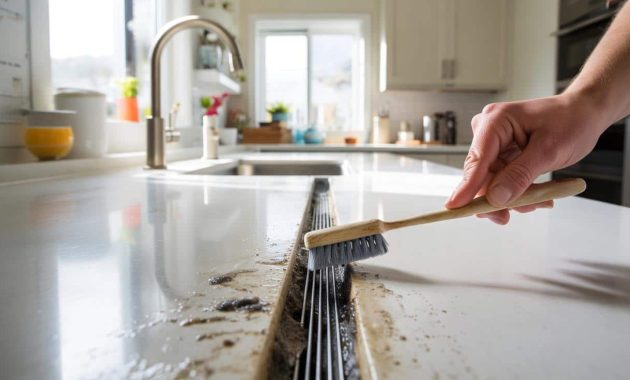
Then, almost by accident, I ran my fingers along the thin rubber strip between the countertop and the back of the sink. My fingers came back slimy. That single detail changed everything.
The hidden spot was the back edge of the sink and the seal where the counter meets the wall.
That tiny ledge where water splashes, coffee drips slide, and dish soap foam slowly collects. Over time, it had turned into a thin, sticky line of gunk. The kind you don’t really see, but bacteria absolutely love.
Every time I wiped “around” it, I left that strip untouched.
It didn’t look dirty from a standing angle. Under kitchen light, it blended in.
But up close, it was a different story: darkened sealant, softened crumbs, and a faint, sour smell that told you something was rotting quietly, day after day.
How I finally scrubbed out the smell (and what I learned)
The fix started with something painfully simple: angles.
Instead of cleaning standing up like I usually do, I literally crouched down so my eyes were level with the countertop. The scene changed. I suddenly spotted dried streaks of tea, forgotten splashes on the faucet base, and that grimy line along the back of the sink.
➡️ “I didn’t understand money confidence until I experienced it”
➡️ China unearths a 2,200-year-old imperial road that challenges our modern highways
➡️ Microwaving a lemon : A simple kitchen trick you’ll keep using
➡️ The everyday reason your recovery feels incomplete
➡️ Experts say one subtle phone habit may be draining attention without you noticing
I grabbed an old toothbrush, a bowl of warm water with dish soap and a splash of white vinegar, and went straight for that strip.
Short, firm strokes.
Foam turned grey almost immediately. I rinsed, wiped, scrubbed again, paying attention to the joints, corners, and the base of the taps. Within ten minutes, that “invisible” area looked new.
The smell didn’t vanish instantly, but it faded fast. By the next morning, the kitchen finally smelled like…nothing. Neutral, quiet air. That’s when it hit me: most of us clean the same spots on autopilot, following a mental map we created years ago. The rest just doesn’t exist in our heads.
We’ve all been there, that moment when you’re convinced something’s wrong with the pipes, or the trash, or the fridge, when the answer is literally a 2-centimeter strip you never really touch.
Let’s be honest: nobody really does this every single day.
We only go after these sneaky areas when something starts to feel “off”.
Once I had found my culprit, I started noticing other almost-invisible traps.
The ridge under the countertop lip. The rails of the cutlery drawer. The underside of the sink plug. All those micro-edges that never feature in cleaning videos, yet harbor the smells that make a “clean” kitchen feel not quite right.
A plain truth kept coming back to me: your nose is usually right before your eyes are.
If your kitchen smells wrong but looks fine, odds are there’s a hidden habitat for moisture, food particles, and bacteria. That’s all a bad smell really is — life happening where you don’t want it. *Once you think of it that way, you stop taking it personally and start getting curious instead.*
The 10-minute “smell check” that changes everything
Now, once a week, I do a short, almost ritualistic smell check.
I start by turning off any scented candles or diffusers so I’m not fooled by artificial perfumes. Then I leave the room for a few minutes, come back in, and pay attention to the first whiff I get. If anything feels heavy, sour, or just “old”, I know there’s a spot to find.
I go straight to the usual suspects: the back of the sink, under the faucet, around the sealant, behind the soap dispenser, under the drying rack.
To clean them, I use three basic tools: an old toothbrush, a microfiber cloth, and a small bowl with soapy water plus a splash of vinegar.
No fancy products, just patience and angles.
A lot of us attack smells the same way we attack stress: cover it up, hope it goes away, throw more products at it.
Air freshener on the counter. Perfumed dish soap. A new candle in a trendy jar. The scent gets stronger but the problem stays put, quietly rotting in that same hidden strip or corner.
If you’ve ever felt slightly ashamed about a lingering kitchen smell, you’re not alone.
It doesn’t mean you’re dirty or lazy. Most of the time, it just means nobody ever pointed out how those tiny, boring edges work. Once you’ve seen it, you can’t unsee it, and that’s actually freeing.
“Clean is what you see.
Fresh is what you don’t smell.”
That sentence, said almost offhand by a professional cleaner I once interviewed, now lives rent-free in my brain every time I pick up a sponge.
- Check the back of the sink strip
Run a finger or cloth along the joint where the sink meets the backsplash. If it feels slimy or gritty, that’s a likely odor source. - Scrub corners and bases
Use a toothbrush around tap bases, soap dispensers, sink edges, and drain covers. Rinse with warm water and wipe dry. - Dry, don’t just wash
Bacteria love moisture. A quick final pass with a dry cloth on seals, edges, and joints cuts smells more than most sprays. - Rotate your “invisible” zones
Each week, pick one: under appliances, inside drawer rails, backsplash joints, under the countertop lip. - Trust your nose
If a smell returns, repeat the search lower, closer, slower. Your first instinct is usually pointing to the right corner.
From spotless to truly fresh: the part nobody films
Since finding that one filthy strip, I’ve started to see kitchens — mine and other people’s — in a different way. Not as before-and-after Instagram squares, but as living spaces with their own quiet habits. A shiny counter doesn’t mean much if the room still smells like last week’s pasta water.
That doesn’t mean spending hours scrubbing every crevice.
It means adding a new layer of awareness: thinking in terms of edges, joints, and wet zones, not just big surfaces. Once a week, ten minutes in the right place beats thirty minutes on the wrong one.
There’s a strange kind of relief in admitting that all of us miss things, especially tiny ones we see every day.
Sometimes the thing that bothers you at home isn’t about effort, but about perspective. The moment you kneel down, lean in, or run a fingertip where a cloth never goes, the story of your “mystery smell” starts to make sense.
Maybe your hidden spot isn’t the sink strip.
Maybe it’s the rubber seal of your dishwasher, the underside of the cutting board, or the groove under the fridge door. Once you’ve cracked it, you can’t help wanting to share the discovery, if only so someone else spends less time doubting themselves and more time just enjoying a quiet, truly fresh kitchen.
| Key point | Detail | Value for the reader |
|---|---|---|
| Hidden odor zones | Areas like sink edges, seals, corners, and faucet bases trap moisture and food residue | Helps target the real source of bad smells instead of wasting time on already-clean surfaces |
| Angle-based cleaning | Crouching, changing viewpoint, and using touch to spot grime your eyes miss | Offers a simple, realistic method to find dirt and odors without special tools |
| 10-minute weekly check | Short smell check plus focused cleaning of one or two small “invisible” zones | Reduces kitchen odors long-term with minimal extra effort and less reliance on perfumes |
FAQ:
- Why does my kitchen smell even when it looks clean?Because smells usually come from tiny, wet, hidden spots — like seals, joints, and corners — that never get scrubbed, even when the main surfaces sparkle.
- What is the most common hidden source of kitchen odor?The back edge of the sink and the area around the faucet base, where water, soap, and food splashes slowly build a slimy film.
- How often should I deep-clean these hidden areas?A quick targeted scrub once a week is usually enough, with a more thorough pass once a month if you cook a lot.
- Can I just use air fresheners to solve kitchen smells?They only cover the odor temporarily; as soon as the scent fades, the underlying bacteria and residue will still be there producing the same smell.
- What simple tools do I need to clean these spots?An old toothbrush, a microfiber cloth, warm soapy water with a bit of vinegar, and a few minutes of focused attention are usually all you need.