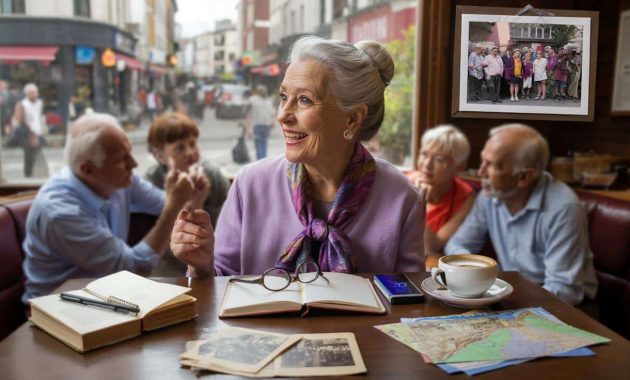
At the café near my apartment, there’s a group of retirees who always claim the corner table by the window. One of them, a thin woman with a messy silver bun and a purple scarf, tells stories like they happened yesterday. She remembers the exact price of her first rented studio in 1973, the name of the landlord’s dog, and the song that was playing on the radio when her daughter was born. The others lean in, a little amused, a little impressed.
You can almost feel the quiet comparison going on around the table. Who still remembers what, and how clearly.
At 70, that gap starts to show.
If you still remember names and faces, your social memory is exceptional
Ask any 70-year-old what they fear losing, and many will say the same thing: “I don’t want to forget people.” Names slip away first for a lot of us. You see a neighbor in the supermarket, you smile, you wave… and your mind goes completely blank. The conversation becomes a small, silent panic.
So when someone in their seventies can still match names with faces, and recall where they met that person, psychologists raise an eyebrow. Social memory is one of the first areas to get “foggy” with age. If yours is clear enough to still attach a name, a context, maybe even a spouse’s name, that’s a strong hint your mind is running above average for your age.
I watched this at a 50-year high school reunion. Some people had to peek at the name tags every few seconds. One man, though, walked in like a local historian. He called old classmates by name, remembered who used to sit in the second row, and asked one woman, “Your brother Mark still living in Denver?” Her jaw dropped. He hadn’t seen her in decades.
She later told me she barely recognized half the room. He, on the other hand, was “like a walking yearbook.” Stories like that aren’t just nostalgia. They’re visible signs of how differently aging brains can function.
Psychologists talk about “face-name binding,” a task that gets tougher as the brain’s wiring ages. The hippocampus and frontal lobes need to work together to store and retrieve that social detail. At 70, plenty of people still function well, but this specific ability often declines. If you’re the one still pulling names and faces from your mental Rolodex with minimal effort, it suggests those brain networks are holding up impressively.
That doesn’t mean you’ll never forget. It just means your baseline is sharper than most of your peers.
If you can recall what you read last week, your working memory is holding strong
Clinical psychologists often ask older patients a deceptively simple question: “What did you read or watch recently that stuck with you?” Many struggle to answer. They remember that they watched “something” on TV, or that there was “an article about health,” but the content evaporates.
➡️ This is what professional organizers focus on before cleaning starts
➡️ Here’s everything you need to know about canned sardines
➡️ Better than air freshener: the taxi method to keep the car interior always fresh
➡️ If your flowers fade quickly, temperature stress is often the reason
➡️ Goodbye balayage, Light Line colouring is the trendiest for spring–summer 2026
If you’re 70 and can easily summarize a book you finished last month or yesterday’s long newspaper piece, you’re using a type of memory that tends to fray early: working memory plus recent episodic memory. That’s the mental space that holds new information, organizes it, and gives it meaning. It’s the difference between “I saw a documentary” and “I saw a documentary on bees, and the part about urban hives in Paris blew my mind.”
An older teacher I know, now retired, keeps a little reading notebook. Not a fancy system. Just book titles, dates, and three bullet points of what struck her. When I asked why, she laughed and said, “So I can check if my brain still works.”
Here’s the twist: she rarely opens the notebook. She doesn’t need to. She’ll talk for ten minutes about a novel she read six weeks ago, quoting characters, comparing it to something else she read in the 90s. That kind of recall isn’t magical. It’s a reflection of circuits that are still flexible, still able to encode and retrieve complex information.
From a cognitive point of view, remembering recent content draws on attention, processing speed, and mental organization. Those are the areas that typically slow by the late sixties. When you can still follow a dense article, link it to older knowledge, and talk about it days later, your brain is doing high-level integration. *That’s not the norm at 70, even if nobody says it out loud.*
You don’t need to remember every detail. The sign of a sharp mind is being able to recall the gist, the key idea, and one or two specific examples without feeling mentally exhausted.
If you remember old arguments – and how they were resolved – your emotional memory is intact
Memory isn’t just facts and dates. It’s how your mind stores emotional events. If, at 70, you can still recall an argument with your father when you were 19, and also how you two made peace afterward, that’s a type of clarity that goes beyond simple nostalgia.
Older adults often remember the emotional burn but lose the storyline. They say, “We had a big fight once,” but the sequence is blurry. When someone can recount who said what, how they felt, and what changed later, psychologists see a sign of preserved narrative memory. It means your brain still weaves your life into a coherent story.
A widower I interviewed could tell, almost scene by scene, the last big disagreement he had with his wife before she passed. He remembered the restaurant, the waiter’s accent, the way she pushed away her dessert when she got upset. Then he described, just as clearly, the quiet car ride home, the apology, the decision they made not to go to bed angry anymore.
He didn’t sound stuck. He sounded anchored. His memories had edges and colors, not just vague emotional shadows. That kind of detail suggests his brain didn’t just store the pain; it stored the learning.
Emotional memory involves areas like the amygdala and hippocampus, which interact closely. With age, some people keep the raw feeling but lose the context. When you still remember both the conflict and its resolution, your mind is doing a more sophisticated job. It’s holding onto nuance, not just trauma.
This type of memory also protects mental health. Being able to remember not only what hurt you, but what healed you, supports resilience and lowers the sense of helplessness that can creep in later in life.
If you still remember where you put things, your spatial memory is beating the statistics
We’ve all been there, that moment when you open the fridge and stare at it like it owes you an apology. At 70, this happens more. Keys migrate. Glasses disappear. Remote controls live secret lives. Everyday misplacement is normal to a point.
Yet some older adults still walk straight to the drawer where the batteries are, recall exactly which jacket pocket holds their metro card, and retrace their steps through a crowded supermarket without hesitation. That’s spatial memory at work, and it’s one of the quiet cognitive skills that separates “doing fine” from “sharper than average.”
A friend’s grandmother, 78, lives in a small, cluttered house. On the surface it looks chaotic: stacks of magazines, boxes in corners, a drawer full of mixed tools. Ask her for anything though, and she’ll tell you, “Top drawer on the right, under the brown notebook, next to the tape.” She’s rarely wrong.
Her doctor once joked that her house is a “spatial memory gym.” Navigating that environment every day keeps her mental map constantly active. While others her age get turned around in a new shopping mall, she still draws quick, accurate mental layouts of spaces she visits.
Spatial memory relies heavily on the hippocampus, which also plays a big role in Alzheimer’s disease. Getting a little more forgetful with objects is expected with age. But if you’re still reliably tracking where you left things, how to get somewhere without GPS, and how a room is organized, that points to relatively preserved hippocampal function.
It doesn’t mean you’ll never misplace your keys again. Let’s be honest: nobody really does this every single day. It just means that, compared to many of your peers, your internal “map system” is staying robust.
If you remember life lessons – and still apply them – your procedural and semantic memory are thriving
Psychologists often look at what you remember not only as “facts,” but as skills and lessons. If, at 70, you can still remember how to calmly de-escalate a tense conversation using a trick you learned in your thirties, or you instinctively follow safe steps you learned at work decades ago, your brain is doing more than reminiscing.
You’re tapping into semantic memory (knowledge about the world) and procedural memory (how to do things), two systems that can remain incredibly strong in healthy aging. When you draw on them in real time, that’s a strong mark of cognitive resilience.
Think about the retired nurse who still runs a mini “triage” in her head when someone falls at a family gathering. She remembers which questions to ask, which symptoms are urgent, the safest way to help someone stand up. Or the former accountant who still mentally checks restaurant bills for errors without even trying.
These aren’t parlor tricks. They’re signs that the brain still stores and retrieves complex professional knowledge, and can adapt it to new situations, even when the job ended years ago.
Neuroscience shows that procedural and semantic memories can be more durable than short-term recall. When those memories stay vivid and accessible at 70, they act like scaffolding for the rest of your thinking. They support decision-making, problem-solving, and that calm, grounded way some older adults have when things go wrong.
One psychologist put it simply:
“The older brain may lose some speed, but it can gain a kind of wisdom speed — it jumps straight to what has worked before.”
Here are some typical signs that these systems are still firing:
- You effortlessly remember multi-step recipes you learned decades ago
- You recall old safety rules and follow them automatically
- You can still teach someone a skill you once used professionally
- You adapt past lessons to new problems without overthinking
If you still remember your goals for next year, your future memory is unusually clear
There’s another form of memory that often gets ignored: remembering the future. Technically it’s called prospective memory, and it’s about holding onto intentions. If, at 70, you can easily list what you want to do next summer, which projects you want to finish this year, and which friend you plan to visit in three months, your cognitive profile stands out.
Many people in their seventies drift away from concrete future plans. Not always by choice. Sometimes the brain just stops projecting forward with the same energy.
I met a 72-year-old man on a train who pulled out a worn notebook filled with dates and small goals. “Walk the coastal path in May. Learn three new songs on the guitar. Digitize family photos before Christmas.” As he spoke, he remembered which steps he had already taken: which trail guide he’d bought, which nephew promised to help with the scanner.
He wasn’t obsessively organized. He was mentally engaged with his own future. That sense of direction, backed by clear recall, is a quiet sign of strong executive function, the part of the brain that plans and tracks our lives.
When psychologists test older adults, they often find prospective memory slipping: people forget appointments, intended phone calls, or tasks they meant to start. If yours remains relatively sharp, it signals that your frontal lobes, which coordinate planning and attention, are still working above the statistical curve for your age.
Remembering your future isn’t just about “not forgetting.” It’s about still seeing yourself as someone who has chapters left to write — and keeping those chapters in mind from one week to the next.
A sharp mind at 70 is rarely an accident
If you recognize yourself in several of these signs — the clear names and faces, the recent books you can still summarize, the old lessons you keep applying — you’re not just “lucky.” You’re living proof that cognitive aging is not a single, fixed path.
Brains age differently. Lifestyle, education, social ties, sleep, even how you handle stress… all of this shapes what stays bright and what fades.
Some people at 70 feel like they’re slipping away from their own memories. Others are quietly running cognitive marathons while the rest of the room searches for their reading glasses. Most of us sit somewhere in between.
Recognizing which memories stay strong isn’t about bragging rights. It’s a way of noticing where your brain is still powerful, so you can lean on those strengths and protect them.
Maybe you’re that grandparent who remembers every grandchild’s birthday and favorite snack. Or the neighbor who still gives the best route advice across town. Maybe you’ve lost speed in one area, but gained a kind of depth in another. **Aging doesn’t erase intelligence; it reshapes it.**
The real question is: what do you want your mind to stay sharp for — and how will you feed the parts of your memory that are still very much alive?
| Key point | Detail | Value for the reader |
|---|---|---|
| Social and emotional memory | Remembering names, faces, and how conflicts were resolved | Signals strong relational intelligence and preserved brain networks |
| Practical and spatial memory | Finding objects, navigating spaces, using old skills in new ways | Supports independence and daily confidence at 70 and beyond |
| Future and knowledge memory | Recalling what you read, learned, and plan to do next | Shows active, engaged thinking and a continued sense of direction |
FAQ:
- Question 1Does forgetting names sometimes mean my memory is failing?
- Question 2Can I improve my memory at 70, or is it too late?
- Question 3What’s the difference between “normal aging” and early dementia?
- Question 4Do brain games and apps really help keep my mind sharp?
- Question 5How can I protect the types of memory that are still strong for me?