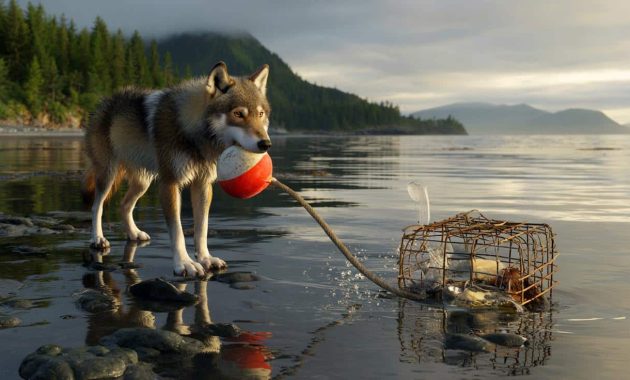
On the Pacific coast of British Columbia, a single video clip has reopened old questions about how animals think, learn, and adapt to us. What looked like a simple case of stolen bait now appears to be a striking example of problem-solving in a wild canid.
A wolf, a buoy and a missing crab trap
The scene takes place on the shores of the Haíɫzaqv (Heiltsuk) Nation territory, a rugged stretch of coastline where dense forest meets cold Pacific waters. Indigenous Guardians in the area had set out crab traps as part of a conservation programme targeting invasive European green crabs, a species that threatens local ecosystems and shellfish.
For months, some traps had turned up mysteriously empty, dragged ashore or damaged. Others simply vanished. Locals wondered who or what was interfering. Bears? Sea lions? Curious humans? To get answers, the Guardians installed motion-triggered cameras along the shore.
One of those cameras captured a scene that now has biologists rethinking what they thought they knew about wolves.
In less than three minutes, a wild wolf calmly located, retrieved and emptied a crab trap system designed by humans.
In the footage, a lone coastal wolf walks to the water’s edge and seizes a floating buoy in its jaws. Then, instead of giving up or just chewing on the plastic, the animal begins pulling the line, step by step. It backs away, repeatedly regripping the rope, patiently drawing the submerged trap toward the beach.
Once the cage reaches shallow water, the wolf uses its teeth and paws to get to the bait, stored inside a small plastic cup within the trap. It eats the reward and then wanders off, leaving the empty gear behind.
Why this behaviour surprised scientists
The sequence, described in the journal Ecology and Evolution by researchers Kyle A. Artelle and Paul C. Paquet, looks simple at first glance. A hungry predator finds food and takes it. Yet for those who study animal cognition, the details matter.
From the shore, the wolf could not see the bait hidden underwater in the trap. What it could see was the buoy, and maybe the top section of rope. The rest of the system was invisible beneath the surface.
➡️ France watches with growing unease as its eternal rival, the Royal Navy, slowly falls apart
➡️ France deploys Charles de Gaulle carrier strike group to Atlantic for ORION 26 war exercise
➡️ Psychology says the rarest mental strength today isn’t resilience or grit
➡️ 5 ways emotionally intelligent people handle their anger
➡️ Why child development experts never use time-outs (the more effective discipline method)
➡️ Many people don’t realise it, but cauliflower, broccoli and cabbage are varieties of the same plant
Instead of randomly tugging or giving up, the wolf performed a short, ordered chain of actions:
- Locate and grip the buoy
- Pull the rope repeatedly, bringing it gradually to land
- Persist until the heavy trap reaches the shallows
- Identify where the bait is hidden inside the apparatus
- Remove and eat the bait before leaving
The behaviour suggests the wolf linked several unseen elements: buoy, rope, submerged trap and hidden food.
That sequence hints at more than reflex. The animal appears to treat the buoy as a handle attached to something valuable out of sight. It behaves as if it understands that pulling the visible part will bring the invisible part closer.
For many researchers, that kind of “if I do this, then that will happen” reasoning sits uncomfortably close to the way humans describe planning and causal understanding.
Does this count as an animal using a tool?
The case drops right into a long-running dispute in animal behaviour research: what counts as an animal using a tool?
Some scientists apply a broad definition. Any time an animal manipulates an object to achieve a goal, from an otter smashing a shell with a rock to a bird dropping nuts on a road, they call it tool use. Under that view, the wolf using the buoy and rope as a means to reach food would qualify.
Others draw a tighter line. They argue that real tool use must involve objects picked up and intentionally used in a flexible way, rather than simply acting on existing structures such as vines, burrows or ropes. For them, pulling on a line may not make the cut.
Either way, the observation presses on another point: sequence and structure. The wolf’s actions were not random, repeated trial-and-error over a long period. The entire clip reportedly lasts under three minutes from first contact with the buoy to the last bite of bait.
Learning, imitation or lucky first attempt?
Artelle and Paquet suspect this wolf may not be unique. They and local Guardians have seen other traps hauled, emptied or damaged in similar ways along the same coastline. That raises the possibility of social learning within a pack or community of coastal wolves.
In captive settings, animals such as dingoes and domestic dogs have been seen manipulating latches, handles and other devices after watching humans or conspecifics. Wild wolves rarely get that kind of opportunity, especially in places where they’re persecuted or constantly disturbed.
The coastal wolves in this protected area live with relatively little harassment, giving them time and safety to experiment.
In a context where wolves are not shot on sight and where human objects are common but not always dangerous, curious individuals can afford to investigate, test and remember. That may be the difference between a wolf that backs away from every buoy and one that treats it as a potential food delivery system.
What this coastal wolf tells us about canid intelligence
For decades, intelligence studies in canids have focused heavily on domestic dogs, whose lives are intertwined with humans. Dogs’ ability to follow pointing gestures, read facial cues and learn words is well documented. Wolves, by contrast, are often portrayed as driven mainly by instinct and rigid social rules.
The Haíɫzaqv wolf challenges that picture. It shows that in the right conditions, wild canids can display flexible thinking, especially when food is at stake.
Researchers point to several cognitive skills likely involved in the crab trap episode:
| Skill | Role in the wolf’s behaviour |
|---|---|
| Causal reasoning | Linking the act of pulling the buoy to the hidden result of bringing the trap closer |
| Persistence | Continuing to pull despite resistance from the heavy, submerged trap |
| Spatial understanding | Working with an object partly above and partly below the water surface |
| Problem-solving | Finding and extracting bait tucked away inside plastic components |
These are not new abilities in the animal kingdom. Corvids, primates and some marine mammals are famous for similar feats. What makes this case stand out is that it involves a wild wolf interacting with a complex, unfamiliar human device in its natural habitat.
Protected environments and the space to think
The researchers highlight a social and political angle often overlooked in stories about animal cleverness. The region where this wolf lives is comparatively safe for predators. Thanks to Indigenous leadership and changing attitudes to carnivores, wolves there face less hunting and trapping pressure than in many other parts of North America.
That relative safety may give them more freedom to roam, investigate and take small risks, like approaching odd floating objects instead of sprinting away from every human scent.
When animals are not constantly fleeing danger, they get more chances to learn, innovate and share new behaviours.
This idea of “behavioural freedom” suggests that we may be underestimating the intelligence of wildlife in heavily persecuted regions. If a wolf spends most of its life dodging bullets or snares, there is less room for calm, curious experimentation with novel things in the landscape.
What this means for conservation and human–wildlife relations
The clever wolf poses a practical challenge for conservation projects that rely on baited traps and other gear. As animals figure out how to exploit or avoid these devices, managers may need to rethink designs and strategies.
For the Haíɫzaqv Guardians trying to control invasive crabs, an intelligent, trap-savvy wolf is both a problem and a sign of ecological richness. It reveals a food web that includes predators willing to interact with human infrastructure, sometimes in quite sophisticated ways.
There are also ethical questions. Stories like this can shift public perception of wolves, from villains to thinking beings, but they can also fuel fears that predators are getting “too smart” and harder to manage. Balancing respect for animal cognition with realistic management goals will be a continuing tension.
Key terms and wider context
Two concepts often come up in discussions of incidents like this.
Cognitive ecology. This field studies how an animal’s environment shapes the way it thinks, learns and solves problems. The crab trap wolf is a textbook example: an industrial fishing device appears in a wild habitat, and a predator incorporates it into its foraging strategy.
Social learning. Many animals pick up new skills by watching others. If one wolf learns that buoys mean easy calories, pack mates may copy the technique. Over time, what started as a single individual’s innovation can become a customary behaviour in a local population.
Humans see something similar in urban wildlife. Foxes in cities learn to open bins; raccoons get better at defeating “animal-proof” locks. Each new generation can start from a slightly higher baseline of street-smarts, thanks to what their parents and neighbours already figured out.
Imagining future encounters with clever predators
Incidents like this invite a more nuanced view of our shared spaces with wildlife. As coastal areas warm and marine species shift their ranges, coastal wolves and other predators may meet more human gear, from fish farms to mooring systems.
It is not hard to imagine a set of scenarios: wolves consistently raiding crab traps, bears learning to flip open coolers left at campsites, or orcas targeting parts of fishing lines to strip off valuable catches. Each case adds to growing evidence that many animals are not simply adapting physically to human impact, but mentally as well.
For people working on the water or in the backcountry, this means paying closer attention to how gear, waste and infrastructure signal opportunity to nearby animals. Designing equipment that is less easily turned into a buffet for sharp-minded predators could reduce conflict and loss on both sides.