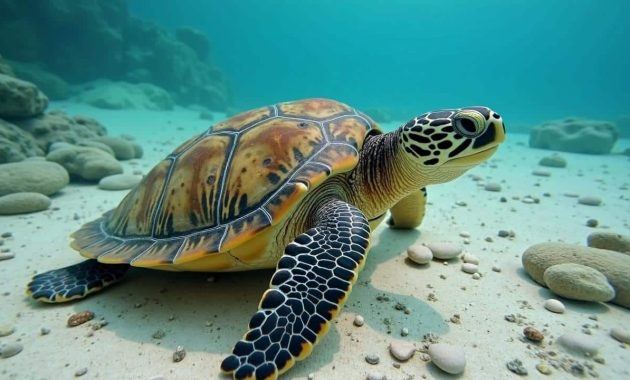
What looks like a peaceful Mediterranean postcard hides a disturbing reality for one group of tortoises. On a tiny North Macedonian island, females are literally being driven off cliffs as they try to escape relentless males, and biologists say the numbers leave little doubt: this is a slow-motion extinction playing out in real time.
Where females jump to their deaths to escape
The drama unfolds on Golem Grad, a small, uninhabited island in Lake Prespa on the border of North Macedonia, Albania and Greece. The island is home to a long‑studied population of Hermann’s tortoises (Testudo hermanni), a small Mediterranean species known more for its peaceful pace than for violence.
Yet field teams tracking these tortoises for more than 16 years have documented scenes that look almost like harassment in a nightclub, but in slow motion. Males vastly outnumber females, and they do not stop trying to mate.
On Golem Grad, researchers estimate there are about 19 males for every single female Hermann’s tortoise.
In that skewed setting, females are chased, rammed, bitten and repeatedly mounted. When several males converge on the same female, she can end up pushed towards the edge of steep limestone ledges. Some are seen falling, tumbling down rock faces and dying from the impact.
Scientists shy away from using human words like “suicide” in a strict sense. These tortoises are not planning their deaths. Yet field notes and carcass locations strongly suggest that, in trying to escape constant harassment, females move into more dangerous terrain and are far more likely to plunge from cliffs than males.
How sexual harassment becomes a demographic trap
The work, published in the journal Ecology Letters, paints a tight chain of cause and effect. Excess males mean constant mating attempts. Constant mating attempts mean stress, injuries and energy loss for females. Those weakened females lay fewer eggs and die more often. That reduces the number of females even further, making the sex ratio more skewed than before.
Biologists describe this feedback loop as an “extinction vortex”: once it starts, every turn makes escape harder.
The team, led by ecologist Dr Dragan Arsovski, combined capture‑recapture data, survival estimates and reproductive records from hundreds of marked tortoises. Compared with populations on nearby mainland sites, females on Golem Grad showed:
➡️ Goodbye microwave: here’s the appliance that will replace it, and it’s much better
➡️ What it means when someone laughs after saying something serious, according to psychology
➡️ I make this raclette toastie in a pan when it’s freezing: 4 ingredients, 15 minutes, total pleasure
➡️ A cosmic treasure in France: this meteorite holds grains older than the Sun
- Lower annual survival
- Fewer clutches laid per season
- Smaller clutch sizes
- More visible trauma around the tail and cloaca
According to the study, around three quarters of females on the island carry genital scars or lesions linked to repeated copulation attempts. These wounds can get infected, and the pain likely disrupts feeding and movement.
When will the last female vanish?
Using demographic models, the researchers projected the fate of the island population if nothing changes. The result is bleak. If current trends continue, the last reproductively active female on Golem Grad could disappear around the 2080s.
That date is not a prediction written in stone, but it shows the time frame at which the population could become functionally all‑male, even if some elderly females remain alive but no longer breed. After that point, extinction becomes only a matter of decades as old males die off.
| Aspect | Female tortoises on Golem Grad | Nearby mainland females |
|---|---|---|
| Sex ratio (males per female) | ≈ 19 : 1 | Closer to balanced |
| Annual survival | Lower | Higher |
| Injury rate | High, frequent genital marks | Much lower |
| Reproductive output | Reduced | Normal |
Why the sex ratio is so badly skewed
One of the strangest parts of this story is that no obvious human persecution caused the imbalance. There has been no major turtle harvest on the island, no targeted killing of females, no recent introduction of predators that only take one sex.
Instead, scientists suspect a mix of long‑term chance, subtle habitat changes and the biology of the species. In many reptiles, the sex of a hatchling depends on the temperature inside the nest. Slightly warmer or cooler conditions when the eggs develop can create more males or more females.
A few decades of slightly biased hatching, mixed with random deaths, may have been enough to push Golem Grad’s tortoises past a tipping point.
Once that tipping point is crossed, behaviour does the rest. Males sense that females are rare, and competition spikes. The more they chase and injure females, the fewer young females survive into adulthood. That further boosts the proportion of males, reinforcing the spiral.
Harassment as a force in evolution
The case on Golem Grad is extreme, but the underlying idea is familiar to evolutionary biologists. In many animals, from ducks to insects, males benefit by mating as often as possible, even when that harms females. This is known as sexual conflict.
Usually, populations stabilise because females evolve defences, or because very aggressive males end up paying a cost, for example by being easier prey. What makes the tortoises unusual is that the balance appears to have broken in an isolated setting where there are few checks on male numbers.
Researchers see this as a rare, real‑world example of sexual conflict pushing a natural population towards extinction without direct human killing. It raises the question of how many other small, isolated animal groups might be sliding down a similar path unnoticed.
Can conservationists still change the ending?
From a practical point of view, several interventions could slow or reverse the spiral. Biologists talking about the study suggest options such as:
- Removing a portion of males from the island
- Translocating females from healthier populations
- Protecting and shading nests to influence hatchling sex ratios
- Fencing off the most dangerous cliff edges used as escape routes
Any move comes with trade‑offs. Removing animals or moving them around alters an ecosystem that has been left largely alone. Yet doing nothing means accepting a high chance that this particular island lineage of Hermann’s tortoises will vanish within a human lifetime.
Authorities would also have to weigh the welfare aspect. When field teams already document females repeatedly injured and chased to fatal falls, reducing male density is not just about long‑term numbers, but about day‑to‑day suffering in a population we claim to protect.
Understanding a few key terms behind the headlines
The phrase “extinction vortex” sounds dramatic, but it has a precise meaning in conservation biology. It refers to a self‑reinforcing loop where being rare makes a species more vulnerable, and that extra vulnerability makes it even rarer. In Golem Grad’s tortoises, rarity of females fuels harassment, which in turn makes females rarer still.
Another idea at play is “sexual selection”, the process by which traits that improve mating success spread, even if they carry risks. Loud bird songs, giant antlers and flashy colours all fall under this. In the tortoises, highly persistent mate‑seeking males might gain many matings, but when too many such males pile into one small space, the entire group pays the price.
For readers visiting Mediterranean regions where tortoises still live in the wild, this research offers a quiet reminder. Simple actions such as not moving reptiles between sites, not collecting them as pets and leaving nesting areas undisturbed can help keep local sex ratios and behaviours closer to balance. On small islands like Golem Grad, a slight push one way or another can echo through generations.