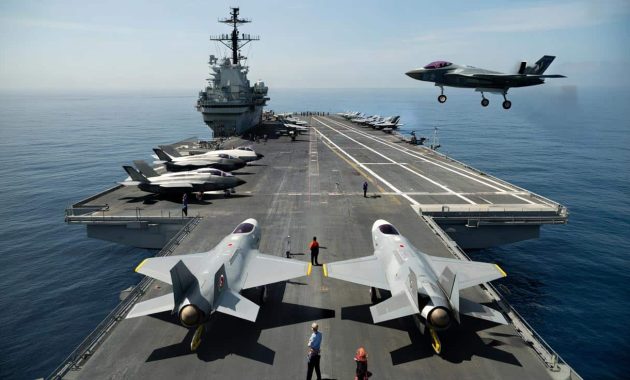
The Royal Navy’s HMS Prince of Wales is hosting Italian F-35B Lightning II fighters for the first time during a major NATO exercise, turning the giant ship into a floating symbol of how European air and naval power are knitting together.
Italian jets touch down on British deck
Italian F-35B short take-off and vertical landing (STOVL) fighters have embarked on HMS Prince of Wales during Exercise Neptune Strike 2025, a NATO-led drill focused on carrier strike operations across the Mediterranean.
The deployment places Italian fifth-generation aircraft side by side with British F-35Bs on the same carrier deck, a picture that would have been hard to imagine just a few years ago.
Italian and British F-35B fighters now share the same flight deck, demonstrating that NATO carriers can operate each other’s most advanced jets almost interchangeably.
The jets joined the carrier as it moved back from an extended Indo-Pacific swing, part of the UK Carrier Strike Group 25’s eight-month Operation Highmast, which has taken the ship from the Atlantic through key chokepoints and into Pacific waters before looping back towards Europe.
What Neptune Strike 2025 is really about
Neptune Strike is more than a set of flight drills and photo opportunities. It is a NATO framework for proving that different nations’ carrier groups, aircraft, and command systems can mesh together under one allied umbrella.
For this edition, HMS Prince of Wales is operating under NATO command alongside the Italian carrier Cavour and a mix of allied frigates, destroyers, submarines, and land-based air assets.
- F-35Bs practise maritime strike against simulated naval targets
- Air defence missions are flown to defend the carrier group
- Land-attack profiles test precision strikes from the sea
- Data links like Link 16 tie jets, ships, and headquarters together
These activities give NATO a realistic stress test of communications, logistics, and procedures when different nations mix aircraft and ships during a fast-moving crisis.
A busy carrier: HMS Prince of Wales on extended deployment
HMS Prince of Wales, the second of the UK’s Queen Elizabeth-class carriers, is a 65,000-tonne floating airbase capable of embarking up to 36 F-35Bs when fully loaded.
➡️ In 2026, these four zodiac signs are set to become millionaires
➡️ 5 health benefits of persimmons: here’s why we should eat more of them
➡️ The hidden reason vehicles feel sluggish in winter
➡️ February feeders place this cheap treat to ensure birds return every morning
➡️ Garden : This plant beloved by the French is now strictly banned across Europe
For Operation Highmast and Neptune Strike, the ship is carrying roughly two dozen British F-35Bs, now reinforced by Italian jets for joint missions and deck operations.
On board are around 4,500 British personnel:
| Service / role | Approximate personnel |
|---|---|
| RAF & Fleet Air Arm aircrew and support | ~600 |
| British Army contingent | ~900 |
| Royal Navy & Royal Marines | ~2,500 |
The ship’s twin “island” superstructure separates navigation and flight control, improving resilience if part of the ship is damaged and helping manage a high tempo of launches and recoveries.
With both British and Italian jets operating from the same hull, the Prince of Wales is acting as a shared European hub for fifth-generation combat aviation at sea.
Italy’s long road to carrier-ready F-35Bs
Italy’s decision to put its F-35Bs on a British deck is the visible result of over a decade of investment and planning in Rome.
The country has committed to 90 F-35s in total, split between conventional take-off F-35As and STOVL F-35Bs. Of these, 30 are the B variant, designed for carriers and short runways.
Orders were politically endorsed in 2012 and reconfirmed in 2017, with programme costs presented to the Italian Parliament at around €14 billion, subject to later adjustments. The first Italian F-35Bs were delivered between 2015 and 2018, with further batches due into the early 2030s.
An unusual joint arrangement inside NATO
Italy is doing something few NATO countries attempt: its navy (Marina Militare) and air force (Aeronautica Militare) share the same F-35B fleet.
This joint approach means:
- Navy pilots can operate from carrier decks like Cavour or foreign carriers such as HMS Prince of Wales
- Air force pilots can use the STOVL capability from short or damaged runways ashore
- Maintenance, training, and logistics are pooled across services
The model offers flexibility but demands tight coordination on who gets aircraft, flying hours, and support at any given time.
What the F-35B brings to the deck
The Italian F-35B is essentially the same machine flown by the UK: a stealthy, sensor-heavy jet able to take off in a short run and land vertically.
Key features include the AN/APG-81 active electronically scanned array radar, an electro-optical targeting system for long-range identification, and the AN/ASQ-239 electronic warfare suite for sensing and jamming threats.
With weapons carried internally to preserve low observability, the F-35B’s combat radius sits around 450–500 nautical miles, giving the carrier group reach deep inland without external fuel tanks or pylons.
The aircraft can carry a tailored load-out:
- Air-to-air missiles for fighter and bomber interception
- Precision-guided bombs for land and maritime strike
- A missionised 25 mm GAU-22A cannon when required
When stealth is less critical, external pylons can be fitted, allowing a total weapons load surpassing 15,000 pounds and pushing the aircraft firmly into the multirole category.
NATO signal: European carriers are still in the game
The image of Italian and British F-35Bs parked nose to nose on the same British deck sends a deliberate political and military message.
In the Mediterranean, the joint deployment underlines that European states still field credible carrier-based air power at a time when attention often drifts toward other theatres.
For allies and rivals alike, the Neptune Strike activity shows that Europe’s major navies are willing to project power beyond their immediate neighbourhood and to do so together, under NATO command, using fully integrated air wings.
After months in the Indo-Pacific during Operation Highmast, HMS Prince of Wales returning to the Mediterranean with Italian jets embarked hints at a future where European carriers regularly host mixed-national air groups during extended global patrols.
Why integrated carrier operations matter
Running mixed air wings from one carrier is not just a political gesture. There are solid operational gains:
- Flexibility: If one nation’s carrier is damaged or in maintenance, jets can shift to an ally’s deck.
- Efficiency: Shared training and procedures reduce duplication and allow smaller European fleets to act as a single, larger system.
- Deterrence: A multi-national carrier group is harder to intimidate or isolate than a single-national deployment.
For pilots and deck crew, working with other nations’ jets and procedures during peacetime exercises reduces the friction that would inevitably appear under combat pressure.
Key terms and what they actually mean
For non-specialists, some of the jargon around this deployment can be confusing. Two concepts are particularly useful to understand:
STOVL (short take-off and vertical landing) refers to the F-35B’s ability to use a short run on a ski-jump deck to take off, then land vertically like a helicopter. This makes it suitable for carriers without catapults, like HMS Prince of Wales and Cavour, and for improvised forward bases ashore.
Data fusion is the F-35’s habit of gathering information from many sensors – its radar, optical systems, electronic warfare suite, and allied platforms – and presenting a single, cleaned-up tactical picture to the pilot. Instead of juggling raw data feeds, pilots see an integrated view of where threats and targets are, which speeds decision-making.
Risks, benefits, and what could come next
All this integration comes with trade-offs. Running a shared carrier aviation architecture means any technical issue in a common system – engines, software, data links – can affect several countries at once. It also creates political dependencies: if one ally restricts the use of certain weapons or data, others may feel constrained.
On the other hand, the benefits are significant. Shared training pipelines, compatible logistics, and standardised operating procedures mean European navies can deploy together more frequently and at lower overall cost. In a crisis around the Mediterranean, or a flare-up in the Black Sea connection, Italian and British F-35Bs operating from whichever deck is in range could provide rapid, networked air power for NATO commanders.
Exercises like Neptune Strike 2025 are effectively rehearsals for that kind of scenario, turning striking images of stealth fighters on a crowded carrier deck into hard military options that decision-makers can actually use when pressure rises.