Friday night, 7:42 p.m.
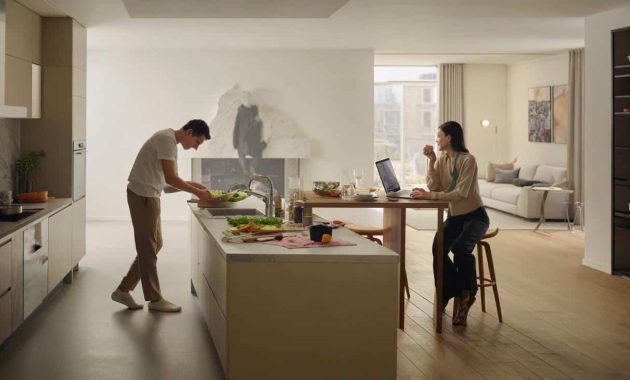
The pasta water is boiling, friends are arriving in 18 minutes, and Emma is doing that familiar awkward dance around her kitchen island. One hand balancing a tray of glasses, the other trying not to bump into the bulky block of marble planted in the center of the room. Her partner slips behind her to grab the fridge. Their son tries to sneak a snack. Everyone collides in the same cramped choreography.
The island was supposed to be “open plan” magic. Instead, it’s become the traffic jam of the house.
Designers have quietly started admitting what many homeowners are now whispering: the kitchen island era is fading. Something slimmer, smarter, and a lot more elegant is taking its place.
From bulky block to flowing hub: the rise of the kitchen peninsula
Walk into the latest high-end showrooms or scroll through 2026 design previews and you notice a pattern. The massive monolithic island is gone. In its place: a lighter, attached shape extending from a wall or unit, opening the room instead of blocking it.
This is the kitchen peninsula.
Not new, but newly refined. It bridges the kitchen and living space, framing movement instead of cutting straight through it. You can cook on one side, chat with friends on the other, and still move freely without circling a stone monument three times a day.
Take a small apartment in Paris’ 10th arrondissement, recently remodeled by a young architect. The old plan featured a heavy central island that looked impressive in photos and miserable in daily life. There were only 80 centimeters around it on each side. Two people in the kitchen and it felt like rush hour.
The architect removed the island and drew a slim peninsula off the main counter. Same amount of countertop, more legroom, and a clear line from entrance to balcony. Suddenly, the space felt almost one-third bigger.
The owners now host friends around that peninsula, using it as a buffet, a bar, a breakfast spot, a homework desk. Same square meters. Completely different life.
The shift is not accidental. The island belongs to a time of oversized kitchens, sprawling suburbs, and magazine-ready layouts. The peninsula fits 2026 realities: smaller homes, blended living spaces, and people who actually cook instead of just displaying appliances.
A peninsula connects to at least one wall or cabinet run, which means less circulation wasted and more functional storage under and above. It defines a boundary without feeling like a barricade.
Designers also like it because it solves a typical problem: people want seating, storage, prep space, and openness. The island could do that, but often ended up doing none of it very well. The peninsula is simply more forgiving.
How to replace a kitchen island with a smarter peninsula
The most practical starting point: sketch the way you already move in your kitchen. From fridge to sink to stove, trace your daily triangle on paper. Then draw a line that extends from a counter or wall without cutting straight across your natural path. That line is where a peninsula often makes sense.
Think of it as a bridge, not a block. It might jut out from the side of your main run, align with your oven column, or even wrap lightly around an existing corner.
Leave breathing room: at least 1 meter of free passage around the peninsula’s “open” side, more if you’re two regular cooks at home. If you can walk by holding a tray without turning sideways, you’re on the right track.
Many people get stuck trying to reproduce the island fantasy in a smaller footprint. They keep the same idea—big block in the middle—just scaled down. The result is a squeezed, frustrating compromise.
The peninsula invites a different mindset: accept that one side is anchored, and use that to your advantage. You can run power through the wall, hang lighting more easily, and create storage that feels built-in rather than stuck-on.
We’ve all been there, that moment when you realize your “dream feature” is secretly what makes your daily life harder. Swapping an island for a peninsula often feels like admitting a mistake. In reality, it’s more like upgrading to a layout that respects how you actually live.
“I used to think an island was the ultimate status symbol,” confides Laura, a kitchen designer who now suggests peninsulas in most of her projects. “Then I started visiting clients six months later and saw how they really used the space. The happiest ones always had the best circulation, not the biggest block of stone.”
- Start with the function
Ask: Do you need more prep surface, more seating, or more storage? Your answer should dictate the depth and length of the peninsula, not the other way around. - Use layered heights
One side bar-height for quick breakfasts, one side counter-height for cooking. This makes the peninsula feel tailored, not generic. - Think about what you’ll look at
Will you face the living room, a window, or a blank wall? Position the peninsula so that standing there feels pleasant, not like doing dishes in exile. - Keep one side visually light
Open shelves, a niche for stools, or a slightly recessed plinth helps the structure feel airy instead of massive. - Plan honest storage
Deep drawers on the kitchen side, and maybe just shallow cupboards or open shelves on the living side. Let’s be honest: nobody really organizes double-sided cabinets perfectly forever.
Beyond the trend: what the end of the island says about how we live
The goodbye to kitchen islands is less a war on furniture and more a quiet shift in priorities. The kitchen is no longer a stage to impress guests once a month. It’s where kids do homework every evening, where laptops open, where sourdough phases come and go. A peninsula acknowledges that constant overlap between task and life.
It’s also a gentler way to divide space. You still get a sense of “here is the kitchen” and “there is the living room”, without a tall wall of cabinetry or a massive stone altar in the middle. The boundary is soft, negotiable, even movable in some modular models.
Some will keep their islands and love them, of course. Especially in truly large rooms where circulation isn’t a struggle. But the future of everyday design looks more intent on flow than on spectacle. *A good kitchen in 2026 is one you barely notice when you move through it, because nothing fights you.*
If you’re planning a renovation over the next two years, the most valuable question may be the simplest: do you really need an island, or do you just need a place that lets people gather without colliding? The answer might be the elegant, practical peninsula quietly waiting along the wall.
| Key point | Detail | Value for the reader |
|---|---|---|
| Peninsula over island | Attached countertop extending from a wall or cabinet run | More space efficiency and better circulation in real-life kitchens |
| Design from movement | Draw your fridge–sink–stove triangle, then place the peninsula outside those lines | Reduces daily frustration and avoids “beautiful but unlivable” layouts |
| Layered functionality | Mix prep space, seating, and storage with varied heights and open zones | Transforms the peninsula into a true living hub, not just another surface |
FAQ:
- Is the kitchen island really “out” for 2026?Not everywhere, but the strong trend is towards slimmer, attached peninsulas, especially in urban and medium-sized homes where circulation and flexibility matter more than imposing centerpieces.
- Can a peninsula work in a very small kitchen?Yes, and that’s exactly where it shines. A short, shallow peninsula can double as a dining table, prep zone, and laptop spot without blocking the room.
- Do I need plumbing or electricity in a peninsula?Not always. Many successful peninsulas are simple worktops with storage and seating, while power or sinks stay along the main wall to keep costs down.
- Will replacing my island be expensive?Costs vary, but anchoring to a wall often reduces the need for complex floor work and services, which can make a peninsula solution more budget-friendly than rebuilding a freestanding island.
- What countertop depth is best for a peninsula?Standard counter depth (around 60 cm) works, but going up to 90 cm with an overhang for stools can create a more comfortable bar and dining feel without overwhelming the room.