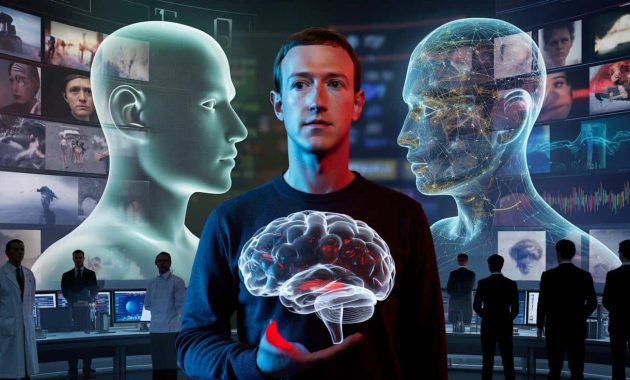
The first time I saw Mark Zuckerberg seriously pitch his new AI vision, it wasn’t on a TED stage or at Davos. It was in a slightly awkward livestream, him in a grey T‑shirt again, casually talking about “AI agents that can help everyone with everything.”
He smiled like he was unveiling a new emoji pack. Scientists watching at home heard something very different: a trillion‑parameter system plugged into billions of human lives.
Outside the tech bubble, this all feels strangely distant and uncomfortably close at the same time. Your phone already auto‑completes your thoughts. Your social feeds already guess what makes you angry, sad, or hooked.
Now the man who turned social attention into one of the most profitable machines in history wants to do the same with human intelligence itself.
And the real question won’t go away.
When Zuckerberg talks about “AI for everyone”, scientists hear something else
On stage, Meta’s AI plan sounds simple and almost generous. Open models, free tools, smart assistants sprinkled across Facebook, Instagram, WhatsApp, maybe even your glasses. Zuckerberg keeps repeating the same line: this is about “democratizing AI” and “helping humanity move forward.”
In the front rows at AI conferences, some researchers confide they feel a chill. Building bigger and bigger models, training them on unfathomable amounts of data, then connecting them to a social network the size of continents. That’s not just a product roadmap. That’s a planetary experiment.
Here’s a concrete snapshot. Inside Meta, the company has poured tens of billions into Llama, its family of large language models. Llama 3, the latest star, is offered “open” so startups and hobbyists can build chatbots on top of it. Great for innovation.
But scientists who study AI safety point out the other side. A powerful, open model can also be fine‑tuned for disinformation campaigns, automated harassment, or deepfake factories. One leaked set of weights can arm thousands of bad actors at once.
You don’t need a sci‑fi robot uprising. You just need a handful of people optimizing these tools for maximum chaos during an election year.
From a research perspective, the horror isn’t just *what* Meta is building. It’s the speed and scale at which it’s being welded onto human attention. AI assistants integrated into Messenger chats. Recommendation engines quietly upgraded with smarter prediction layers.
Some scientists talk about “capabilities overhang”: models becoming surprisingly competent at tasks nobody explicitly trained them for. Toss that into a social network that already nudges moods, choices, and votes, and you get a system no single person fully understands.
➡️ I learned it at 60: few people actually know the difference between white and brown eggs
➡️ I tested the new Citroën C5 Aircross and it really is a cloud on wheels
➡️ Harvest leftovers outperform expensive fertilizers according to seasoned gardeners
➡️ What psychology reveals about people who need time alone after positive social moments
➡️ Brain Rejuvenation Is Measurable In Adults Who Move More
Let’s be honest: nobody really reads the full AI policy updates before clicking “agree”. And that’s exactly where the fear creeps in.
Is this actually saving us… or just turning us into better products?
Before we label Zuckerberg a cartoon villain, it’s worth looking at what this AI turn could genuinely fix. Meta claims its models will spot hate speech and toxic content faster. AI filters can auto‑block spam and violent images before they hit your feed. At Meta’s scale, that’s not a nice‑to‑have, it’s operational survival.
Imagine an AI that can flag a suicidal post in seconds, alerting moderators or emergency hotlines with far more sensitivity than old keyword filters. There are already stories from inside the company of AI tools catching dangerous posts at 3 a.m. when no human team could react in time. In those moments, the tech looks like a quiet lifesaver.
But we’ve all been there, that moment when you scroll “for just five minutes” and suddenly it’s an hour later. Now picture that attention engine given a PhD in persuasion. AI that learns not just what you click, but how long your eyes linger, what you stop on when you’re tired, which posts pull you back after you threaten to leave.
One Meta researcher once described the algorithm as “a ruthless optimizer for engagement.” The worry is that new AI agents are just that same optimizer on steroids, dressed up as your friendly assistant. Ask for homework help, get a subtle ad. Ask for health advice, get nudged toward a “sponsored” solution. The line between help and harvest starts to blur.
From a business angle, Zuckerberg’s plan is brutally coherent. Advertising growth is slowing. Young users flirt with TikTok, BeReal, and whatever pops up next. So Meta needs a new operating system for attention. AI is that system.
Integrating smart agents across all apps means more reasons to stay inside the Meta universe. More data about what you say, feel, and fear. More surfaces to sell to brands as “personalized experiences.” Scientists aren’t horrified because AI exists. They’re horrified because a fragile, unpredictable technology is being fused with humanity’s largest profit‑seeking attention machine.
One plain‑truth sentence echoes in research circles: **if your revenue depends on people staying hooked, your AI will quietly learn how to keep them hooked.**
The quiet choices that decide whether this becomes a rescue mission or a disaster
Behind the grand speeches, the real power lies in hundreds of small, almost invisible choices. Which metrics matter more: time spent or mental health indicators? Does an AI assistant suggest a break after 30 minutes of doomscrolling, or does it push “just one more” viral clip?
Designers inside Meta describe internal debates about friction. Should AI systems make it easy to share sensational political content, or add tiny speed bumps that give people time to breathe? A slight delay, an extra confirmation, a label that calmly says “this content is disputed”. Those micro‑decisions can change the trajectory of millions of users a day.
For the average person, this all feels ridiculously abstract. You’re just trying to answer messages, post a photo, maybe get a recipe. You’re not sitting there wondering whether your AI sticker generator contributes to some long‑term experiment with human cognition.
That’s why a lot of scientists talk about agency. Not the AI’s, ours. The biggest mistake, they say, is to treat these tools as neutral magic that “just works.” Asking basic questions is not paranoia, it’s hygiene. Who trained this model? What data did it learn from? Can I opt out, or at least turn some of it off?
*The more invisible AI becomes in your daily apps, the more intentional you need to be about how you use it.*
Meta’s former AI researchers, now in academia, often repeat a simple warning: “Powerful systems don’t need evil intent to cause harm. They just need bad incentives and no brakes.” They’re less worried about a robot rebellion than about a slow drift, year by year, toward a world where our collective behavior is nudged by a few opaque models trained on our past clicks.
- Ask what’s being optimized
Is the AI trying to help you solve a task, or keep you engaged as long as possible? That single question often reveals whose interests are really in charge. - Look for transparency clues
Labels, explanations, and control panels may be clumsy, but their absence is a sign the system doesn’t really want you poking around. - Use intentional friction
Decide in advance when and where you want AI help, and where you’d rather think slowly, even if it’s less efficient. - Listen to the outliers
When safety researchers and ethicists say they’re worried, they usually see failure modes long before they hit the news cycle.
A future written by code… and by what we tolerate
The strange thing about Mark Zuckerberg’s new AI plan is that both narratives can be true at once. He might genuinely believe these systems will help humanity, while also steering Meta into an era where your attention, your voice, and even your relationships are more tightly packaged as data products than ever.
Scientists aren’t united on the exact risk level. Some fear existential catastrophe, runaway models, loss of control. Others are focused on nearer harms: mass unemployment in creative fields, turbocharged propaganda, mental health erosion pushed by hyper‑personalized feeds. What unites them is a feeling that the speed dial is stuck on maximum, and the people paying the price weren’t really asked.
The story isn’t finished. Governments are scrambling toward regulation. Whistleblowers leak internal memos. Users slowly wake up to the fact that “free” AI might be the most expensive deal of all, paid in privacy, calm, and autonomy.
The next few years will show whether Meta’s AI agents help us think more clearly, or quietly learn to think for us. Whether they protect kids online, or just become smoother dealers of endless content. Whether Zuckerberg is remembered as the man who brought powerful AI into ordinary hands, or as the one who wrapped the human mind in yet another profitable interface.
In the end, the question isn’t just “What is he doing?” It’s what we’re willing to live with on our screens every day.
| Key point | Detail | Value for the reader |
|---|---|---|
| Scale of Meta’s AI plan | Trillion‑parameter models integrated into Facebook, Instagram, WhatsApp and more | Helps you grasp how deeply this could shape daily digital life |
| Why scientists are alarmed | Open, powerful systems mixed with engagement‑driven incentives and weak oversight | Clarifies that the threat isn’t sci‑fi robots but real‑world manipulation and instability |
| Your practical leverage | Question optimization goals, seek transparency, add “friction” to your own usage | Gives you concrete ways to stay more in control of your attention and data |
FAQ:
- Is Mark Zuckerberg’s AI strategy really different from other Big Tech plans?
Yes and no. All giants are racing to build huge AI models, but Meta is pushing harder on “open” releases and weaving AI into social apps with billions of users. That mix of openness and scale is what many experts find uniquely risky.- Why are scientists “horrified” if AI can also do so much good?
Because large‑scale benefits and large‑scale harms often come from the same systems. The tools that can detect hate speech or suicide risk can also personalize manipulation, political propaganda, or addictive content with frightening precision.- Could Meta’s AI actually help protect democracy?
It could help catch fake accounts, bots, and coordinated disinformation faster. At the same time, more powerful recommendation models can amplify polarizing content. The net effect depends on design choices we mostly don’t see.- Is the fear about AI becoming “sentient” at Meta?
Not really. Most researchers are focused on failures like misuse, loss of control over complex systems, economic disruption, and the psychological impact of living inside AI‑shaped feeds, not on conscious machines plotting revenge.- What can I personally do as Meta rolls out more AI features?
Check privacy and AI settings, turn off what you don’t need, and pause before adopting every new “assistant.” Ask what the feature optimizes for, and consider whether you want that goal guiding your behavior day after day.