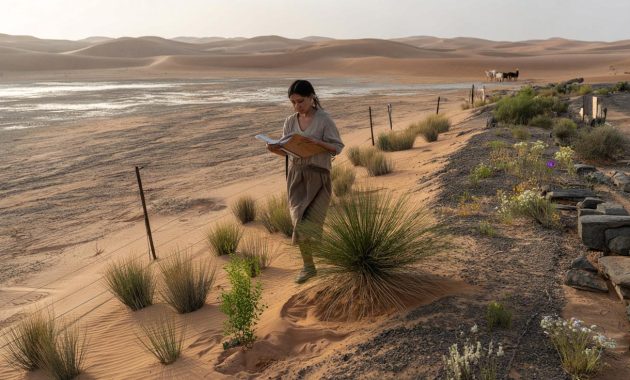
Just before sunrise on the edge of the Sahara, the desert looks almost colorless. Sand, rock, a pale sky that hasn’t quite woken up. Then, as the light lifts, you start to notice shapes that weren’t there a few years ago: low shrubs gripping the dunes, small patches of grasses catching the breeze, rows of thorny saplings guarded by wire and hope. You can hear faint movement too — an insect, a bird, something alive.
A local technician walks between the young plants with a battered notebook, counting survivors from last season’s planting. She bends to press the soil around a spiny shrub, talking to it under her breath like it’s an old friend. She knows every one of these species by name, and where their seeds were collected, sometimes by hand, kilometers away.
She looks up at the spreading line of green and says quietly: “The land is breathing again.”
The quiet revolution of replanting deserts
Across the world’s drylands, more than 5 million native plants have been reintroduced in the past few years, from North Africa and the Middle East to the American Southwest and Australia. They’re not just any plants pulled from a nursery catalog. They’re local species, grown from local seeds, adapted over centuries to survive heat, salt, wind, and long silence between rains.
On satellite maps, these projects still barely show up. To the naked eye, though, whole landscapes are changing. Places that were turning into dust bowls are now dotted with shrubs anchoring the soil, roots stitching the ground back together. The change feels slow on a human day, but fast on the desert’s own clock.
Behind each cluster of green, there’s a simple idea: maybe the best way to save a dying landscape is not to fight the desert, but to work with the plants that already knew how to live there long before us.
In southern Morocco, for example, a corridor of native shrublands has been replanted across once-barren land to slow advancing dunes. Over 300,000 seedlings of hardy species like Atriplex and Retama now form a living barrier, breaking the wind that used to strip topsoil away in a single storm. Goat herders who once avoided this area now cut through it, following the low cover and its returning shade.
A thousand kilometers to the east, in Jordan, volunteers and Bedouin families have helped replant pockets of wild steppe vegetation near overgrazed slopes. Their work looks almost modest at ground level: a few fenced plots here, a cluster of seedlings there. Yet when you compare photos from five years ago to today, bare ground suddenly has texture. There’s lichen creeping back on rocks, grass tufts holding moisture after a rare rain, and the first wildflowers blinking open where there was nothing but crusted dust.
Even big engineering-style projects are changing. In China’s Kubuqi and Mu Us deserts, older campaigns focused on fast-growing, non-native trees. Many of those failed once the irrigation ended. Newer phases are leaning hard on native shrubs and grasses with deep, stubborn roots. The lesson is raw but clear: in these places, survival belongs to species that already know the script.
Scientists who track land degradation talk about thresholds, those invisible tipping points when soil stops behaving like soil. Once the top layer is gone, each gust of wind strips a little more away, and each rainstorm cuts small scars that spread. That spiral is what people mean when they say “deserts are expanding.” It isn’t just less green. It’s the land losing its memory.
➡️ This $12.7 billion mega airport could shift the center of global aviation toward Ethiopia
➡️ France delivers a 500-tonne steel giant to power the UK’s new Hinkley Point C nuclear reactor
➡️ An Unusual March Polar Vortex Disruption Is Approaching: And It’s Exceptionally Strong
➡️ Under Antarctica there is a hidden world
➡️ Thermal stealth, anti-drone armor and active camouflage: future US tanks aim to leave no trace
Native plants slow that loss in ways that sound almost ordinary: they cast shade, break the wind, drop leaves, and feed soil microbes. But taken together, these small actions reprogram whole areas. Root systems open tiny channels that help rare rain sink in rather than race off in muddy floods. Leaves trap dust and organic matter, building fresh topsoil millimeter by millimeter. Seed heads feed insects and birds, which then spread more seeds.
Once enough of these plants are back, the landscape flips from a system that sheds life to one that catches and holds it. That’s when people start noticing unexpected guests: lizards sunning on rocks again, small foxes at night, even pollinators that hadn’t been seen in a generation. The desert hasn’t turned into a forest. It’s just remembered it can be something other than empty.
How people are actually doing this on the ground
The work is surprisingly hands-on. In many projects, teams begin by walking the land with elders and herders, asking a simple question: “What used to grow here?” They collect seeds from the last remaining pockets of native vegetation — sometimes from plants clinging to gullies, graveyards, or roadside edges where animals don’t graze so hard. The seeds are dried, cleaned, and cataloged like tiny archives of local resilience.
Then comes nursery season. Simple, low-tech greenhouses pop up on the edges of villages, run by small crews who water trays at dawn and dusk. These nurseries don’t grow lush, ornamental trees. They raise tough, often scraggly seedlings whose value lies in their roots, not their looks. When the first good rains are forecast, planting teams fan out at pace: augers, shovels, GPS maps, tired laughter.
The trick is matching each species to the exact micro-habitat where it stands a fighting chance. Rocky slope, salty flat, wind corridor, dry riverbed — every spot has its preferred survivors. That attention to detail, more than any drone or app, is what pushes the survival rate above the sad graveyard of failed desert greening schemes.
One thing project leaders keep repeating: don’t rush to plant trees just because trees look good in before/after photos. In many arid zones, shrubs and grasses are the real engineers of recovery. Their dense, fibrous roots can hold sand and silt in place far better than a few tall saplings spread out over a large area. Yet donors and politicians still love the image of a tree.
The smartest teams now start with ground-hugging species that stabilize the soil and create shade at ankle height. Only once that low layer is established do they begin to introduce taller native trees in small numbers. Let’s be honest: nobody really does this every single day with perfect discipline, especially when funding comes with deadlines and visibility targets. But the ones who stick closest to this patience-based strategy are the ones seeing real, long-term change.
There’s another common mistake: ignoring local grazing practices. *You can plant half a million seedlings and lose them all in one hungry goat season.* Many reintroduction programs now involve herders from the start, agreeing on temporary grazing closures, rotating access, or fodder compensation. That kind of negotiation takes time and trust that can’t be outsourced to a consultant’s slide deck.
The people leading these efforts tend to sound less like distant experts and more like neighbors who’ve simply spent a long time listening to the land.
“Everybody wants a miracle tree,” laughs a project coordinator in northern Kenya. “But our best results come from plants nobody ever puts on a poster. They’re small, spiky, and half the time you’d step over them without seeing. Yet they’re the ones that hold the ground when the big winds come.”
Around those “quiet hero” species, teams often build simple, repeatable practices:
- Collect seeds locally from at least 30–50 parent plants to keep genetic diversity strong.
- Plant at the start of the rainy season, not when the funding contract says to start.
- Use stone lines, half-moons, or small earthen bunds to slow runoff and give seedlings a chance to drink.
- Protect new plots with temporary fencing or community grazing rules, agreed in open meetings.
- Monitor survival each season, and replant only where previous species have truly failed, not just looked awkward.
Why these 5 million plants matter far beyond the desert
Taken plant by plant, the numbers sound almost fragile: a few dozen seedlings on a dune crest, a couple of hundred along a dry riverbed, a handful of shrubs tacked into a crumbling slope. Zoom out to a map, though, and the story begins to feel bigger. More than 5 million native plants now form a loose network of recovery zones across the world’s arid belts, like stitches in a torn fabric.
These efforts aren’t just about “beautifying” empty land. They’re buffering dust storms that can travel for thousands of kilometers. They’re holding carbon in roots and soils that were once bleeding it out. They’re giving communities a little more protection from flash floods and crop failures. And they’re doing it in ways that fit local cultures, rather than flattening them under a single global template of what restoration should look like.
You don’t have to live near a desert to feel a connection to this story. Every city has its own version of fragile ground — a riverbank, a vacant lot, a dry hillside where nothing seems to stick. Each of those places could learn from the desert’s new playbook: start small, work with what’s already adapted, listen to people who remember what grew there before. The next time you scroll past a photo of a dusty hillside suddenly dotted with stubborn green, it might be worth pausing for a second. That pixelated plant could be one of millions quietly teaching us how to live with less water and more heat, without giving up on life returning.
| Key point | Detail | Value for the reader |
|---|---|---|
| Native plants stabilize soil | Deep, adapted root systems slow erosion and hold topsoil in place | Helps you understand how land degradation can actually be reversed |
| Local knowledge is central | Projects work best when communities choose species and manage grazing | Shows why top-down “tree-planting” campaigns often fail in real life |
| Small species matter most | Hardy shrubs and grasses create the base layer for resilient ecosystems | Challenges the common myth that only big trees equal real restoration |
FAQ:
- Are deserts supposed to be green now?Not exactly. The goal isn’t to turn deserts into forests, but to restore the natural vegetation that should exist there, including hardy shrubs, grasses, and occasional trees. Healthy deserts still look dry, but they’re full of hidden life.
- Why focus on native plants instead of fast-growing species?Native plants are adapted to local heat, drought, pests, and soils. They survive without constant irrigation or chemicals, and they support local insects, birds, and animals that evolved alongside them.
- Can replanting really slow climate change?By restoring vegetation and soils, these projects store more carbon and reduce dust and degradation. They’re not a silver bullet, but they’re a meaningful piece of the climate puzzle, especially combined with cutting emissions.
- What about people who rely on grazing animals?Many of the best projects involve herders from the start, setting up temporary grazing bans, rotation systems, or designated fodder areas. When the land recovers, there’s often more forage overall.
- How can someone living in a city support this kind of work?You can back organizations that prioritize native species and community leadership, push your own city to use local plants in parks and roadside projects, and stay skeptical of flashy “billion-tree” campaigns that ignore local ecology.