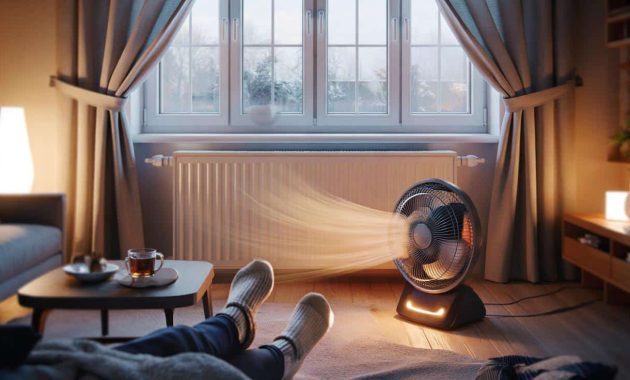
The first cold evening always catches you off guard. You twist the thermostat a little higher, rub your hands together and wait for that familiar wave of warmth… that never quite comes. The radiator gurgles, clicks, barely warm to the touch. Meanwhile, your breath fogs up when you walk past the window, and the living room still feels like a train station platform at 11 p.m. in November.
You remember some old advice: “Put aluminum foil behind the radiator, it reflects the heat.” You’ve maybe even done it, smoothing the shiny sheet against the wall and feeling oddly proud.
Then you sit back down on the sofa.
The room is still cold.
The real game-changer is somewhere else entirely.
No, the smartest “radiator hack” isn’t on the wall
Aluminum foil behind radiators has become the DIY equivalent of an urban legend. People swear it works miracles, your uncle mentions it every winter, and social media loves a shiny trick. The reality is more dull: in most modern homes, that foil barely changes anything.
The real reason some rooms stay icy is not that heat disappears into the wall. It’s that the warm air never really circulates. It piles up above the radiator, stuck in a narrow column, while your feet stay frozen. Your boiler works, your bill rises, yet the temperature where you actually live – at sofa height, at desk level – lags behind by several long, chilly degrees.
Take a typical city flat. Radiator under the window, heavy curtains that were already there when you moved in, a big sofa just in front because, well, that was the only place it fit. You don’t think twice. You hang thicker curtains “to keep the cold out”. You push the couch a bit closer “to gain some space”.
Result: your poor radiator is boxed in, literally. The hot air hits the back of the sofa, gets trapped behind those thick curtains, and just spins in place. You then push the thermostat from 19°C to 21°C, then 22°C. The room still feels slow to heat. The air a metre above the radiator is roasting. Two metres away, your toes are still numb.
The physics are simple and a bit brutal. Radiators heat mainly through convection: they warm the air, the warm air rises, cooler air replaces it, and a loop is created. Block that loop with fabric, furniture, or clutter, and the system chokes.
➡️ Turkey goes toe-to-toe with France as it unveils the ideal partner for its next-gen Kaan fighter
➡️ Breathtaking new details revealed by multiple spacecraft and observatories
Foil on the wall can help a little with old, badly insulated walls, but its impact is tiny compared to a blocked airflow. *A badly placed curtain can waste more heat than any reflective sheet can ever “save”.*
The smarter trick is not about reflecting. It’s about guiding. And once you see it, you can’t unsee it.
The surprisingly simple trick: turn your fan into a “heat booster”
The far smarter move is this: use a small fan to push warm air into the room. Yes, the same kind of fan you use in summer. Place it on the floor next to the radiator, at low speed, angled slightly upward, so it gently blows across the hot surface and sends that air toward the centre of the room.
Within ten to fifteen minutes, the difference is striking. The heat is no longer stagnating around the window area. It spreads faster, more evenly, and the room feels warmer at body level. The thermostat might read the same number, but your hands, nose and feet tell a very different story.
Most people never think of doing this. A fan in winter feels counterintuitive, almost wrong. You picture cold drafts and wind on your neck. Yet what you’re actually doing is simply accelerating the natural convection loop that’s already happening too slowly.
We’ve all been there, that moment when you keep bumping the thermostat up because “the radiators don’t do anything”. Instead of asking your boiler to work harder, you can ask your existing heat to move smarter. The electricity used by a small fan on low speed is tiny compared to one extra degree on your heating system across several hours.
There’s a physical logic behind the feeling of comfort. Your body doesn’t care only about the air temperature; it cares about how evenly that warmth is distributed. A room that reaches 20°C everywhere in 15 minutes feels much better than one that crawls to 22°C in an hour, with cold zones in the corners.
The fan trick helps flatten those “cold pockets”. It pulls cool air from the floor, pushes it past the hot radiator, and sends it back into the room warmed up. This circulating loop repeats again and again, each time gaining a small degree. The room warms faster, the thermostat stabilises sooner, and you can often keep the set temperature slightly lower while feeling just as cosy. **That’s where the real savings quietly happen.**
How to do it at home (and what to stop doing right now)
The method is almost embarrassingly simple. Take a small desk fan or floor fan. Place it near the base of your radiator, not directly in front of it, but slightly off to the side. Set it to the lowest speed and tilt it so that the airflow just grazes the radiator and heads toward the centre of the room.
If your radiator is under a window, aim the fan diagonally so it “pushes” the warm air away from the glass and into the living area. You don’t want to feel wind on your skin; you just want to see that warm bubble of air gently nudged into motion. After a few minutes, walk to the far corner of the room. The temperature there starts catching up much quicker than usual.
There are a few traps that kill this effect. The biggest one: curtains covering the top of the radiator. If your curtains fall in front of it, you’ve created a perfect heat prison. Either shorten them or tie them back so they sit above the radiator, not over it.
Next enemy: furniture too close. A sofa pushed flush against the radiator acts like a wall. Even a distance of 10–15 cm can let air pass and change everything. And yes, those decorative radiator covers with no real vents look charming in photos, but they’re comfort assassins. Let’s be honest: nobody really rearranges the room every single day, yet sliding the couch a palm’s width away is a one-time effort with a lasting payoff.
“People think their heating system is weak, when in fact their room layout is fighting against it,” explains a home energy adviser I spoke to. “The fan trick is so simple that many dismiss it. Then they try it once and never go back.”
- Free up the radiator zone
Lift or tie back curtains, move furniture a little away, and clear objects from the top of the radiator. - Use a small fan at low speed
Place it near the radiator, angled to blow warm air into the room without creating a noticeable draft. - Test, then adjust the thermostat
After 15–20 minutes, if the room feels warmer, you can often lower the set temperature by 0.5 to 1°C. - Skip the foil obsession
On a modern insulated wall, reflective foil adds almost nothing compared to proper airflow and circulation. - Watch the “comfort level”, not just the number
Pay attention to your hands, nose and feet; they’re often better judges of real warmth than the thermostat alone.
Rethinking heat: from “more power” to “better flow”
Once you start seeing your radiators not as hot metal objects but as the heart of an air current, your whole relationship with heating shifts a bit. You notice where air is stuck, where it escapes, where it stagnates. That stack of boxes in the corner, the heavy armchair in front of the only radiator in the room, the long curtain sweeping the floor like a velvet dam – suddenly they’re not just decor choices. They’re small, silent obstacles between you and a truly warm space.
The fan trick is only one gesture among many others, yet it embodies a quiet, modern shift: instead of consuming more, we try to use what we already produce more intelligently. Some evenings, you’ll still nudge the thermostat up because you feel like it. That’s life. On others, you’ll hear the soft hum of a discreet fan and feel the warmth finally reach the place where you’re actually sitting, reading, scrolling. And you may find yourself sharing this “winter fan secret” with a friend, somewhere between two sips of hot tea, as the room around you finally starts to match the comfort you imagined when you came home.
| Key point | Detail | Value for the reader |
|---|---|---|
| Airflow beats foil | Radiators work by convection, which is often blocked by curtains and furniture | Understands why rooms stay cold despite heating and can act on the real cause |
| Use a fan in winter | A small fan on low speed pushes warm air into the room and evens out temperature | Warmer feeling faster, sometimes at a lower thermostat setting |
| Micro-changes, real comfort | Freeing radiators, adjusting layout, then fine-tuning the thermostat | Better comfort without major work or expensive gadgets |
FAQ:
- Does foil behind the radiator really do nothing?
On very old, poorly insulated walls, it can slightly reduce heat loss, but the effect is usually small. Improving airflow and freeing the radiator zone almost always has a much bigger impact on comfort.- Won’t a fan make the room feel colder?
On low speed, pointed at the radiator and not directly at you, the fan mainly moves warm air, not cool drafts. Most people report feeling warmer, not colder, once the air is better mixed.- Can I use any kind of fan for this trick?
Yes: desk fan, small floor fan, even a quiet tower fan on the lowest setting. The key is gentle, constant airflow across or near the radiator, not a strong wind.- Is this useful with underfloor heating or only radiators?
With underfloor heating, the effect is less noticeable since heat is already spread out, but a fan can still help even out temperature in large rooms or spaces with big windows.- Will this really lower my heating bill?
It depends on your home and habits, but many people find they can lower their thermostat slightly while feeling just as warm. Over a full winter, that small adjustment can translate into real savings.