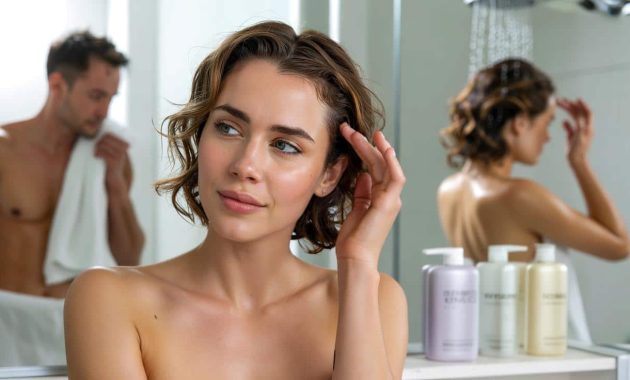
Tuesday morning, crowded metro, and that familiar little panic: you raise a hand to tuck your hair behind your ear and instantly wonder, “Wait… is it greasy already?” You did a full shampoo on Sunday. Your friend swears by washing her hair every single day. On TikTok, someone insists we should only wash once a week “to train the scalp”. Your mother still says “every other day, or it’ll smell”.
Somewhere between all these loud opinions sits your scalp, quietly trying to keep up.
And then a dermatologist comes along and says: all of that is far too simplistic.
How often should we really wash our hair?
Dermatologists will tell you: the real question isn’t “How often should we wash?” but “What does my scalp actually do all day?” Your scalp is skin. It sweats, sheds, reacts to stress and hormones, and produces sebum at its own pace. One head might be bone-dry, another shiny by noon.
So this universal “once a week” or “every other day” rule a lot of us repeat? That’s more habit than science.
The dermatologist I spoke to smiled when I asked for a magic number. “People want a schedule like they want a gym program,” she said. “But your scalp doesn’t live by a calendar.”
Take Sarah, 29, who proudly decided to “train” her hair to go seven days without washing. She started a kind of hair boot camp: dry shampoo daily, tight buns to hide the oil, no water, no shampoo. By day four, her scalp felt tight. By day six, she had angry red patches behind her ears.
When she finally went to a dermatologist, the verdict was clear: irritated scalp, clogged follicles, seborrheic dermatitis flaring up. The “no-wash challenge” had pushed her skin into full-on crisis.
On the other end, there’s Max, 35, who showers twice a day after the gym and always shampoos. His hair is soft, but his scalp burns, flakes, and itches. He thought it was dandruff. It was just a barrier screaming for mercy.
What both stories reveal is simple: *your ideal wash rhythm is a balance between sebum, sweat, and sensitivity*. Not a number a stranger posted online.
➡️ No vinegar and no baking soda: pour half a glass of this and the drain clears itself
➡️ If your spider plant has dry brown tips, it’s time to rethink watering
➡️ Here are the 3 types of friendship you really don’t need for true happiness
➡️ The price shock in supermarkets: this basic food becomes a luxury and gets people talking
➡️ How to whiten teeth that have yellowed with age?
Dermatologists usually give a flexible range, then fine-tune: oily scalps, sometimes daily or every other day with a gentle formula. Normal scalps, anywhere from two to three times a week. Curly, coily, or very dry hair, often once a week, sometimes even less, with lots of moisture in between.
The real red flags are extremes. Never washing and letting build-up harden on the skin, or scrubbing every day with harsh shampoos that strip everything away. Healthy hair lives somewhere in the middle.
The dermatologist’s method: listen to your scalp, not the trends
One dermatologist trick sounds terribly old-fashioned: look, touch, smell. That’s it.
Run clean fingers along your roots, ideally in daylight. Does the scalp feel slippery and coated after just one day? You may be in the “frequent washer” group. Does it stay light and airy for three days? You can space things out. Are there scales, tightness, or burning right after washing? Time to rethink the products, not just the timing.
Then there’s the shower test. Shampoo, rinse thoroughly, and see how your scalp feels 24 hours later. Comfortable and neutral is the goal, not squeaky and tight.
There’s also the “gym hair” panic, which a lot of dermatologists know very well. Sweat doesn’t automatically equal dirt. If you work out often, the dermatologist’s advice is usually: rinse more, shampoo less aggressively. That might mean a quick water rinse or a very mild shampoo after intense workouts, and a “real” wash only a few times a week.
Let’s be honest: nobody really does this every single day. Most people improvise, pile on dry shampoo, or throw their hair up and hope for the best. The scalp adapts, up to a point, but long-term build-up can lead to dull lengths and a scalp that feels “off” without you really knowing why.
Here’s where false myths get sneaky. We’ve all been there, that moment when someone confidently says, “If you wash less, your scalp will stop producing sebum.” Dermatologists raise an eyebrow at that one.
Your sebum production is driven mostly by hormones, genetics, and age. Washing too often can irritate the surface and give the impression that you get greasy faster, because the skin is stressed and inflamed. Skipping shampoo for ten days won’t magically “re-educate” your glands. What does help is this:
– choosing a gentle formula
– massaging the scalp instead of scratching it
– rinsing thoroughly so no residue stays stuck on the skin
That’s the quiet routine that gradually calms things down.
Mistakes we repeat… and what dermatologists suggest instead
The number one dermatologist tip is deceptively simple: match your shampoo to your scalp, not your hair length. Roots are skin, lengths are fiber. Once you get that, everything makes more sense.
Oily or acne-prone skin? Go for a purifying or balancing shampoo at the roots, then add a nourishing conditioner only from mid-length to tips. Very dry scalp? Choose a hydrating, fragrance-light shampoo and be gentle with the water temperature.
And whatever your schedule, one rule keeps coming back in every consultation: take a full minute to massage, and two full minutes to rinse.
Plenty of people wash at the “right” frequency but still feel uncomfortable, simply because of technique. Scrubbing with your nails, using scalding hot water, or piling conditioner on the scalp are all frequent offenders.
A dermatologist will often say, “Act like your scalp is slightly sunburned, even when it’s not.” That means lukewarm water, fingertips only, circular motions without dragging. Conditioner stays on the lengths, never ground into the roots. And dry shampoo? Useful, yes, but not four days in a row. That powder has to come off at some point, or it mixes with sebum and sweat to form a sticky film.
“Most people don’t need a miracle shampoo,” says dermatologist Dr. Léa Martin. “They need the right frequency for their lifestyle, and the discipline to rinse properly. The scalp is like a city: it can handle traffic, but not a permanent traffic jam of products and oil.”
- If your scalp is oily by the next morningTry washing every day or every other day with a mild, non-stripping shampoo, focusing only on the roots.
- If your scalp feels tight and itchy after washingSpace out shampoos to twice a week and switch to a gentle, fragrance-light formula; avoid very hot water.
- If you have curls or coilsWashing once a week or even every 10 days can work, as long as you clean the scalp well and hydrate the lengths generously between washes.
- If you exercise a lotAlternate: some days, just rinse with water or use a tiny amount of gentle shampoo; keep “full” washes to 2–3 times a week.
- If you love dry shampooUse it as a buffer for one or two days, then do a proper wash to clear the build-up and give the follicles breathing room.
A new way to think about “clean” hair
Once you start paying attention, you realize how moralized hair washing has become. “Greasy” equals lazy, “squeaky clean” equals virtuous. But a healthy scalp doesn’t always look like a shampoo ad. Some people’s roots shine slightly by the evening. Some frizz instead of shine. Some scalps simply like three calm wash days a week.
The dermatologist’s perspective is oddly freeing: the right rhythm is the one where your scalp feels comfortable, your hair looks like itself, and you don’t spend the whole day wondering if everyone can see your roots.
Maybe that means daily washing with a super-gentle shampoo because your job is physical and you sweat a lot. Maybe it means two precise wash days, with a warm towel and a little massage that turns shower time into a ritual instead of a chore. Maybe it means letting go of the idea that “once a week” is the gold standard for everyone.
What sticks is this plain-truth sentence: clean hair is not a number on a calendar, it’s a conversation between your scalp and your life. Once you tune into that, the rest feels strangely simple.
| Key point | Detail | Value for the reader |
|---|---|---|
| Frequency is individual | Dermatologists adjust washing rhythm based on sebum, sweat, hair type, and scalp comfort | Helps you stop copying random routines and find your own realistic rhythm |
| Scalp first, lengths second | Choose shampoo for the scalp’s needs and conditioner for the hair fiber | Reduces grease at the roots and dryness at the ends at the same time |
| Technique matters as much as timing | Lukewarm water, fingertip massage, thorough rinsing, and limited dry shampoo | Improves comfort, shine, and long-term scalp health without buying tons of products |
FAQ:
- How many times a week do dermatologists usually recommend washing hair?Most give a range: daily or every other day for very oily scalps, two to three times a week for many people, and once a week or slightly less for very dry, curly, or coily hair. The final answer always depends on how your own scalp feels and reacts.
- Can washing my hair too often cause hair loss?Frequent gentle washing doesn’t make hair fall out permanently, but harsh shampoos, very hot water, and aggressive scrubbing can irritate the scalp and break fragile strands. Hair seen in the shower is usually hair that was going to fall out anyway.
- Is it true that washing less will “train” my hair to be less oily?Not really. Sebum production is mainly linked to hormones and genetics. Washing less can reduce irritation from harsh products, which sometimes makes the scalp feel calmer, but it doesn’t reprogram your glands in a dramatic way.
- What if my scalp is itchy but my hair looks clean?Itch can come from dryness, sensitivity, or conditions like seborrheic dermatitis. You may need a gentler shampoo, a medicated formula, or a different wash rhythm. Persistent itch is a good reason to see a dermatologist.
- Do I need to double-shampoo every time?Not necessarily. One shampoo is often enough for everyday life. A double wash can be useful after heavy styling products, oil treatments, or a lot of pollution exposure, but it shouldn’t feel like a punishment routine.