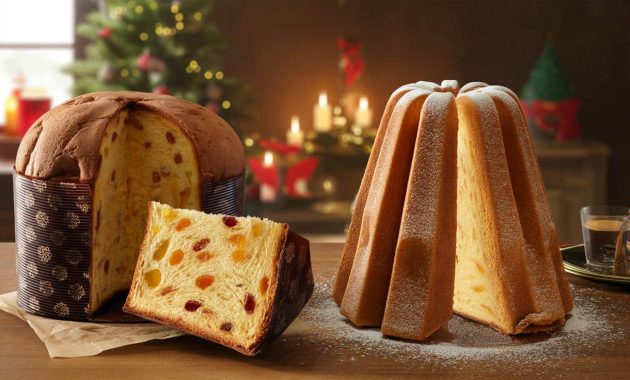
Panettone and pandoro arrive in glossy boxes, stacked in supermarket pyramids and delicatessen windows each December. They look festive, luxurious, vaguely similar… but they are not twins. Behind those tall golden domes and star-shaped loaves hide two very different stories, textures and traditions.
The Italian Christmas cake showdown
Ask an Italian family what “the real” Christmas cake is and you will trigger a polite, but very firm, debate. In Milan, the answer is panettone. In Verona, it is pandoro. Geography shapes loyalties just as much as flavour.
Panettone leans towards richness and complexity, while pandoro offers softness and gentle vanilla comfort.
Both cakes are made from enriched dough, both rely on long fermentation, and both are eaten between Christmas and New Year. Yet their ingredients, shapes, and even the way they are sliced send them down very different paths.
Panettone, the towering classic from Milan
Panettone was born in Milan and has become a nationwide symbol of Christmas across Italy. The name likely comes from “panetto” (small bread) turned into “panettone” – literally, the big bread. Its generous dome makes it look more like a festive sculpture than a simple loaf.
A romantic legend and a serious dough
Several stories claim to explain its creation. One involves a young apprentice baker called Toni, who allegedly enriched a basic bread with butter, eggs and fruit to impress the daughter of his master. Another version gives the role to a baker called Ughetto, whose love life similarly inspired a more decadent dough.
Whatever the true origin, today’s panettone is anything but improvised. It uses a slow-risen dough made with wheat flour, eggs, sugar, butter, and natural yeast or sourdough. To this base, bakers fold in plenty of raisins and candied citrus peel.
The hallmark of good panettone is its cloud-like crumb: long, stretchy strands of dough that pull apart in soft shreds.
This texture is the result of time. The dough is kneaded, rested, and proofed several times. Industrial versions can shortcut the process, but artisanal producers often let the dough ferment for more than 24 hours. The mixture is finally baked in a tall paper mould, which helps the cake keep its vertical shape and caramelised top.
➡️ “I’m 65 and my legs felt heavy every evening”: the circulation mistake I didn’t notice before
➡️ How to turn stale bread into crunchy croutons that make any soup feel gourmet and taste divine
How Italians actually eat panettone
Panettone usually appears on the table at the end of Christmas lunch or on St Stephen’s Day (26 December). It is cut into tall wedges, often still in its paper case.
- Served plain alongside espresso or cappuccino
- Paired with a sweet wine such as Moscato d’Asti or Vin Santo
- Lightly toasted and topped with mascarpone or custard
- Reused as French toast or bread-and-butter pudding when it goes slightly stale
For British households, panettone has quietly become a clever alternative to traditional Christmas pudding: lighter, easier to share, and more forgiving the next morning at breakfast.
Pandoro, the golden star of Verona
Pandoro, by contrast, comes from Verona and carries a name that means “golden bread”. Where panettone looks like a tall cylinder, pandoro resembles an eight-pointed star when sliced, thanks to its mould.
Vanilla, butter and a snowfall of sugar
Unlike its Milanese cousin, pandoro contains no candied fruit and no raisins. The dough is also enriched with eggs, butter and sugar, but with a focus on buttery, vanilla notes rather than citrus and dried fruit. The result is a soft, almost brioche-like crumb.
Pandoro is often described as the cake for people who “don’t like bits” – silky, plain-looking, yet quietly luxurious.
The baking process is still meticulous. Long rising times are needed to achieve that tight yet fluffy interior. Once unmoulded, the cake gets dusted generously with icing sugar, usually from a separate sachet found in the box. Shaken in a bag or sprinkled at the table, the sugar is meant to recall fresh snow on the roofs of Verona.
New Year’s favourite
While panettone dominates Christmas Day, pandoro frequently steals the show at New Year’s Eve parties. Hosts often slice it horizontally into thick rings, then reassemble them slightly offset to recreate a tiered star, almost like a casual, edible Christmas tree.
Many Italians serve pandoro with sauces: zabaglione (an egg yolk and wine cream), chocolate ganache, or whipped cream flavoured with citrus or liqueur. Children tend to prefer pandoro; adults often fall into one camp or the other for life.
Key differences at a glance
| Feature | Panettone | Pandoro |
|---|---|---|
| Origin | Milan | Verona |
| Shape | Tall dome in a paper case | Star-shaped, baked in ridged mould |
| Main flavours | Raisins, candied citrus, buttery crumb | Vanilla, butter, mild sweetness |
| Texture | Very airy, fibrous, irregular strands | Fine, soft, more uniform crumb |
| Typical occasion | Christmas, St Stephen’s Day | New Year’s Eve and New Year |
How to choose a good panettone or pandoro in the UK
The rise of Italian imports means shoppers now face whole aisles of boxed cakes. Some stand far above the rest. Price is one clue, but labels tell you more.
Look for a short ingredient list, high butter and egg content, and a long shelf life without artificial preservatives.
For panettone, the fruit should be clearly listed as candied peel and raisins rather than generic “mixed fruit”. The percentage of fruit gives a hint: a richer cake usually contains more. For both cakes, “natural yeast” or “sourdough starter” signals a more traditional method than fast-rising industrial yeast.
Weight also matters. A very light cake for its size can indicate a well-risen, airy dough, while a dense one may feel heavy and doughy rather than soft.
Serving ideas beyond Christmas pudding
For British or American celebrations, these Italian cakes offer plenty of flexibility. They can replace several traditional desserts and work across different mealtimes.
- Christmas morning breakfast: slices toasted and spread with butter or marmalade
- Festive brunch: layered with yoghurt and berries like a trifle
- Boxing Day dessert: panettone turned into a rum or brandy bread pudding
- Crowd-pleaser: pandoro cut into cubes for a trifle with custard and fruit
One practical tip: both cakes dry out quickly once opened. Wrap leftovers tightly in foil or reusable beeswax wrap, and store them at room temperature, not in the fridge, to keep the crumb soft for a few days.
Why Italians argue about them – and what that says about tradition
The gentle rivalry between panettone and pandoro highlights how regional food identities still run deep in Italy. Choosing one cake can signal family roots, childhood memories, or simply personal taste. Some families buy both to keep the peace at the table.
In many Italian households, the question “panettone or pandoro?” is less about dessert and more about belonging.
For international eaters, understanding the difference helps with more than small talk. It lets hosts match the right cake to the right moment: panettone when a mix of textures and strong flavours is welcome; pandoro when a softer, more neutral base suits sauces, creams or picky guests.
Two Italian words worth knowing: “lievitazione” and “artigianale”
On imported boxes and foodie blogs, two Italian terms appear often. “Lievitazione” refers to the rising or proofing stage. Long “lievitazione” usually points to dough that has fermented slowly, developing more flavour and better texture. For people who struggle with heavy cakes, this can make a noticeable difference.
“Artigianale” means artisanal. It suggests small-batch production and traditional methods, though it is not a guarantee of quality by itself. Paired with clear, honest ingredients, it can guide those who want something closer to what Italian families actually serve at home.
Whether your plate holds panettone or pandoro this year, knowing the story and structure of each cake adds a quiet pleasure to every slice. And once people around the table learn the difference, that polite debate about which one wins rarely takes long to start.