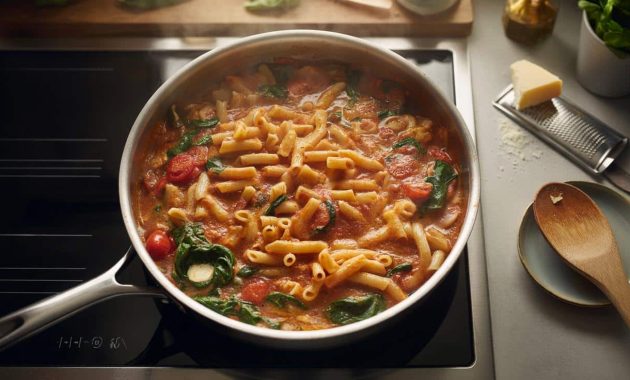
The once-suspicious idea of simmering dry pasta straight in its sauce is now edging into the mainstream, pushed by busy home cooks, food scientists and time-poor parents who want real flavour without a sink full of pans.
How cooking pasta in its sauce changes everything
Traditional pasta nights follow a strict ritual: boil a big pot of water, cook the pasta, drain it, then finish it in a separate pan of sauce. Between waiting for water to boil and cleaning up, that “simple” meal quietly eats 40 minutes of your evening.
The one-pot method flips that script. Dry pasta goes straight into a wide pan or deep sauté pan with a modest amount of water or stock, aromatics and sauce ingredients. As it all heats together, the pasta cooks, the liquid reduces and the flavours concentrate.
Instead of juggling two or three pans, you stir one single pot and sit down to dinner in around 20 minutes.
This isn’t just a trend from social media. The technique, popularised in the US by Martha Stewart and rooted in southern Italian cooking, is now standard for many people who want “proper food” on a Tuesday night without planning their whole evening around it.
The time-saving math behind one-pot pasta
The real gain starts with the water. Classic instructions recommend about 1 litre of water for every 100 g of pasta. One-pot pasta slashes that to roughly 1 litre for 500 g of pasta. That’s a fivefold cut in water for the same quantity.
Less water means less time waiting for a big pot to come to a rolling boil. It also means you skip two steps entirely: draining the pasta and combining it with sauce later. Those might sound small, but they add up when you cook several times a week.
- Less water to heat = faster boiling
- No colander to wash = reduced clean-up
- No separate sauce pan = fewer dishes, less gas or electricity
- Pasta and sauce ready at the same moment = no overcooked, claggy noodles
For anyone feeding children, working late or sharing a tiny flat kitchen, shaving even 15 minutes off dinner prep can change the mood of the whole evening.
The science: starch, gelling and natural creaminess
The method isn’t magic; it’s chemistry. Pasta is mostly starch, made up of two main molecules: amylose and amylopectin. Around 60°C, those starch granules start to swell and burst in a process called gelatinisation.
➡️ Excessive rainfall could transform the Sahara and upend Africa’s balance, study warns
➡️ Why walking barefoot at home can improve balance over time
➡️ The hidden meaning behind repetitive habits during stressful periods
In a big pot of water, lots of that starchy liquid gets poured down the sink with the cooking water. With one-pot pasta, all of it stays trapped in the pan. The small amount of water becomes heavily loaded with starch as the pasta cooks.
That concentrated starch clings to every piece of pasta and thickens the liquid, giving you a glossy, silky sauce without adding cream.
When that starch-rich water meets fat from olive oil, cheese or a knob of butter, you get a stable emulsion. Tiny droplets of fat are suspended evenly through the saucy liquid, which is why the end result feels so rich on the palate.
Food scientists, including French molecular gastronomy pioneer Hervé This, see this not as a lazy hack, but as a smart use of starch chemistry at home. You’re essentially making a rapid, family-friendly version of the technique chefs use when they finish spaghetti in its sauce with a ladleful of pasta water.
Pasta risottata: the Italian cousin of one-pot pasta
In parts of southern Italy, especially Puglia, this way of cooking has long been known as pasta risottata. The name hints at what’s going on: you treat pasta a bit like rice in a risotto, letting it absorb a flavourful liquid as it cooks.
Many cooks start everything cold. Pasta, liquid and flavourings go into the pan before you turn on the heat. That gives starch more time to seep out gently, which supports that creamy texture later.
The key ratio is simple: about one part dry pasta to two parts liquid by volume, adjusted slightly depending on shape and brand.
For example, 500 g of pasta with about 1 litre of water or stock works well in a 28 cm-wide sauté pan. Wider pans give more surface area, so liquid reduces faster and the sauce thickens instead of feeling watery.
Step-by-step: a basic one-pot pasta that works
Here’s a clear, weekday-friendly framework you can adapt with what you have:
The stirring rhythm matters. Every two minutes is enough to keep pieces from welding to the bottom while still letting a light crust form in places, which can add toasted notes and depth of flavour.
Common mistakes that ruin one-pot pasta
The method is forgiving, yet a few missteps can give disappointing results. Three issues come up repeatedly: too much liquid, the wrong pasta, and lack of seasoning.
| Problem | Likely cause | Simple fix |
|---|---|---|
| Watery sauce | Too much liquid or pan too small | Use a wider pan, reduce liquid slightly, let it simmer uncovered for a few extra minutes |
| Pasta undercooked | Heat too low or not enough liquid added towards the end | Keep a gentle simmer and add small splashes of hot water as needed |
| Pasta sticking badly | Not stirred often enough during the first 10 minutes | Stir every 1–2 minutes at the start, then less frequently |
| Flat flavour | Seasoning left to the end | Salt the liquid from the beginning and taste at least twice during cooking |
Nutrition, budget and energy: the hidden benefits
Beyond speed, there are quieter gains that appeal to modern households facing high energy costs and rising food prices.
Using less water and one burner for a shorter time cuts energy consumption. The difference per meal is small, but over dozens of dinners in a winter, those minutes of boiling add up on your bill.
Starch-rich sauces also make plant-based meals feel more satisfying. A pan full of pasta, beans, vegetables and stock feels hearty without relying on cured meats or heavy cream. That can support people trying to reduce meat for health or environmental reasons.
From a budget angle, this style of cooking suits odds and ends in the fridge: half a courgette, a stray carrot, a handful of frozen peas. All those can go straight into the pan and benefit from the shared cooking liquid.
When one-pot pasta makes sense – and when it does not
Not every pasta dish is suited to this technique. Delicate shapes that break easily, such as fresh ravioli, fare better with classic boiling. Very thick sauces based on slow-cooked meat need their own long simmer; pasta can’t safely stay in the pan for hours.
Where one-pot shines is in weeknight scenarios: coming home late, arriving from the gym, or managing children’s homework at the kitchen table while dinner cooks. Being able to stir the pan with one hand and answer emails with the other is part of why this style has taken off on both sides of the Atlantic.
The method also suits holiday rentals and student halls. One good pan, one wooden spoon and a chopping board can turn a basic kitchenette into a workable cooking space, no specialist gear required.
Key terms and practical tweaks
A couple of phrases pop up often in discussions around this style of cooking:
- Al dente: pasta cooked so it is tender on the outside with a slight firmness in the centre. One-pot pasta reaches this stage quickly, so tasting a piece every minute near the end helps avoid overcooking.
- Emulsion: a stable mix of two substances that usually do not blend, such as fat and water. Starch from pasta acts like a bridge, holding olive oil and water together in a smooth sauce.
Once you understand those two ideas, tweaking becomes easier. If a pan looks greasy, you probably need a splash more water so the starch can pull the fat into a proper emulsion. If the texture feels gluey, you may have gone a minute too far, and next time you can cut the cooking time slightly or loosen the sauce with extra liquid right at the end.
As more home cooks embrace these fast, science-backed methods, pasta cooked directly in its sauce is shifting from internet curiosity to reliable midweek habit. The appeal is simple: fewer decisions, fewer pans, and a plate that feels like comfort food without demanding your entire evening.