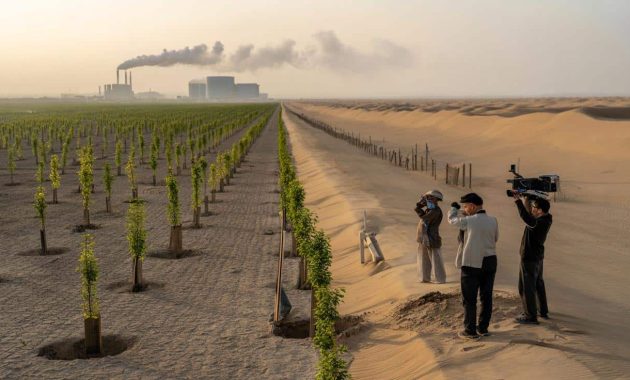
On the edge of the Mu Us Desert in northern China, the wind tastes like dust. It sticks to your lips, your lashes, your phone screen. Then, suddenly, the beige horizon breaks. A straight, unnatural line of green rises from the sand — rows and rows of young poplars, each supported by a stick, each tagged with a QR code. A local official proudly waves his arm, as if he’s unveiling a miracle. “This,” he says, “is how we save the planet.”
A drone buzzes overhead, filming the scene for a government promo. Nearby, volunteers pose for selfies with saplings, framed by banners promising “ecological civilization.” It all looks clean, hopeful, almost cinematic. Yet if you turn your head just a little, you still see dunes creeping forward, swallowing old fields, power lines half-buried.
So is this forest a real solution, or just a very green curtain?
China’s great green wall: miracle forest or mirage?
China has planted more trees than any other country in modern history. Since the late 1970s, the “Great Green Wall” program has aimed to stop the deserts of the north from marching towards Beijing and beyond. Maps look impressive: streaks of green expanding year after year across what used to be bare land. Satellite images show whole regions going from brown to pale green.
On paper, it’s the kind of climate story we’re desperate to share. Huge nation, huge effort, billions of trees, tons of carbon absorbed. A comforting headline at a time when everything else feels like it’s on fire. Yet numbers don’t always tell you how those trees are really living — or dying — in the ground.
Travel with scientists in Inner Mongolia and the fairy tale blurs. You find “forests” where the trees are planted in ruler-straight lines, all one species, all the same age. Dig a little, and the soil is dry as flour a few centimeters below the surface. Locals point to areas where plantations once stood tall, now full of dead trunks, bleached by the sun like bones. On some plots, survival rates are quietly whispered: 15%, 20%, if they’re lucky.
One researcher measured tree growth over a decade in a heavily promoted zone. The result? Stunted trunks, shallow roots, and very little long-term carbon stored. The trees were alive, technically, but trapped between drought, poor soil, and the pressure to “green” land that maybe never wanted to be a forest. That’s the part you don’t see in the glossy campaign posters.
The logic behind the billion-tree dream is seductive. Plant trees, absorb CO₂, stop sandstorms, restore nature, ease guilt. Yet landscapes are not blank pages you can just color green. In many northern Chinese regions, natural vegetation is not dense forest but grassland, scrub, or scattered shrubs deep-rooted enough to survive brutal dry seasons. Replace them with thirsty fast-growing poplars, and you exhaust groundwater, stress the soil, and sometimes make land more fragile.
Environmentalists in China quietly point out another twist. Large-scale tree counts look fantastic in international climate talks. They can also distract from emissions from coal, cement, and industry that remain stubbornly high. *A billion saplings are easier to photograph than a closed coal plant.* The risk is that trees become a kind of moral offset, a green halo around a still very grey economy.
Reforesting right: what actually works on the ground
On a windy afternoon in Ningxia, a farmer named Zhao stoops to show visitors something that doesn’t look like much. Not trees, but knee-high shrubs, spaced widely apart, surrounded by straw grids patterned like a chessboard on the sand. This method isn’t new or glamorous. Straw barriers trap moisture, reduce wind speed at ground level, and give roots a fighting chance. Zhao says the word “slow” like it’s both a curse and a blessing.
➡️ Few know it, but France is Europe’s only nation capable of building jet engines at this level
➡️ If your dog gives you its paw, it’s not to play or say hello : animal experts explain the reasons
➡️ Satellite Images Reveal the Reality of Saudi Arabia’s $2 Trillion Megacity in the Desert
➡️ If conversations drain you, this boundary helps quietly
➡️ 14 Yoga Poses That Help Open Tight Hips and Improve Mobility
➡️ These phrases only people who are truly there for you ever say
➡️ Kate Middleton sparks debate after copying Duchess Sophie’s gesture and bending royal protocol
Instead of planting millions of poplars in one go, his village rotated grazing areas, let patches rest, and mixed drought-resistant species — some trees, many shrubs, some native grasses. It took years before the land looked “green” enough for a nice drone video. Yet the soil under those shrubs stays cool and holds water longer. Birds and insects have come back. The landscape looks less like a plantation, more like something that could actually last.
When we talk about “planting a billion trees” on social media, we rarely talk about what happens on year three, or ten. That’s the unglamorous reality: survival, not just planting, is what counts. Many Chinese provinces used to be rewarded by how many seedlings they stuck in the ground. You can guess what happened next. Crowded plots, no irrigation plan, minimal follow-up. A few seasons of drought and half the forest quietly vanished.
Newer guidelines try to correct this, prioritizing native species and mixed stands. Yet the pressure for rapid results is still huge. Officials want before/after photos that fit a five-year plan, not a twenty-year ecological timeline. It’s the same tension that you might feel in your own life between doing something that looks good right now and something that keeps working long after the photo is taken.
Experts who work on “ecological restoration” tend to repeat the same thing in a tired voice.
“Trees are not magic wands,” one Chinese ecologist told me. “Sometimes the bravest thing you can do is let a place be a grassland, or even a wetland, and protect it from being turned into an instant forest just to tick a box.”
They talk about basic, almost boring rules:
- Plant the right species in the right place, not the fastest-growing ones everywhere.
- Count tree survival after 5–10 years, not only trees planted this spring.
- Restore natural vegetation first, then add trees where they truly fit.
- Allow local communities to benefit, so forests aren’t abandoned or overused.
- Limit monoculture plantations and leave space for messy, diverse patches.
Let’s be honest: nobody really does this every single day. But this is where reforestation stops being a photo opportunity and starts being real climate work.
Green dreams, grey realities, and the space in between
China’s tree-planting story sits on a knife edge between genuine progress and smart PR. On one side, there are real victories: sandstorms that hit Beijing less often than in the early 2000s, communities who now earn from managing forests and not just cutting them, carbon that genuinely ends up locked in wood and soil. Some degraded areas have been pulled back from the brink, and you can see that with your own eyes.
On the other side, there’s a temptation to treat every tree as a moral receipt, a way of saying: yes, we burn coal, but look at all this green. No country is innocent here; China is just doing it on a massive, highly visible scale. The deeper question is not whether planting a billion trees is good or bad. It’s whether those trees change the underlying story of how we produce energy, use land, and consume — or simply sit on top of it like a leafy filter.
We’ve all been there, that moment when you choose the visible gesture over the slow, invisible grind that actually changes things. A reusable shopping bag instead of a rethink of how much you buy. A tree-planting donation instead of a tough conversation about flying less. China’s forests mirror that tension, just magnified to the size of a continent. Maybe the real test won’t be how many trees are planted by 2030, but how many are still alive, still diverse, and still part of a living landscape in 2050 — when nobody remembers the slogans, only the shade.
| Key point | Detail | Value for the reader |
|---|---|---|
| Tree-planting is not automatically “green” | Monoculture plantations in dry areas can waste water and collapse after a few years | Helps you question feel-good headlines and look for real ecological impact |
| Quality beats quantity | Survival rates, native species, and long-term care matter more than raw planting numbers | Shows what to demand from governments, NGOs, or companies that tout reforestation |
| Trees can’t hide fossil fuels forever | Reforestation helps but doesn’t replace cutting emissions from coal, oil, and gas | Clarifies why climate solutions need both nature protection and energy transition |
FAQ:
- Is China really planting a billion trees?Yes. Since the late 1970s, China has planted billions of trees under massive programs like the “Great Green Wall,” and campaigns continue today at national and local levels.
- Do these trees actually help the climate?They can absorb CO₂ and reduce dust storms, especially where diverse, well-managed forests are established, but poorly planned plantations often store less carbon than promised.
- What’s the main problem with China’s tree-planting model?Large areas rely on single-species plantations in dry regions, which struggle to survive, deplete water, and create fragile ecosystems that are vulnerable to pests and drought.
- Is China using trees to distract from pollution and coal?Reforestation boosts China’s green image, while the country still burns a lot of coal; both realities coexist, and critics say tree numbers can overshadow slower progress on cutting emissions.
- What should we look for in a “good” tree-planting project?Native species, mixed and messy ecosystems, long-term care, local community involvement, and transparent data on survival rates and carbon storage, not just big planting targets.