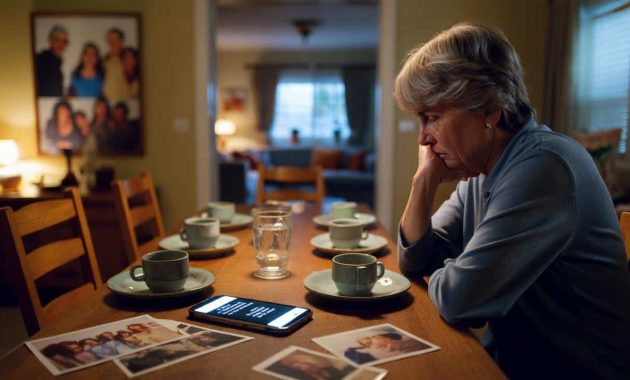
The real shock comes when you notice who doesn’t come looking for you anymore.
At some point, many people stop being the one who always texts first, always plans the coffee, always keeps the friendship alive. What follows isn’t drama, but a long, echoing silence that raises a brutal question: were those friendships ever truly mutual, or were you simply propping them up on your own?
The loneliness no one warned you about
When people picture loneliness in later life, they often imagine an empty house or a calendar with no plans. Psychology paints a more complicated picture. Loneliness is less about being physically alone and more about the gap between the relationships you thought you had and the reality that appears when you stop doing all the work.
The sharpest loneliness in ageing often comes from realizing some “close friends” were only close because you kept chasing them.
The quiet ending of these friendships can feel like a kind of unacknowledged grief. There’s no argument, no big betrayal, nothing anyone else would call a “break-up”. Just a slow fade, and a dawning awareness that the effort was never truly shared.
The psychology of one-sided friendships
Why reciprocity matters so much
Decades of research on relationships point to a simple rule: people feel happiest when effort feels roughly balanced. Psychologists often refer to this as “equity” in relationships. That doesn’t mean counting favours or splitting everything 50/50, but it does mean each person feels the other is also investing time, care and emotional energy.
When one person always gives more, something starts to crack. The over-giver feels drained or taken for granted. The under-giver may feel guilty or uncomfortable, and sometimes simply avoids contact. In friendships, which have no formal commitments or obligations, that imbalance is especially fragile.
Romantic partners might stay together for years while feeling unequal. Parents and adult children keep showing up for each other out of duty or love. Friendships have none of that scaffolding. If mutual willingness fades, the relationship can vanish almost silently.
Friendships survive on voluntary effort alone. When that effort only flows one way, the bond is already in trouble, even if both people still like each other.
The “stop texting first” moment
Social media often turns this into a challenge: stop initiating contact and see who reaches out. Behind the viral posts is a fairly accurate psychological test of reciprocity. The results can be devastating.
➡️ This profession rewards long-term commitment with financial comfort
➡️ What It Means When Someone Underlines Their Name In A Signature, According To Psychology
➡️ The baking soda method to clean burnt pots that restaurants swear by
➡️ These zodiac signs are destined for major prosperity in 2026, according to astrological forecasts
When nobody replies, you’re not just disappointed about this week’s plans. You’re forced to reinterpret years of shared memories. All those birthday messages, long messages after a breakup, calls to check in after a hospital stay – you thought you were participating in a two-person project. It starts to feel like you were running a one-person social service.
Studies on adult friendship and wellbeing consistently show that mutual “maintenance effort” is a key ingredient in feeling valued. When both people invest, each one feels they matter. When only one person invests, that sense of mattering erodes, even if the friendship looks fine from the outside.
Why it hits harder as you age
When structure disappears
In your teens, twenties and even thirties, friendship often runs on autopilot. You see the same faces at school, work, clubs, or your kids’ activities. You don’t need to plan every interaction; proximity does half the job for you.
Age strips away that structure. Retirement takes away colleagues. Adult children move away. People relocate, lose mobility, or cut back on going out at night. Social contact shifts from automatic to intentional. Only the relationships where both people actively choose to stay in touch survive for long.
Large studies on older adults repeatedly show that social isolation and loneliness are widespread. Around a quarter of people over 65 living in the community are classed as socially isolated. Close to half of those over 60 say they feel lonely at least some of the time.
Many older adults don’t lack names in their phone. They lack people who will ever press “call”.
The hidden grief of friendship loss
We have rituals and language for romantic heartbreak: songs, films, supportive friends, sometimes lawyers. Losing a friend quietly in midlife or later comes with none of that. Saying “my friend stopped texting back” rarely draws the same sympathy as “my partner left”. Yet the emotional punch can be similar, especially if that friend was your main confidant.
Research on ageing shows that friendships can protect against depression, cognitive decline and even physical illness. But there is far less research into what happens when those friendships fail, particularly in later life. That gap mirrors a social blind spot: people feel this loss deeply, but struggle to speak about it without sounding needy or oversensitive.
Quality over quantity: what socioemotional selectivity says
Why we naturally narrow our circles
One influential theory in psychology, socioemotional selectivity theory, suggests that as people become more aware that time is limited, priorities shift. Younger adults often value novelty and wide networks. Older adults tend to value emotional meaning and reliability.
Over time, many people deliberately or unconsciously prune their social circles. They keep the relatives, neighbours and friends who feel emotionally safe, and quietly let go of more distant or draining connections. Research finds that older adults generally report fewer close friends, but higher satisfaction with the ones who remain.
There is a catch that glossy articles often skip. The pruning doesn’t always feel like a wise, calm choice. For many, it begins with that gutting realization: the people you would have gladly kept never chose you back with equal enthusiasm. The theory explains why a smaller circle can feel good later. It doesn’t erase the pain of losing people on the way there.
The loneliest part isn’t empty rooms
Psychologists define loneliness as the gap between the relationships you want and the relationships you actually have. That means you can feel deeply lonely while married, surrounded by family, or sitting in a busy retirement complex, if those interactions don’t feel genuinely mutual.
The most piercing loneliness is not physical solitude, but the sense that your love and effort were a one-way street.
When you realise certain friendships were held together almost solely by your efforts, the loss reshapes the past as well as the present. Memories that once felt warm now look lopsided. You start to wonder: if I hadn’t organised that reunion, made that call, remembered that birthday – would this friendship ever have existed?
Yet the same research that documents loneliness in older age also offers a reassuring pattern. A small number of close, reciprocal friendships has more protective power than a large network of casual contacts. Once people have a handful of genuinely mutual relationships, adding more acquaintances doesn’t dramatically reduce loneliness.
What this means for your relationships now
Practical ways to protect your emotional energy
Recognising one-sided friendships can feel bleak, but it also gives you useful data. You can start to invest differently. Some people use informal “rules of thumb” to check reciprocity:
- If I stopped organising, how long would it take before this person contacted me?
- When I share something vulnerable, do they ever follow up later to ask how I’m doing?
- When they need support, do they only appear, then vanish once they feel better?
These questions aren’t about scoring points. They help you notice patterns. You might still choose to keep some unbalanced friendships, especially if someone is going through a hard time, or if you simply enjoy their company. But you can adjust expectations and protect the friendships where energy genuinely flows both ways.
| Sign of reciprocity | What it often indicates |
|---|---|
| They initiate contact sometimes | You matter to them beyond convenience |
| They remember details you shared | They are emotionally engaged, not just passing time |
| They offer help without being asked | The relationship includes genuine care, not just talk |
| They apologise when they drop the ball | They value the friendship and want to repair it |
Normalising the grief
Psychologists sometimes talk about “disenfranchised grief” – real loss that society doesn’t fully recognise. Quietly losing a long-term friend often fits this category. Naming it as grief can be surprisingly relieving. You are not just “too sensitive”. You are mourning a story you believed: that this person would keep walking alongside you.
Some people find it helpful to mark the change, even privately: writing a letter you never send, lighting a candle, or talking it through with a therapist or a trusted friend. These small acts can validate that the loss was real, even if nobody sends you sympathy cards.
Where hope actually lives
Large, long-running studies of ageing consistently show one striking pattern: the strongest predictor of long-term happiness and health is not income, status or even diet. It is the quality of close relationships. That doesn’t mean having a bustling social life. It means having a few people you can rely on, who also know they can rely on you.
Seen through that lens, when some friendships fall away once you stop initiating, you have not failed at socialising. You have uncovered which relationships were truly mutual. The silence itself is information. The people who do eventually text, call, knock on your door or check in after a long gap are signaling something powerful: “I was thinking of you without being prompted.”
Ageing shrinks many things: energy, mobility, sometimes confidence. It can also, quietly, sharpen your standards. You have less time for friendships powered solely by guilt or habit. The work now is not to keep everyone, but to notice who genuinely meets you halfway – and give those people the best of what you have left to offer.