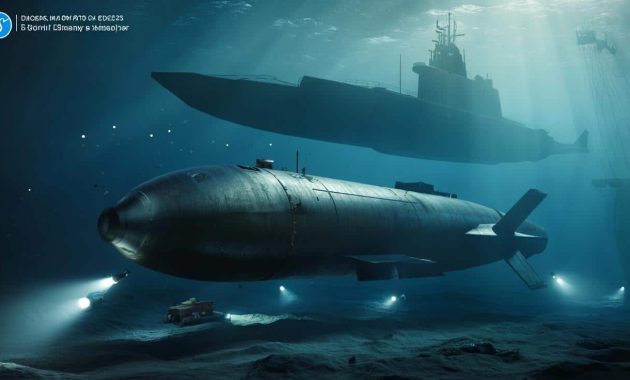
Russia claims to have developed an autonomous nuclear-powered underwater drone, code-named Poseidon, designed to slip under traditional defences and strike enemy coastlines with unprecedented force. Western militaries now face a system that does not fit their usual playbook of missiles, bombers and submarines.
A nuclear drone built for the deep sea
The Poseidon system, officially designated 2M39, is not a conventional torpedo. It is closer to a robotic mini-submarine with a nuclear reactor on board. According to open-source estimates, it stretches around 20 metres in length, weighs about 100 tonnes, and travels at extreme depth.
Poseidon is designed to cruise thousands of kilometres at more than 1,000 metres depth, far below most current tracking networks.
That combination of autonomy, range and depth gives it a very different profile from classic ballistic or cruise missiles. Instead of arcing through space, it creeps through the ocean, where sound travels in complex ways and detection remains notoriously difficult.
The weapon’s reported mission is blunt: reach an enemy coast undetected and detonate a multi-megaton thermonuclear warhead close to shore. Russian officials and state media have suggested that such a blast could generate a towering, contaminated wave capable of sweeping over coastal cities and ports.
Key specifications of Poseidon
The Russian government keeps hard data classified, but defence analysts and satellite imagery have built up a rough picture of its capabilities:
- Length: about 20 m; diameter: about 2 m
- Weight: around 100,000 kg
- Propulsion: compact nuclear reactor, with effectively global range
- Depth: cruising below 1,000 m according to Russian claims
- Speed: up to 185 km/h at peak, lower for extended cruising
- Warhead: thermonuclear, several megatons, intended for coastal targets
Even at the low end of those estimates, the destructive potential is huge. A strike near a major naval base could cripple fleets, destroy fuel and ammunition depots, and contaminate harbours for years.
The real innovation is not just raw power: it is the mix of stealth, autonomy and psychological shock, aimed directly at cities built on the shore.
The Kremlin’s new second-strike card
President Vladimir Putin first referred to Poseidon in 2018 as part of a group of “invincible” strategic systems. Russian officials frame it as a second-strike weapon, designed to survive any initial nuclear exchange and guarantee retaliation.
➡️ A400M: Airbus bets on a “mother ship” aircraft for drones
➡️ The phrase Albert Einstein told his 11-year-old son that every parent should repeat
➡️ The bright promises of EyePulse, the French military drone from Daher that the armed forces lack
➡️ For every dessert, its apple! The ultimate guide to finding the right apple to use
➡️ Hygiene after 65 : not once a day, not once a week, shower frequency that keeps you thriving
➡️ A rare environmental event has scientists paying close attention
That concept sits at the heart of nuclear deterrence: if no side can escape devastating retaliation, then nobody starts a nuclear war. With Poseidon, Moscow wants to show that even if its missile silos, bombers and regular submarines were disabled, an underwater drone already at sea could still obliterate a coastal region.
The chilling idea is that such drones could loiter in remote ocean areas, waiting for a signal or a pre-programmed trigger. That possibility alone forces rival governments to account for an additional, elusive threat that standard missile defences cannot touch.
The Belgorod: a giant submarine as mothership
To carry Poseidon, Russia has built what may be the longest submarine in the world: the K-329 Belgorod. Based on an extended Oscar II hull, it is around 184 metres long and has been adapted specifically for covert missions.
Belgorod is believed to carry up to six Poseidon drones in dedicated launch bays. It also supports other deep-sea tasks, such as placing undersea sensors, studying or tampering with internet cables, and testing new underwater technologies. Unusually, it falls under the control of specialised units within the Russian Navy, rather than the regular fleet chain of command.
By combining Poseidon with Belgorod, Russia is building an underwater toolbox that goes well beyond a single doomsday weapon.
Can a nuclear torpedo really trigger a tsunami?
The most controversial part of the Poseidon narrative is the “radioactive tsunami” scenario. Russian commentators have described a wave tens of metres high, sweeping inland and leaving long-lasting radioactive contamination.
Many Western physicists are cautious. Generating a massive tsunami requires shifting a huge volume of water across a broad area, something more akin to an earthquake than a single explosion. A nuclear detonation underwater would create an extremely violent local effect, but whether it translates into a large, stable wave is contested.
That said, even a fraction of the imagined scenario would be devastating for a coastal city. A multi-megaton underwater blast could destroy port infrastructure, sink ships in harbour, and scatter radioactive material across sea and land.
What a Poseidon strike might look like
Analysts outline a typical scenario like this:
- A Poseidon drone is quietly deployed months earlier and parks in deep water, waiting.
- On command, it approaches the target coast at depth, using pre-loaded maps and inertial navigation.
- It rises just enough to reach the planned detonation point, a few kilometres offshore.
- The warhead detonates under or near the surface, generating a powerful shockwave and wall of water.
- Harbour facilities, naval bases and nearby coastal districts suffer catastrophic damage and contamination.
Even without a giant tsunami, that kind of blast would reshape any affected coastline and its economic life for decades.
A nightmare for NATO’s underwater defences
NATO states have spent years refining missile shields, early warning satellites and interceptor systems like the U.S. Aegis network. Those systems track objects in the air or in space, not autonomous machines creeping through cold, dark water.
To locate a Poseidon drone, an alliance would need extremely sensitive acoustic surveillance over vast areas. That implies long chains of seabed microphones, patrolling submarines, and new generations of unmanned underwater vehicles. It also demands heavy data analysis: the ocean is full of noise from storms, marine life and shipping.
The question confronting Western planners is blunt: how do you build a credible defence against a threat that hardly shows up on your existing sensors?
Some NATO members are now ramping up investment in undersea warfare: extra attack submarines, patrol aircraft with advanced sonar, and experimental “drone-hunting drones” that can linger underwater for months at a time. Arctic waters, where Russian submarines often operate, have become a particular focus.
A weapon that blurs the line between deterrence and intimidation
Poseidon raises awkward questions about nuclear strategy. Classic deterrence involves large, visible systems: missile silos, bomber fleets, ballistic submarines. Their presence signals intent and creates a stable, if tense, balance.
An autonomous underwater weapon adds ambiguity. If intelligence services detect a strange object moving toward a coastline, leaders face a split-second decision: is it a test, a malfunction, a bluff, or the start of a nuclear attack? Misreading that signal could spark rapid escalation.
Some experts argue that this uncertainty itself may be part of the design. By forcing rivals to factor in a stealthy, uncontrollable system, Russia amplifies psychological pressure as well as physical risk. Others warn that such pressure could backfire, increasing the chance of miscalculation during a crisis.
Key concepts worth understanding
Two strategic ideas help frame the debates around Poseidon:
- Second-strike capability: the assured ability to hit back with nuclear weapons after absorbing a first strike. Poseidon is marketed precisely as this kind of survivable response option.
- Mutual assured destruction (MAD): the theory that if both sides can annihilate each other, neither side starts a nuclear war. New systems like Poseidon challenge how stable that balance really is, especially when one party introduces exotic and hard-to-track weapons.
Risks, uncertainties and future scenarios
Beyond the immediate military implications, Poseidon raises long-term environmental and safety questions. A reactor-powered drone lost on the seabed would become a radioactive object in fragile marine ecosystems. A malfunction during tests could scatter contaminated debris across fishing grounds or shipping lanes.
Strategists are already sketching “what if” scenarios: fleets of similar drones deployed by multiple countries, environmental damage from underwater tests, or regional arms races as coastal states rush to protect harbours and undersea infrastructure. Even if Poseidon never leaves its storage bays, the research behind it is likely to influence a new generation of long-range, autonomous underwater vehicles, both military and civilian.
For coastal populations living near big ports or naval bases, this type of weapon adds another layer of vulnerability to an already complex nuclear age. The conversation is shifting from missile flight times to questions like: how do you monitor the deep ocean, and how many autonomous nuclear machines might already be out there, waiting in the dark?